Chart of the Week: Oil Prices & Energy Subsidies
IMF Blog, November 27, 2017
Source details
- Canonical URL
- Chart of the Week: Oil Prices & Energy Subsidies
Other formats
Bibliographic details
- Authors: The Editors
- Published: November 27, 2017
Overview
- Universal fuel and energy subsidies have been prevalent in sub-Saharan Africa but have substantial drawbacks: they tend to benefit the rich rather than the poor, foster fuel overconsumption, and crowd out more productive government spending.
- Reforms in some mostly oil-exporting countries, along with lower international fuel prices since 2014, have reduced the size of fuel subsidies in sub-Saharan Africa, and they need to do more given the recent rise in international fuel prices.
- Timeframe referenced: June 2014 to early 2017.
Transmission of international oil price changes
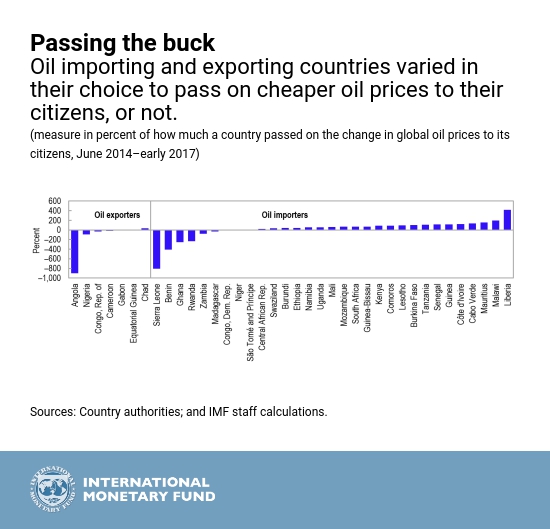
- An IMF survey of fuel prices in the region indicates different pass-through patterns between oil exporters and oil importers over June 2014–early 2017:
- Oil exporters: ratio of changes in retail fuel prices relative to changes in international fuel prices (expressed in local currency) was −19 percent, reflecting increases in domestic fuel prices despite lower international prices.
- Oil importers: ratio was 62 percent, indicating partial transmission of lower global oil prices to consumers (less than 100 percent pass-through).
Domestic pricing mechanisms and observed pass-through
- Fuel prices in the region are mostly set by governments, either on a discretionary basis or by automatic adjustment formulas.
- Only about one-third of sub-Saharan African countries allow automatic adjustment of retail prices; the remainder set prices administratively.
- This pricing structure has historically translated into relatively low pass-through to changes in global oil prices.
Key elements of successful fuel and energy price reform
- Country experiences suggest a comprehensive strategy with these elements:
1. a communication campaign; 2. phased and gradual price increases; 3. targeted social spending or essential investment to mitigate the impact of the reform on affected households and firms; 4. introduction of an automatic pricing formula; 5. accompanying measures to improve the efficiency of state-owned enterprises and service delivery.
Implications
- Partial pass-through in oil importers (62 percent) implies consumers did not fully benefit from lower international fuel prices between June 2014 and early 2017.
- Negative ratio for exporters (−19 percent) reflects policy moves to increase domestic fuel prices in some oil-exporting countries despite falling global prices.
- Given the recent rise in international fuel prices, further reforms and robust mitigation measures are needed to manage subsidy costs and protect vulnerable households.
Source: Chart of the Week: Oil Prices & Energy Subsidies (IMF, November 27, 2017).
Content in this bundle
- 本周图表:石油价格与能源补贴, 作者:基金组织博客, 2017 年11 月.27 日
- 今週のグラフ: 石油価格とエネルギー補助金; IMF ブログ 2017年11月27日掲載
- Gráfico de la semana: Precios del petróleo y subsidios de la energía