Improving Financial Stability in China
IMF Blog, December 7, 2017
Source details
- Canonical URL
- Improving Financial Stability in China
Other formats
Bibliographic details
- Authors: Ratna Sahay, James P Walsh
- Published: December 7, 2017
Overview
- Authors: Ratna Sahay, James P. Walsh
- Publication date: December 7, 2017 (page shows December 6, 2017 as well)
- Context: Results from the IMF's Financial Sector Assessment Program (FSAP) review of China.
- Key framing: China is transitioning from the “world’s factory floor” toward a more modern, consumer-driven economy. The financial system permeates virtually all aspects of economic activity and played a key role in facilitating rapid economic growth and sharply reducing poverty rates.
- Systemic importance noted: China has the world’s largest banks and second-largest stock market.
Three concerns identified by the FSAP
- Lending boom
- Sustained rapid credit growth despite the slowing economy, driven by a focus on maintaining growth and employment.
- Debt is largely owed by companies—some of which may not have good prospects—and local governments, with an increasing share owed by households.
- Note: “Credit growth is an important indicator of future financial distress, because lending standards often fall in the rush to make more loans.”
- Complexity
- Rules on bank lending to traditional sectors (such as construction and real estate) have pushed risky borrowers away from banks toward more lightly regulated financial products.
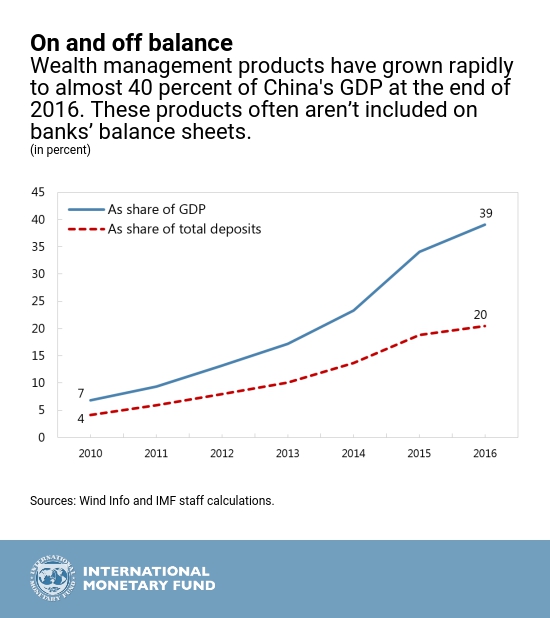
- Banks are offering increasingly complex wealth management products to savers seeking higher-yielding assets.
- Guarantees
- Banks often compensate investors for losses on financial products to preserve reputations; the government has repeatedly intervened to stabilize financial markets; investors expect state-owned enterprises will be bailed out.
- Implicit guarantees encourage underestimation of risk and can lead to misallocation of investment to less productive activities.
Systemic monitoring and political economy constraints
- The interaction of the three concerns has created a highly dynamic, fast-moving financial system that is difficult to monitor.
- Removing implicit guarantees is particularly challenging because it involves allowing markets to fall, firms to fail, and investors to lose money.
- Complementary measures needed: better social safety nets, financial education, and improved bankruptcy procedures.
- Fiscal/political constraints: Credit growth will not slow sustainably unless tolerance for job losses and slower economic growth rises—particularly at local level—and new sources of revenue are found for local governments.
Key goal and recent policy actions
- China’s authorities recognize these risks and are seeking to contain them; President Xi in April cited financial stability as a key goal for China.
- Since the last assessment in 2011, supervision of banks, insurance companies, and securities firms has been continuously improved.
- Authorities recently created a Financial Stability and Development Committee to monitor systemic risks and prevent financial disruptions and announced new rules to contain riskiness of asset management products.
IMF’s main recommendations (five key areas)
- Systemic risk monitoring
- Create a body focused solely on financial stability to improve oversight of systemic risk.
- The body should regularly discuss and assess issues on a cross-agency basis and make recommendations to implementing supervisors.
- Improving the quality of data is important for effective monitoring.
- Interagency coordination and supervisory independence
- Financial supervisors need greater independence to pursue mandates without concern about being overruled.
- Supervisors need more resources to adequately supervise a large and complex system.
- Better coordination is essential at all levels, not just at the top, to identify and manage risks.
- Bank capital
- Gradually increase capital at banks to cushion against a sudden cyclical economic downturn, given the large size of the credit boom.
- Higher buffers are recommended at several large banks to prevent shocks from spreading across the financial system.
- China-specific risks (lifting implicit guarantees and large off-balance sheet exposures historically guaranteed by banks) call for higher levels of capital across the system during the transition.
- Liquidity buffers and interbank lending
- Banks and financial institutions are increasingly using very short-term borrowing to finance investments.
- To contain risks if those flows reverse, banks should hold more liquid assets.
- Rules on lending among financial institutions should be amended to encourage safer, longer-term lending.
- Crisis management and resolution
- Several elements of an effective crisis-management framework are already in place.
- Further reforms needed to reduce reliance on public funds in managing weak financial institutions while ensuring they can fail safely.
- Specific recommendation: expand administrative resolution powers in line with international standards.
Challenges and concluding observations
- Supervising one of the world’s largest and most complicated systems is a challenging task; many gaps remain despite substantial progress.
- Addressing the identified concerns should help China continue to grow both rapidly and safely.
Source: Improving Financial Stability in China, Ratna Sahay and James P. Walsh, December 7, 2017.
Content in this bundle
- China Financial Stability
- 中国での金融安定性強化; ラトナ・サヘイ ジェームス P. ウォルシュ IMF ブログ 2017年12月6日掲載
- Укрепление финансовой стабильности в Китае
- Mejorar la estabilidad financiera en China