A Dream Deferred: Inequality and Poverty Across Generations in Europe
IMF Blog, January 24, 2018
Source details
- Canonical URL
- A Dream Deferred: Inequality and Poverty Across Generations in Europe
Other formats
Bibliographic details
- Authors: Christine Lagarde
- Published: January 24, 2018
Overview and key findings
- Publication and author: Christine Lagarde, January 24, 2018.
- Main theme: widening gap between generations in Europe — working-age people, and especially the young, are falling behind despite relatively stable average income inequality since 2007.
- Incomes:
- Incomes for those who are 65 years and older increased by 10 percent as pensions were better protected.
- Incomes for young people declined after the 2007 crisis due to unemployment; they have since recovered, but have not grown.
- Poverty:
- Before the global financial crisis, relative poverty of young (18-24) and older people (65 +) in Europe was similar.
- Since the crisis, a major gap has developed: one in four young people in the region are at risk of poverty — living with incomes below 60 percent of the median.
- Labor market and employment statistics:
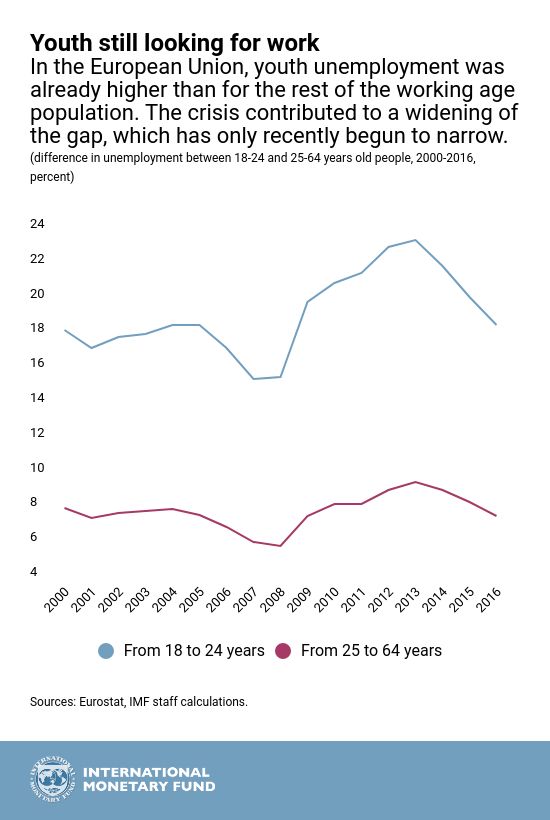
- Youth unemployment started high and spiked to 24 percent in 2013.
- Today, nearly one in five young people in Europe are still looking for work.
- Financial vulnerability:
- Young people have the highest debt relative to their assets of any age group, making them more vulnerable to financial shocks.
- Labor-market dynamics:
- IMF staff research shows unemployment can lead to “scarring”: long spells of unemployment and limited experience reduce the likelihood of finding work and depress future wages.
- Underemployment increased following the crisis.
- The rise of the “gig” economy and increases in temporary contracts decreased job stability, particularly for the young.
- Social protection:
- Following the crisis, non-pension social benefits were often curtailed, sometimes too narrowly targeted or not indexed to inflation, limiting effectiveness for young people.
- Pensions and social security have helped many, particularly Europe’s senior citizens, who have been relatively well protected.
Country examples and policy-relevant practices
- Germany:
- Long-standing apprenticeships and training programs have helped the young stay in the workplace.
- Flexible employment rules allowed young people to keep their jobs during and after the crisis.
- Result: Germany’s youth now have the lowest unemployment of any European Union country.
- Portugal:
- Exempted its first-time job holders from paying social security taxes for three years.
- Youth unemployment remains high, but the measure is cited as moving in the right direction.
Drivers and mechanisms
- Primary drivers of intergenerational inequality in focus: income effects from unemployment, labor-market changes (underemployment, temporary work, gig economy), and weakened non-pension social benefits.
- Mechanisms:
- Lost wages and foregone savings during formative career years are difficult to recover later.
- Scarring effects reduce long-term earnings trajectories.
- Insufficient social protection for young workers amplifies risk of poverty.
Policy recommendations and actions for policymakers
- Labor-market measures:
- Reduce social security contributions and taxes on low wage workers to create jobs and incentivize work.
- Invest in education and training to help young people close the skills gap and improve future job prospects.
- Social protection reforms:
- Adapt social spending, especially unemployment and other non-pension benefits, to ensure young people are better protected in the event of job loss.
- Tax policy:
- Consider more progressive tax systems and wealth taxes (including inheritance taxes) to help fund social programs for younger citizens; note that wealth taxes are lower today than in 1970.
- Principles:
- Policies should be tailored to country-specific needs, recognize political realities, and stay within a budget.
- Emphasis that supporting young people is complementary to protecting older generations — not a zero-sum choice.
Risks, opportunities, and timing
- Risks:
- Without action, a generation may never be able to recover; scarring and high debt-to-asset ratios increase long-term vulnerability.
- Opportunities:
- Stronger global growth and the recovery in Europe provide a timely window to implement difficult but necessary reforms.
- Message:
- Building an economy that works for young people creates a stronger foundation for everyone, supports social safety nets, and helps rebuild trust within society.
Source: A Dream Deferred: Inequality and Poverty Across Generations in Europe — Christine Lagarde, January 24, 2018.