Countries in the IMF Financial Spotlight in 2018
IMF Blog, January 31, 2018
Source details
- Canonical URL
- Countries in the IMF Financial Spotlight in 2018
Other formats
Bibliographic details
- Authors: The Editors
- Published: January 31, 2018
Overview
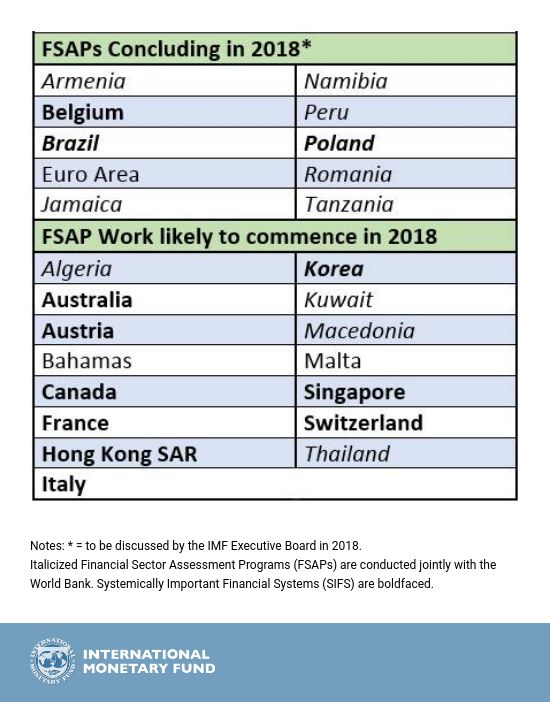
- The IMF in 2018 will complete ten assessments of countries’ financial systems to identify risks and propose policies to strengthen their financial stability.
- Three of this year’s reviews will be for countries with Systemically Important Financial Systems: Belgium, Brazil and Poland.
- In addition, IMF experts will assess the euro area’s financial stability.
- Other financial stability assessments in 2018 will cover: Armenia, Jamaica, Namibia, Peru, Romania, and Tanzania.
Highlights of 2018 Financial Sector Assessment Program (FSAP) reviews
- Armenia:
- Since the 2012 assessment, banks have improved their capital ratios and strengthened their supervision.
- Vulnerabilities remain due to a highly dollarized financial system, which amplifies exposure to external shocks.
- The assessment will review banks’ resilience to external risks—including a dryout of liquidity in foreign currency—and will assess bank consolidation needs, and the adequacy of the prudential framework for mitigating dollarization risks.
- Brazil:
- Recovery is underway from the most severe recession in Brazil’s history, but the needed fiscal adjustment is large and the political environment is uncertain.
- The IMF will assess banks’ risks and vulnerabilities, including those that stem from the corporate sector, the nexus between governments and the banks that hold their domestic debt, and the connections to the large asset-management industry.
- Focus areas include factors that helped banks withstand the recession; the role of state banks, which hold more than half of the banking sector’s assets; and reform of the directed-credit sector.
- Euro area:
- Officials have made impressive progress in constructing a banking union to complement the monetary union, even as they seek to address the legacy of the global financial crisis and the stress to their balance sheets created by government debt.
- The project is far from complete; the big issue is how to balance national conditions and priorities with the need to harmonize and establish a level playing field—in banking supervision, macroprudential policy, crisis preparedness and management, and systemic liquidity management.
- Peru:
- Banks appear to be strong, but the banking sector is concentrated and the economy is highly dollarized.
- The assessment will consider measures to further reduce the risks from dollarization, to increase competition in financial services, and to strengthen underdeveloped money markets and capital markets.
- Other key areas will be the institutional mandates and accountability lines for financial oversight, macroprudential policy, and crisis management and resolution.
- Poland:
- Systemic risks appear well contained given high bank capital and liquidity levels and a strong economy.
- The assessment will evaluate financial oversight for all types of deposit-taking institutions including cooperatives and credit unions, and insurance firms, and the crisis-management framework, which has been tested with the collapse of several smaller cooperatives.
- The IMF will also examine vulnerabilities arising from rising inflationary pressures and the prospect of interest-rate hikes, and from the tighter linkages between the banking industry and the government.
- Romania:
- The economy is growing at a brisk pace, on the back of the government’s policy to increase spending and reduce taxes, and easy monetary policy.
- The assessment will look at growing vulnerabilities from banks’ exposures to government debt; mortgages provided at low rates; and a large share of foreign-currency-denominated corporate debt.
- The assessment will provide targeted policy recommendations designed to contain those risks, and to strengthen the authorities’ macroprudential and crisis-management frameworks.
- Jamaica, Namibia, Tanzania:
- These jurisdictions are among the additional countries scheduled for FSAP reviews in 2018 (no further detail provided in the source text).
Planned new FSAPs and scope in 2018
- In addition to the ten assessments to be completed this year, 15 new financial stability assessments are likely to begin in 2018.
- Those are likely to cover nine systemically important financial systems: Australia, Austria, Canada, France, Hong Kong SAR, Italy, Korea, Singapore and Switzerland.
- Other probable assessments will cover: Algeria, the Bahamas, Kuwait, the Former Yugoslav Republic of Macedonia, Malta and Thailand.
- Five of those assessments will be conducted jointly with the World Bank Group.
Cross-cutting findings and IMF priorities
- Completed assessments show countries are adopting better methods to monitor and oversee financial vulnerabilities.
- Countries are improving their bank solvency stress-testing frameworks.
- Implementation of regulatory reforms put in place since the global financial crisis is beginning to make a clear difference.
- Remaining gaps and shortcomings are concentrated in three broad areas:
- Analysis of macrofinancial risks.
- Risk-based supervision of banks and nonbanks.
- Crisis management.
- The IMF will continue to focus on these issues and will work with member countries in addressing them.
Source: Countries in the IMF Financial Spotlight in 2018 (The Editors, January 31, 2018)