Smartphones Drive New Global Tech Cycle, but Is Demand Peaking?
IMF Blog, February 8, 2018
Source details
- Canonical URL
- Smartphones Drive New Global Tech Cycle, but Is Demand Peaking?
Other formats
Bibliographic details
- Authors: Benjamin Carton, Joannes Mongardini, Yiqun Li
- Published: February 8, 2018
Overview
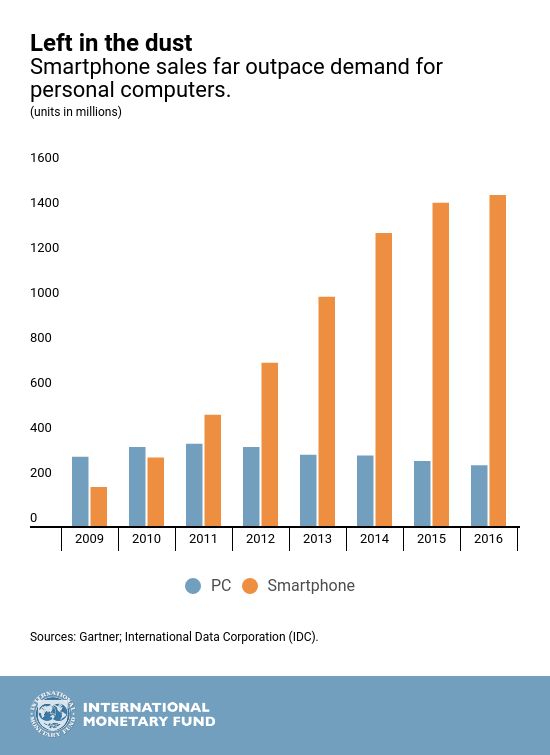
- Over a decade of spectacular growth in smartphones created a new global tech cycle that "last year produced a new smartphone for every fifth person on earth."
- While the global smartphone market may be saturated, demand for other electronics continues to support rising semiconductor production in Asia.
Tech is the new trade — trade and value-added impacts
- Global smartphone sales in 2016 reached almost 1.5 billion units.
- China exported $107 billion of smartphones to the rest of the world in 2016, equivalent to 5 percent of the nation’s total exports.
- In South Korea, semiconductor exports were 17 percent of total exports (2016 context).
- At the peak of the cycle, components for smartphone production accounted for:
- more than a third of total exports from Taiwan Province of China,
- 15 percent of exports from Singapore and South Korea,
- 11 percent of exports from Malaysia.
- OECD data on value added by the computer, electronics, and optical sectors:
- South Korea: 7.4 percent of total value added in 2013.
- Japan: 2.1 percent in 2012.
- Ireland: 2.0 percent in 2012.
- The percentages "probably increased substantially in years since, reflecting the new tech cycle."
Rising tech cycle — cycle mechanics and drivers
- Demand for smartphones is highly cyclical and linked to the release of new models.
- The new tech cycle differs from the earlier PC-associated cycle and cannot be captured by standard seasonality; it "depends on the release dates of Apple Inc. iPhones."
- The cycle subdivides into two components:
- Pre-release: export of components from several Asian countries to China (the producer of most smartphones).
- Post-release: shipments of smartphones from China to the rest of the world.
- Apple iPhone sales growth example:
- 35.1 million units in the first quarter of 2012.
- 78.3 million units in the fourth quarter of 2016.
- A quarterly pattern: second- and third-quarter sales are usually weaker, reflecting expectations of a fourth-quarter release.
- The amplitude of this quarterly pattern has been established since the September 2014 release of the iPhone 6/6 Plus.
- There are clear spillovers from the fourth quarter into the first quarter, ahead of the Chinese New Year.
Evidence global market may be saturated — signs and sectoral shifts
- The analysis suggests the new tech cycle may have peaked in late 2015 and reached a high point in September 2015, accounting for annual 15-day factory shutdowns for Chinese New Year.
- China’s domestic smartphone market declined in 2017 for the first time.
- Apple recorded a year-on-year decrease in iPhone sales in the fourth quarter of 2017.
- Industry projections still foresee increases in unit sales, but the analysis indicates smartphone makers "may have to count on price increases to support continued revenue growth."
- Concurrent sectoral dynamics:
- Asia continues to gain market share in embedded automobile computers, smart appliances, and wearable devices.
- Trend demand for South Korea semiconductor exports "continues to accelerate," despite the slowdown in global smartphone sales.
- The underlying trend in electronic export orders "also remains strong in Taiwan Province of China."
Key implications and takeaways
- The smartphone-driven tech cycle has materially reshaped exports and growth performance across several Asian economies.
- If global smartphone demand is peaking or saturated:
- revenue growth for smartphone makers may increasingly rely on price increases rather than unit growth,
- component and semiconductor producers may see offsetting demand from other consumer electronics (embedded automobile computers, smart appliances, wearables).
- Semiconductor production in Asia is being sustained by demand outside smartphones, supporting continued export growth in jurisdictions with large electronics value chains.
Source: IMF blog post by Benjamin Carton, Joannes Mongardini, Yiqun Li — February 8, 2018.