The Euro Area Needs a Fiscal Union
IMF Blog, February 21, 2018
Source details
- Canonical URL
- The Euro Area Needs a Fiscal Union
Other formats
Bibliographic details
- Authors: Helge Berger, Giovanni DellAriccia, Maurice Obstfeld
- Published: February 21, 2018
Context and authorship
- Authors: Helge Berger, Giovanni Dell’Ariccia, Maurice Obstfeld
- Publication date: February 21, 2018
- Theme: Monetary unions; euro area institutional architecture and resilience
Current situation and core finding
- The euro area is experiencing a robust recovery, but the architecture supporting Europe’s currency union remains incomplete and leaves the region vulnerable to future financial crises.
- Without some degree of fiscal union, the region will continue to face existential risks that policymakers should not ignore.
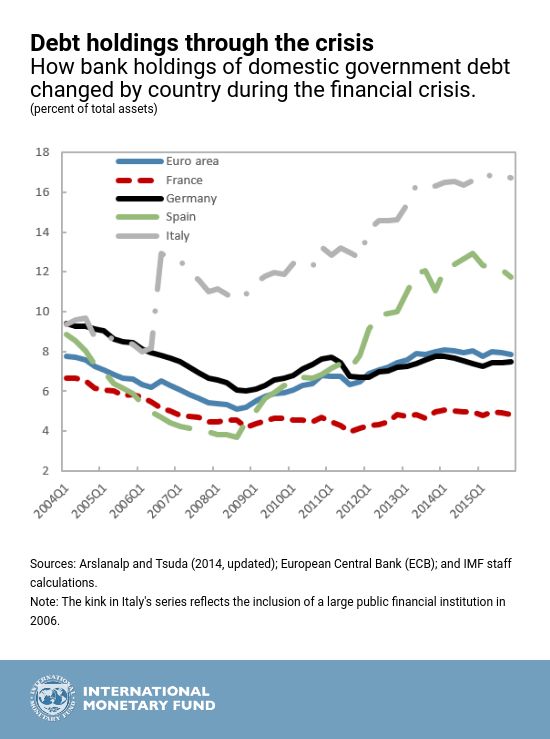
- The recent financial crisis demonstrated how sovereign-financial distress can create large negative spillovers both inside and outside EMU.
Banking union: immediate priorities
- Given the threat posed by the still strong bank-sovereign links, EMU should move quickly to complete its banking union.
- Progress since the 2010-12 debt crisis includes:
- Creation of the European Stability Mechanism
- Central-level institutions for financial supervision and bank restructuring
- The European Central Bank’s Outright Monetary Transactions framework addressing severe distortions in sovereign debt markets
- Remaining gaps to fill:
- Unified policies to support effective area-wide deposit insurance
- A common backstop to the Single Resolution Fund
- Expected benefits of completing the banking union:
- Prevent a banking crisis from jeopardizing a country’s fiscal stability and euro membership
- Reduce bank holdings of domestic sovereign debt to prevent a vicious sovereign-bank feedback loop
- Add credibility to the “no bailout” rule by allowing sovereign debt to be restructured without threatening local banking systems
Need for fiscal union and forms of fiscal risk sharing
- A banking union alone is insufficient; EMU requires a fiscal union to mitigate country-specific macroeconomic shocks.
- Automatic risk-sharing mechanisms in established currency unions are the most efficient way to insure against business cycle risks.
- Private markets do not provide sufficient insurance against declines in consumption during an economic crisis; government deficit spending may be constrained when public debt is already very high.
- Proposals for fiscal risk sharing include:
- An EMU-wide unemployment insurance system to directly stabilize private incomes
- A dedicated central fiscal capacity that collects annual contributions from members in exchange for transfers linked to local shocks when they occur
- Such a facility could smooth business cycles while ensuring fiscal discipline and avoid moral hazard problems (as described in the forthcoming IMF paper, “Filling a Gap in the Euro Area Architecture: A Central Fiscal Capacity for Macroeconomic Stabilization”)
- Participation in such mechanisms could be conditional on complying with fiscal rules or structural reforms to reduce the likelihood of one-sided, long-term transfers
- Legacy issues such as non-performing bank loans will need to be addressed separately
Fiscal discipline, moral hazard, and market discipline
- Introducing fiscal risk sharing could, counterintuitively, strengthen fiscal discipline by making the “no bailout” rule more credible and by increasing market incentives to penalize imprudent fiscal behavior through higher interest rates.
- Current market perceptions may not fully believe in the “no bailout” rule; the risk of spillovers from a sovereign default can make a bailout the least bad option for EMU members.
- More fiscal risk sharing—starting with a full banking union with adequately funded backstops—would:
- Reduce the spillovers from government default
- Reduce the probability of a bailout
- Increase market discipline on fiscal misdeeds
- Moral hazard remains a major concern; a complete fiscal union needs effective rules and institutions to contain it.
- Historical comparison: constraints on state-level or regional governments’ policies tend to be tighter when fiscal risk sharing is higher.
- For EMU, this may require simplifying existing rules, enforcing them more strictly, and ultimately moving some decision-making power from member states to a central level.
Political economy and implementation challenges
- Completing the euro area’s institutional setup is politically difficult and involves:
- Complicated institutional decisions
- Reallocation of sovereign power
- Questions of democratic accountability
- Progress requires thorough public debate; decisions lacking broad public support have the potential to backfire.
- Economic necessity: without more tangible elements of a fiscal union, the euro area will remain fundamentally vulnerable to shocks; conversely, the promise of a more complete EMU tomorrow will add to its resilience today.
IMF blog post: "The Euro Area Needs a Fiscal Union" (Helge Berger, Giovanni Dell’Ariccia, Maurice Obstfeld), February 21, 2018.