Money Sent Home by Migrants Buffers Income Shocks
IMF Blog, February 28, 2018
Source details
- Canonical URL
- Money Sent Home by Migrants Buffers Income Shocks
Other formats
Bibliographic details
- Authors: Kimberly Beaton, Zsoka Koczan
- Published: February 28, 2018
Migration and scale of remittances
- Worldwide, 250 million people, or 3 percent of the global population, live outside their country of birth.
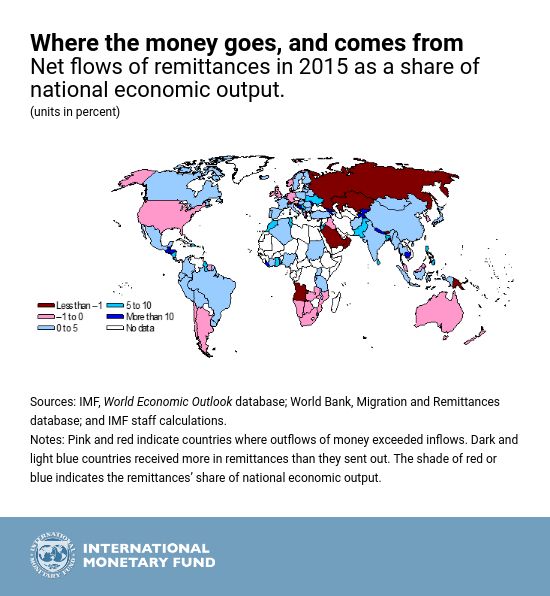
- In 2015, migrants sent home $441 billion – almost three times the total value of official development assistance.
- About 45 percent of these remittances flow from advanced economies to emerging market and developing economies.
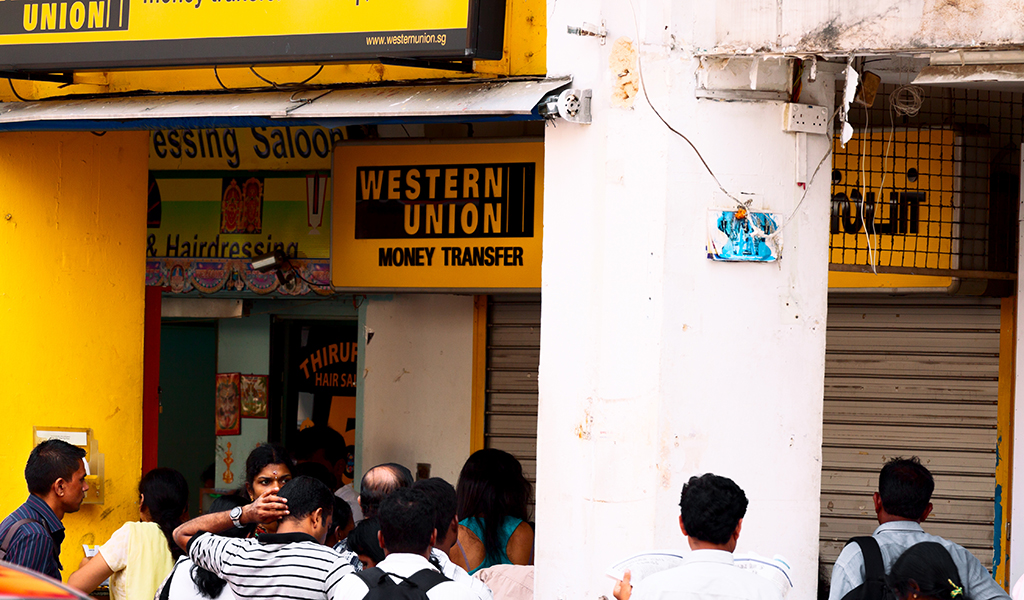
- Photo caption: Credit Singapore, Singapore - September, 23th 2012: Indian people are standing outside of Western Union bank office for opening hour. Capture is taking in Little India of Singapore. Western Union, Singapore: In 2015, migrants sent home $441 billion – almost three times the total value of official development assistance (photo: iStock by GettyImages).
Limited risk-sharing through financial integration
- Poorer countries are often weakly integrated into global markets and cannot rely on borrowing and lending in capital markets to smooth consumption.
- The October 2017 World Economic Outlook study calculates the extent to which remittances can fulfill the role of smoothing income shocks, under what circumstances, and with what country characteristics.
- Recipients in developing countries often do not have bank accounts or access to credit, limiting domestic mechanisms for smoothing (example: a coffee farmer in Ethiopia cannot easily borrow when coffee prices fall).
Remittances are a stable source of income
- Remittances are the least volatile component of balance-of-payments inflows.
- Volatility of the current account is significantly lower for countries receiving high net remittances than for countries without significant remittances.
Remittances facilitate consumption smoothing — empirical findings
- On a broad basis across countries, about 30 percent of income variation is not reflected in consumption or is smoothed, consistent with partial risk-sharing.
- Interpretation: for any extra dollar of income that is lost in the home country, consumption falls by only 70 cents because of consumption-smoothing.
- Of the income variation that is smoothed, about 27 percent is due to remittances.
- The 27 percent estimate holds regardless of whether a country receives a high or a low level of remittances and regardless of the extent to which the country is financially integrated.
- The smoothing effect can be somewhat larger as a proportion of the total smoothed component during major country-specific financial crises.
- The consumption-smoothing effect is more pronounced for commodity-exporting countries, especially during periods of low commodity prices.
Policy implications and recommendations
- Remittances act like a global insurance policy for economic shocks.
- Measures that promote remittances, preserve correspondent banking relationships, and reduce the cost of remittances can significantly enhance worldwide risk-sharing – making everyone better off.
Source: Money Sent Home by Migrants Buffers Income Shocks, Kimberly Beaton and Zsoka Koczan, February 28, 2018 (IMF blog).
References
- https://www.imf.org/wp-content/uploads/2018/02/BLOG-1024x600-Singapore-remittances-cash-pickup-at-Western-Union-iStock458280355.jpg
- https://www.imf.org/wp-content/uploads/2018/02/Remittances-Chart-1.jpg
- World Economic Outlook
- https://www.imf.org/wp-content/uploads/2018/02/Remittances-Chart-2.jpg
- https://www.imf.org/wp-content/uploads/2018/02/Remittances-Chart-3.jpg