Ending Harassment Helps #TheEconomyToo
IMF Blog, March 5, 2018
Source details
- Canonical URL
- Ending Harassment Helps #TheEconomyToo
Other formats
Bibliographic details
- Authors: Christine Lagarde, Corinne Delchat, Monique Newiak
- Published: March 5, 2018
Summary of core message
- Providing legal protection against sexual harassment creates an environment in which women are more likely to be economically and financially active.
- New IMF staff research “What is Driving Women’s Financial Inclusion Across Countries?” finds a link between financial access and protection against harassment based on surveys of 1,000 individuals in each of more than 140 countries.
- Unlocking women’s potential requires equality in legal rights and equality in access to education, health, and finance, as well as ensuring a safe environment free from harassment.
Legal safety and financial inclusion — empirical findings
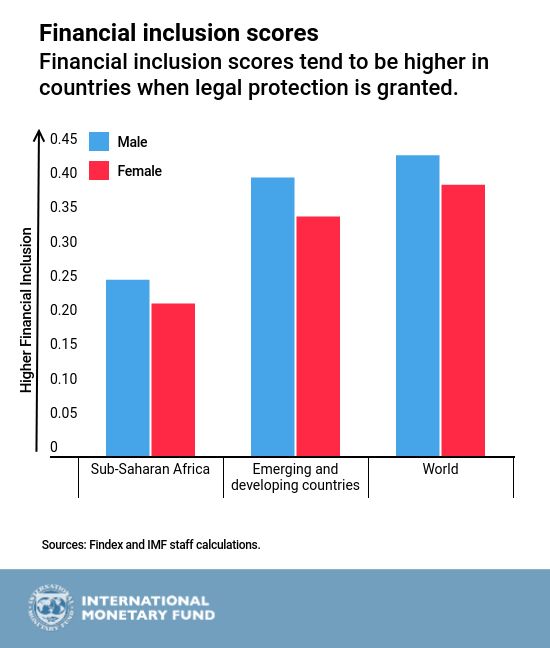
- Women are less likely than men to gain access to financial services; in emerging and developing markets, financial inclusion scores are about 14 percent lower for women than for men.
- Women who live in countries with stronger protection against harassment, including at work, are more likely to open a bank account, borrow and save, and use financial services such as mobile payments.
- Quantified impacts:
- For the average woman living in an emerging market or developing country, financial inclusion scores are almost 16 percent deeper when legal protection is granted.
- For the average sub-Saharan African woman, financial inclusion scores are almost 25 percent higher when legal protection is granted.
- Eliminating harassment and increasing women’s access to financial services can transform lives and boost women’s economic activity, including entrepreneurship, which translates into higher economic growth, productivity, more equal income distribution, higher profits for businesses, and greater economic stability.
Significant gaps in legal protection — key statistics
- In 2017, almost 290 million adult women were not legally protected from sexual harassment.
- In 2017, more than 360 million women were not shielded from harassment in employment.
- In almost a quarter of countries, there is no protection against domestic violence.
- Almost 100 million girls are not sufficiently protected legally from being married as a child.
- Some countries set different legal ages of marriage for women than for men.
Policy implications and recommendations
- Changing laws alone is not sufficient; legal protections need enforcement and complementary policies.
- Fiscal policy can play a larger role through investments in:
- transport safety and sanitation facilities for women and girls,
- support for victims of gender-based violence.
- IMF recommendations for reducing gender inequality include:
- strengthening and enforcing legal rights,
- increasing investment in infrastructure, health, and education,
- policies to help reduce violence against women.
- Advice to advanced economies emphasizes:
- well-designed parental leave,
- affordable and high-quality childcare,
- tax policies that do not penalize secondary earners.
- IMF-supported programs in Egypt and Niger include measures to empower women economically, such as investments in public nurseries and better public transport safety.
IMF engagement and projected impacts
- The IMF is expanding country-level analysis and advice on gender equality issues and has studied and provided advice on gender equality issues in about one-sixth of our 189 member countries.
- A forthcoming study on Nigeria shows that reducing gender inequality could increase real GDP growth by an average of 1¼ percentage points annually.
- The IMF commits to working with governments and partners to identify policies that help women realize their potential and to keep gender equality at the top of the policy agenda year-round.
Christine Lagarde, Corinne Deléchat, Monique Newiak — March 5, 2018