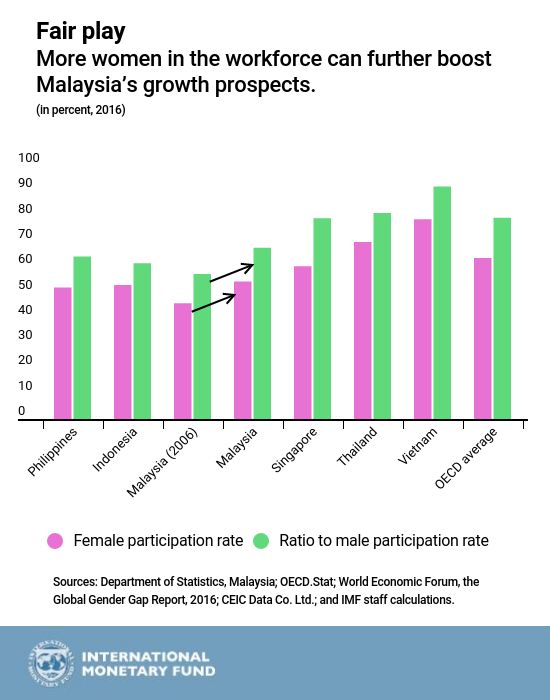
Chart of the Week: Malaysia Needs More Women in the Workforce
IMF Blog, April 2, 2018
Source details
- Canonical URL
- Chart of the Week: Malaysia Needs More Women in the Workforce
Other formats
Bibliographic details
- Authors: The Editors
- Published: April 2, 2018
Key findings
- Between 2010 and 2016, women’s employment in Malaysia grew at a compound annual rate of 4½ percent; male employment grew at a compound annual rate of 2 percent.
- Malaysia’s labor force participation rate for women remains just above 54 percent.
- Men’s participation rate is about 80 percent.
- The contribution of female employment to Malaysia’s economic growth increased from 4 percent (from 2001 to 2008, of real GDP growth) to 14 percent (from 2011 to 2016).
- The contribution of male workers increased from about 7 percent of GDP to about 13 percent of GDP.
- If the female labor force participation rate had not changed since 2012, real GDP would have been about 1 percent lower in 2016 compared with what it was that year.
Drivers and challenges
- Sectoral growth: Health and hospitality services, and the public sector saw the highest rate of increase in female employment.
- Education: Enrollment rates in high school and university education are now higher for women than for men, contributing to a higher share of skilled occupations among women.
- Disparities: Labor force participation rates are particularly lower for less educated women. Incidence of unemployment is higher for women living in rural areas, aged below 29 years, or primary school educated.
- Education quality: Public spending on education, as a share of GDP, is much higher in Malaysia than in peer countries, but the country needs to improve the quality of education.
- Time use and family responsibilities: Most women report housework or family responsibility as the dominant reason for being outside the labor force.
Policy objectives and government targets
- The government’s 11th Malaysia Plan prioritizes improving the female labor participation rate by 5 percentage points to 59 percent by 2020.
- Malaysia Education Blueprint Plan aims to improve the quality of education and build skills that are viable in the global market.
Policy measures in the 2018 budget and other recommendations
- Policies included in the government’s 2018 budget that have the potential to improve women’s labor force participation:
- Increasing the duration of maternity leave for the private sector to 90 days to match that of the public sector;
- Setting a minimum of 30 percent participation of women in boards of government-linked companies and investment companies by end-2018;
- Implementing personal income tax exemptions on a maximum of 12-months consecutive salary for women, with a career break of at least two years for those who intend to return to the workforce between 2018 and 2020.
- Other recommended policies:
- Increasing access to childcare facilities;
- Implementing family–friendly labor laws.
Source: Chart of the Week: Malaysia Needs More Women in the Workforce — The Editors, April 2, 2018.
Content in this bundle
- Bagan Minggu Ini: Malaysia Memerlukan Lebih Banyak Perempuan dalam Angkatan Kerja