Risky Business: Reading Credit Flows for Crisis Signals
IMF Blog, April 10, 2018
Source details
- Canonical URL
- Risky Business: Reading Credit Flows for Crisis Signals
Other formats
Bibliographic details
- Authors: Claudio Raddatz
- Published: April 10, 2018
Overview and research scope
- Authors: Claudio Raddatz Kiefer
- Date: April 10, 2018
- Research coverage: 25 years of data for nonfinancial companies in 55 emerging and advanced economies.
- Central question: How much of additional credit during booms flows to relatively riskier companies versus more creditworthy firms?
Key findings on credit allocation and risk
- When credit grows rapidly, the firms where debt expands faster become increasingly risky relative to those with the slowest debt expansions.
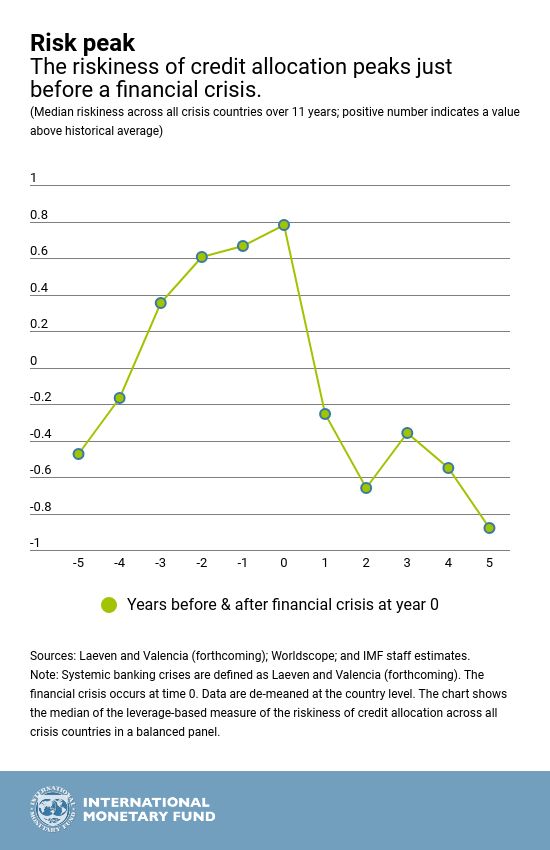
- An increase in the riskiness of credit allocation points to greater odds of a severe economic downturn or a banking crisis as many as three years into the future.
- The buildup of lending to relatively less creditworthy companies adds an extra dose of risk on top of the dangers associated with rapid growth of credit overall.
- Lending to risky firms can be rational and profitable, but may also reflect poorer screening of borrowers or excessive risk-taking.
- Low interest rates can encourage a “search for yield,” leading banks and investors to extend credit to riskier companies that pay relatively higher rates of interest.
- The riskiness of credit allocation may serve as a barometer of risk appetite.
Global pattern and historical evolution
- Riskiness was elevated in the late 1990s.
- Riskiness fell from 2000 to 2004, in the aftermath of financial crises in Asia and Russia and the dot-com equity bubble.
- From a historic low in 2004, riskiness rose to a peak in 2008, when the global financial crisis erupted.
- It then declined sharply before rising again to a level near its historical average at the end of 2016, the last available data point.
- Riskiness may have continued to rise in 2017 as market volatility and interest rates remained very low in the global economy.
Policy implications and recommendations
- Supervisors should monitor both the total volume of credit and the riskiness of its allocation.
- When warning signals flash, regulators can:
- require banks to hold more capital;
- impose limits on bank loan growth to restrain risk-bearing capacity and increase buffers;
- ensure the independence of bank supervisors;
- enforce lending standards;
- strengthen corporate governance by protecting minority shareholders.
- A period of rapid credit growth is more likely to be followed by a severe economic downturn if more of that credit is flowing to riskier firms; policy makers should take appropriate steps in response.
Source: Risky Business: Reading Credit Flows for Crisis Signals (April 10, 2018).