The Digital Gamble: New Technology Transforms Fiscal Policy
IMF Blog, April 12, 2018
Source details
- Canonical URL
- The Digital Gamble: New Technology Transforms Fiscal Policy
Other formats
Bibliographic details
- Authors: Vitor Gaspar, Genevive Verdier
- Published: April 12, 2018
Overview
- Authors: Vitor Gaspar, Geneviève Verdier
- Publication date: April 12, 2018
- Digital tools are being used for tax and expenditure policy, public financial management, and public service delivery.
- Examples highlighted:
- Rwanda: digitally-monitored drones deliver blood supplies to hospitals.
- Estonia: it takes five minutes to file taxes and 99 percent of government services are available online.
- Singapore: first city to implement electronic road pricing to manage congestion.
- Photo credit: Traffic congestion along Scotts Road on 15 January 2015. (Newscom TagID: sphphotos000206.jpg) [Photo via Newscom]
The gamble: potential payoffs and risks
- Opportunities from better, timely, and accurate information:
- Governments can build better systems and design and implement better policies.
- Digital tools facilitate citizens’ lives: effortless tax filing (examples: Kenyans pay taxes on their smart phones; Norwegians have their tax returns prepopulated by their government).
- Delivery of social benefits via electronic transfers linked to biometric identification (example: India).
- Fiscal gains from digital enforcement:
- British customs use big data to detect fraudulent behavior of importers at the border.
- Estimated potential increase in annual indirect tax collection at the border: up to 1-2 percent of GDP.
- Cross-border information exchange:
- The Panama and the Paradise papers exposed substantial wealth sheltered in low-tax jurisdictions—an average of 10 percent of world GDP.
- Digital cross-country information exchange about taxpayers offers prospects for more effective tracking of such wealth.
Avoid the gamble? Constraints and risks
- Trust and privacy:
- Citizens may not trust governments to safeguard personal information (example: in the United States, less than a third of people believe the government can keep their digital records secure).
- Inclusion and access:
- Many poor households lack access to digital tools; digitalization can leave people behind (example: fewer than half of the population of Africa subscribes to a mobile phone).
- New fraud and enforcement challenges:
- New fraud opportunities arise (example: authorities in Korea recently raided the country’s largest cryptocurrency exchanges for alleged tax evasion).
- Cash-strapped governments with low capacity face greater challenges managing these risks.
Digital firms and taxation challenges
- Characteristics of digital firms:
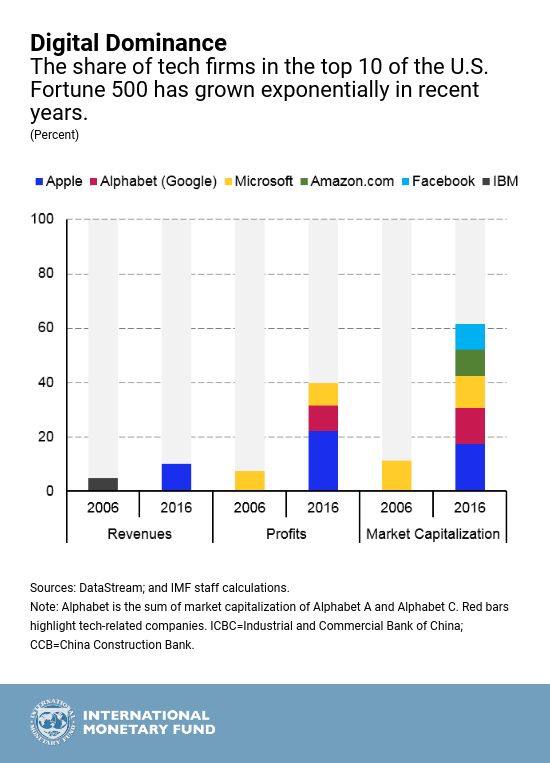
- Firms like Google, Apple, Facebook and Amazon generate sales with little physical presence and benefit from value created by users.
- User-generated activity on apps produces free yet valuable information.
- Policy questions:
- Can and should governments tax value where the consumer resides even when the firm’s physical home is elsewhere?
- The scale of digital activities raises concerns about fairness in the allocation of international taxing rights.
- Current uncoordinated responses:
- Some countries (example: Israel, Italy) have introduced specialized tax measures targeting digital firms.
- Such uncoordinated solutions cannot provide the answer; global solutions are required as the whole economy becomes digital.
The way forward: recommended actions
- Overcoming challenges will require:
- A proactive and comprehensive reform agenda that addresses political and institutional weaknesses to manage digital risks and ensure inclusion.
- Example: India combined biometric identification with reforming program design to deliver income support to the right beneficiaries.
- Adequate resources in the budget.
- Example: Korea secured budget resources for multi-year plans early on in its digitalization process.
- International cooperation.
- Example: Reducing evasion to low-tax jurisdictions or forming a consensus on the taxation of the digital economy will require multilateral efforts.
- Cautionary note:
- Digitalization will not solve all policymaker problems and may create new ones.
- Governments cannot ignore the trend: "Resist at your peril, or embark on a journey to shape the way forward."
Source: The Digital Gamble: New Technology Transforms Fiscal Policy, Vitor Gaspar and Geneviève Verdier, April 12, 2018.