Bringing Down High Debt
IMF Blog, April 18, 2018
Source details
- Canonical URL
- Bringing Down High Debt
Other formats
Bibliographic details
- Authors: Vitor Gaspar, Laura Jaramillo
- Published: April 18, 2018
Overview
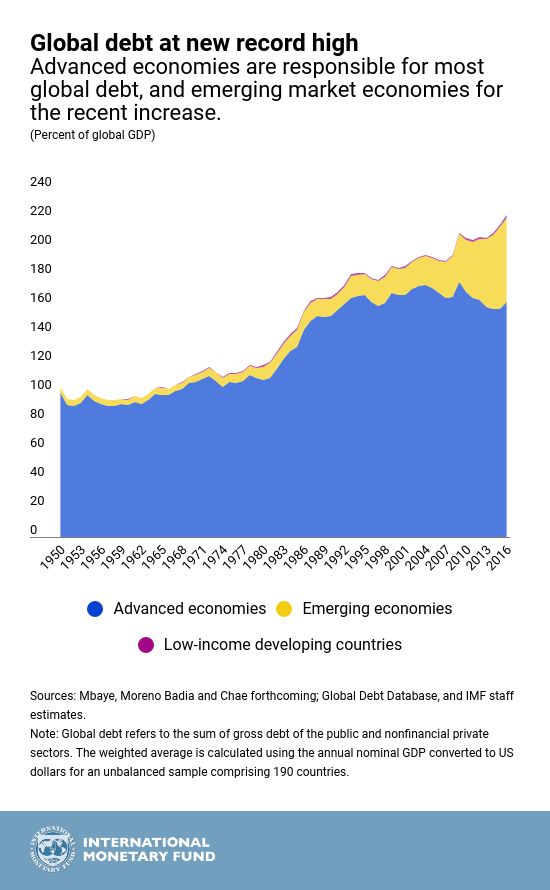
- Global debt hit a new record high of $164 trillion in 2016, the equivalent of 225 percent of global GDP.
- Both private and public debt have surged over the past decade, making governments’ financing vulnerable to sudden changes in market sentiment and limiting their ability to provide support in a downturn or financial crisis.
- The April 2018 Fiscal Monitor explores how countries can reduce government deficits and debt in a growth-friendly way.
Why high government debt is a concern
- Of the $164 trillion, 63 percent is nonfinancial private sector debt, and 37 percent is public sector debt.
- Advanced economies are responsible for most global debt, but emerging market economies have driven most of the increase in the last ten years.
- China alone contributed 43 percent to the increase in global debt since 2007.
- Low-income developing countries’ contribution to the global increase is barely noticeable, though their debt climbed 13 percentage points in the last five years.
- Public debt ratios:
- In advanced economies, debt-to-GDP ratios are at levels not seen since World War II and have been increasing persistently over the past fifty years.
- In emerging market economies, public debt is at levels seen only during the 1980s’ debt crisis.
- In low-income developing countries, average public debt-to-GDP ratios are well below historic peaks (noting earlier reductions involved debt forgiveness).
- Debt service burden in low-income developing countries has doubled in the past ten years to close to 20 percent of taxes, reflecting greater reliance on nonconcessional debt and expanded domestic debt issuance to nonresidents.
- High government debt and deficits increase vulnerability to changing financing conditions and can increase the depth and duration of recessions because governments may be unable to deploy sufficient fiscal support.
Timing: why now is the right moment to act
- As growth gains momentum in most countries, fiscal stimulus to support demand is no longer appropriate.
- Fiscal multipliers are expected to be smaller now, implying limited benefits from short-term fiscal stimulus and relatively smaller economic costs of reducing debt and deficits.
- Reducing debt and deficits now will:
- Diminish a country’s vulnerability to changing market sentiment.
- Ensure policymakers have sufficient resources to act in case of a downturn—precisely when fiscal multipliers are larger.
Projections and country-specific notes
- Overall forecasts indicate debt-to-GDP ratios would come down over the next three to five years in most countries, conditional on countries delivering fully on their policy commitments.
- Public debt ratios are forecasted to come down in all advanced economies except one:
- United States: the revised tax code and the two-year budget agreement lead to an expansion in economic activity until 2020, but give rise to overall deficits above $1 trillion over the next three years, which is more than 5 percent of GDP, bringing government debt to 117 percent of GDP in 2023.
- Forecasts are qualitatively similar to those recently published by the Congressional Budget Office.
Policy recommendations
- Avoid fiscal policies that provide unnecessary stimulus when economic activity is already picking up.
- Most advanced, emerging market, and low-income developing countries should:
- Deliver on their fiscal plans and put deficits and debt firmly on a downward path.
- Enact fiscal reforms that increase productivity and promote human and physical capital.
- Low-income developing countries should strengthen their tax capacity to:
- Service their debt.
- Finance spending priorities—such as health, education and public infrastructure—to attain the 2030 Sustainable Development Goals.
Vitor Gaspar, Laura Jaramillo — April 18, 2018