Volatility Strikes Back
IMF Blog, May 3, 2018
Source details
- Canonical URL
- Volatility Strikes Back
Other formats
Bibliographic details
- Authors: Sergei Antoshin, Fabio Cortes, Will Kerry, Thomas Piontek
- Published: May 3, 2018
Summary of recent market events
- Authors: Sergei Antoshin, Fabio Cortes, Will Kerry, Thomas Piontek
- Date: May 3, 2018
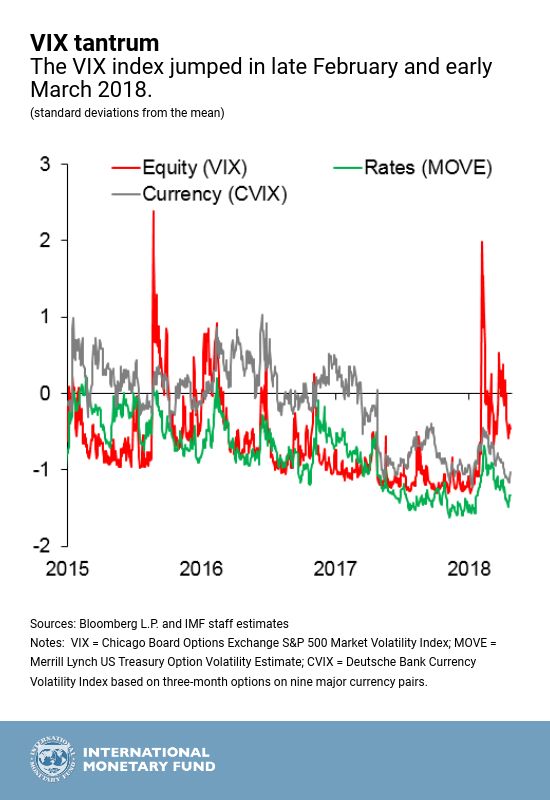
- The bouts of volatility in early February and late March were confined to equity markets but illustrated the potential for sudden market moves to expose fragilities across the financial system.
- Central banks in advanced economies are set to normalize monetary policies just as trade and geopolitical tensions flare up, which may increase economic and policy uncertainty and cause financial conditions to tighten abruptly.
- A more sustained period of renewed volatility is a plausible risk.
Background and drivers
- The early-2018 turbulence followed a prolonged period of calm characterized by low economic uncertainty, low interest rates, easy funding conditions, and improving corporate performance (as shown in the October 2017 Global Financial Stability Report).
- Popularity of volatility index-linked products increased during the calm period, notably strategies selling VIX futures on the Chicago Board Options Exchange (CBOE) equity volatility index (the VIX).
- The VIX shows the expected level of price fluctuations in the Standard & Poor’s 500 Index of stocks over the next month.
Mechanisms that amplified the spike
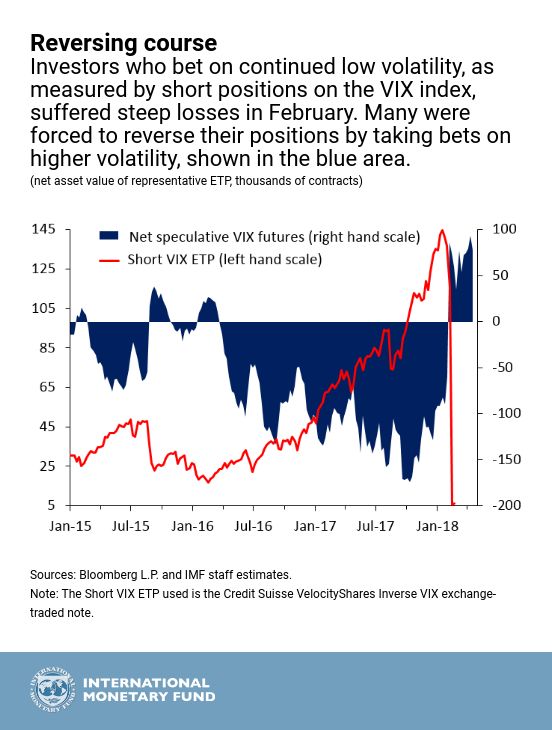
- Short VIX strategies were profitable before the early February spike because implied volatility exceeded realized volatility, creating a premium that sellers of VIX futures captured.
- During the VIX tantrum, that premium turned negative, reducing the appeal of these strategies.
- The April 2018 Global Financial Stability Report documents how some short VIX strategies contributed to the February volatility spike:
- Exchange-traded products that had built up significant bets on low volatility, often sold to retail investors, incurred steep losses.
- Investors who expected low volatility to persist were forced to reverse positions and take bets on higher volatility, amplifying the surge in the VIX.
Ongoing vulnerabilities
- Some short-VIX strategies marketed to retail investors appear to have been unwound.
- Other strategies predicated on low volatility reportedly remain widespread, particularly among institutional investors.
- A sustained rise in volatility across asset classes could force a broader class of investors to rebalance portfolios, exacerbating price declines, especially where positions employ financial leverage.
- Volatility-targeting strategies remain popular and could be vulnerable:
- These strategies aim to keep expected portfolio volatility at a target and use leverage to achieve it.
- Size and flexibility to deviate from targets vary significantly across funds.
- Variable annuities and funds using trading algorithms are apparently more likely to react to a spike in volatility by selling assets, potentially exacerbating turbulence; the exact extent and speed of such rebalancing are unclear.
Policy recommendations and regulatory priorities
- Regulators and market participants should remain attuned to risks associated with higher interest rates and greater volatility.
- Ensure financial institutions maintain robust risk management, including close monitoring of exposures to asset classes with valuations judged to be stretched.
- Policymakers should develop tools to discourage excessive build-up of leverage that could increase market fragility.
- Be mindful of migration of activities and risks to more opaque segments of the financial system.
- To address risks related to investment funds’ activities:
- Endorse a common definition of financial leverage.
- Strengthen supervision of liquidity risk.
Source: Volatility Strikes Back, May 3, 2018
References
- https://www.imf.org/wp-content/uploads/2018/04/BLOG-1024x600-volatility-coney-island-roller-coaster-richard-b-levine-newscom-lrphotos089950.jpg
- Global Financial Stability Report
- https://www.imf.org/wp-content/uploads/2018/04/eng-april-20-volatility1-3.jpg
- https://www.imf.org/wp-content/uploads/2018/04/eng-april-20-volatility3-3.jpg
- Global Financial Stability Report
- https://www.imf.org/wp-content/uploads/2018/04/eng-april-20-volatility2-3.jpg
- https://www.imf.org/wp-content/uploads/2018/04/eng-april-20-volatility-table-3.jpg