Shifting Tides: Policy Challenges and Opportunities for the G-20
IMF Blog, July 18, 2018
Source details
- Canonical URL
- Shifting Tides: Policy Challenges and Opportunities for the G-20
Other formats
Bibliographic details
- Authors: Christine Lagarde
- Published: July 18, 2018
Overview
- Author: Christine Lagarde; Date: July 18, 2018.
- Key framing: "Take advantage of global growth before the tides change."
- IMF World Economic Outlook Update confirmed the April forecast of 3.9 percent global growth for 2019.
- Growth is beginning to slow in the Euro Area, Japan, and the United Kingdom; US growth is projected to moderate in the medium term. Emerging market growth is more uneven due in part to rising oil prices and currency pressures.
Global trade
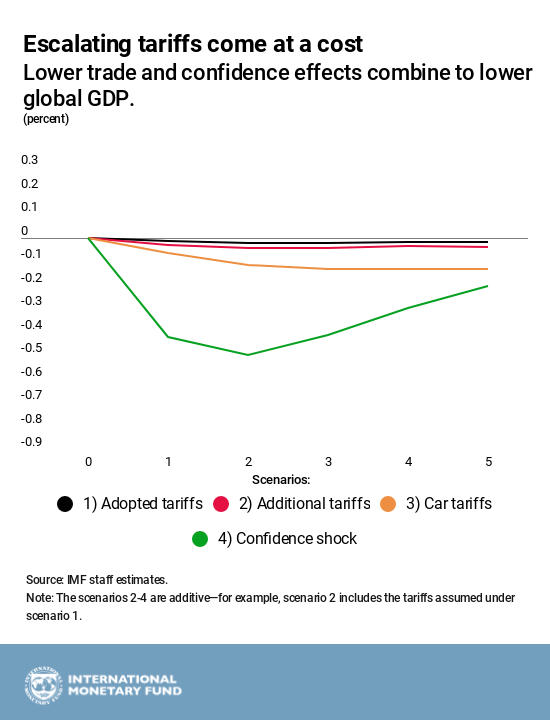
- Findings and scenarios:
- Recent tariffs and counter-tariffs have gone into effect and are already leaving a mark on trade flows and business confidence (noted decreases in new export orders and wavering confidence among some car-exporting countries, including Germany).
- IMF G-20 Surveillance Note simulates four hypothetical trade scenarios.
- If all currently announced tariffs go into effect, global output would be reduced by 0.1 percent in 2020.
- If investor confidence is shaken by these tariffs, global GDP could decrease by ½ percent—or roughly US$430 billion—below the current projection for 2020.
- The US economy is especially vulnerable because much of its global trade would be subject to retaliatory measures.
- Policy recommendations:
- Move past tit‑for‑tat tariffs and develop multilateral solutions to improve the global trading system.
- Modernize trade rules to address intellectual property rights.
- Adopt innovative agreements on e-commerce and digital services; “The future of trade is the future of data.”
Emerging market vulnerabilities
- Findings:
- Rising US interest rates have put pressure on many developing economies, including Brazil and Turkey.
- Investors withdrew over 14 billion dollars from emerging markets in May and June of this year.
- Most pressure has been limited to a few countries and is nowhere near as widespread as the Taper Tantrum of 2013, but risk remains as US interest rates continue to rise.
- Policy recommendations ("Use all the tools at their disposal"):
- Exchange rates should remain flexible and act as a shock absorber to help countries weather the departure of investors’ money.
- Regulators should coordinate to prevent excessive credit growth from turning into another crisis, including by ensuring liquidity in financial markets.
- With high debt levels in many countries, fiscal policy should be used to preserve and rebuild buffers where needed.
- IMF role:
- The IMF will continue to provide guidance and is committed to helping members strengthen their economies and increase resilience.
The impact of technology on jobs
- Findings:
- Advances in artificial intelligence and automation promise to raise productivity and growth, but could lead to job losses and increased inequality.
- Many nations lack an accurate picture of how technology is changing the workforce; labor market statistics are hampered by a lack of information about the scope of the gig economy.
- Estimates of productivity can overlook how technology increases efficiency (example: a watch in 2018 can also be a cellphone, a movie theater, a navigation tool, and a supercomputer).
- The IMF’s new G-20 paper on the future of work shows measurement gaps.
- Policy recommendations:
- Modernize social safety nets to address disruptions from automation.
- Reform education systems to provide for lifelong learning.
- Commit to major investments in digital infrastructure.
- Learn from examples such as Singapore, which prioritized infrastructure over the last decade and now "possess[s] the most advanced digital infrastructure of any nation in the world."
- Imperative:
- It is time to prepare for accelerating technological disruption and to pair better measurement with bold policy action.
Conclusion and choice for the G-20
- The current moment of growth may not last forever; the G-20 should use the opportunity to build a solid economic foundation rather than a fragile system.
- Since the Global Financial Crisis nearly ten years ago the G-20 nations have chosen to build resilience; finance ministers should continue that path in Buenos Aires.
Source: Shifting Tides: Policy Challenges and Opportunities for the G-20 — Christine Lagarde, July 18, 2018 (IMF blog).
Content in this bundle
- 潮起潮落:二十国集团的政策挑战与机遇; IMF blog; 2018 年7 月18 日
- 潮目を変える G20の政策課題と機会; クリスティーヌ・ラガルド, IMF ブログ 2018年7月18日掲載
- Group of Twenty: Future of Work: Measurement and Policy Challenges, July 18, 2018
- Приливы и отливы: задачи и возможности для Группы 20-ти в области экономической политики
References
- عربي
- Português,
- https://www.imf.org/wp-content/uploads/2018/07/BLOG-1024x600-MDG20-cars-china-Imagine-china-Newscom-ichphotos363638.jpg
- World Economic Outlook Update
- IMF warned against the self-inflicted economic wounds
- G-20 Surveillance Note
- https://www.imf.org/wp-content/uploads/2018/07/eng-july-11-md-g20-2.png
- The future of trade is the future of data
- Policy Actions to Sustain Growth and Guard Against Risks
- No Time to Stand Still: Strengthening Global Growth and Building Inclusive Economies