Addressing Global Imbalances Requires Cooperation
IMF Blog, July 24, 2018
Source details
- Canonical URL
- Addressing Global Imbalances Requires Cooperation
Other formats
Bibliographic details
- Authors: Maurice Obstfeld
- Published: July 24, 2018
Overview
- Excess imbalances remain generally unchanged and are increasingly concentrated in advanced economies.
- Their persistence is fueling trade tensions among countries.
- The configuration of imbalances does not pose an imminent danger, but if unaddressed, it could threaten global stability down the road.
- The assessments reported are from the 2018 External Sector Report (ESR) covering the 30 largest economies and evaluate when current account surpluses and deficits are appropriate or signal risks.
Key findings on excessive imbalances
- After narrowing in the aftermath of the global financial crisis, global current account surpluses and deficits have remained relatively unchanged over the past five years at about 3¼ percent of global GDP.
- The analysis indicates that about 40 to 50 percent of these global balances are excessive, and increasingly concentrated in advanced economies.
- Geographic concentration:
- Higher-than-desirable current account balances prevail in northern Europe — in countries such as Germany, the Netherlands, and Sweden — as well as in parts of Asia — in economies like China, Korea, and Singapore.
- Lower-than-desirable balances remain largely concentrated in the United States and the United Kingdom.
- Excessive external imbalances (both deficits and surpluses) pose risks for individual countries and for the global economy:
- Deficit risks: economies that borrow too much may become vulnerable to sudden stops in capital flows.
- Surplus risks: countries with excessive surpluses may invest savings abroad when domestic investments could offer higher social returns and may become targets for protectionist measures.
- The ESR focuses on each country’s overall current account balance rather than bilateral trade balances.
Risks down the road
- Under planned policies, imbalances are projected to grow over the medium term and could eventually pose a risk to global stability.
- Specific projected dynamics:
- The planned fiscal expansion in the United States will likely increase the country’s current account deficit — with mirror-image larger surpluses in the rest of the world — and result in a faster pace of US monetary policy normalization.
- The ensuing tightening of global financial conditions could prove disruptive to emerging and developing economies, especially the more vulnerable ones who have already been subject to some pressure.
- Continued patterns and consequences:
- Limited actions by surplus countries suggest their surpluses will linger.
- Net foreign asset stock positions will continue diverging, increasing the likelihood of disruptive currency and asset price adjustments down the road in indebted countries.
- Such developments would diminish global growth, also harming the surplus economies.
- Adjustment dynamics:
- Because of the risk that foreign lending dries up, deficit countries face greater pressure to balance their international accounts than surplus countries do.
- When adjustment comes, both debtor and creditor countries lose, as illustrated by the adjustment in the aftermath of the global financial crisis.
How to tackle imbalances — Policy recommendations
- In the current conjuncture (many countries near full employment and limited fiscal room), governments should carefully calibrate policies to achieve domestic and external objectives while rebuilding monetary and fiscal policy buffers.
- Policy guidance by country type:
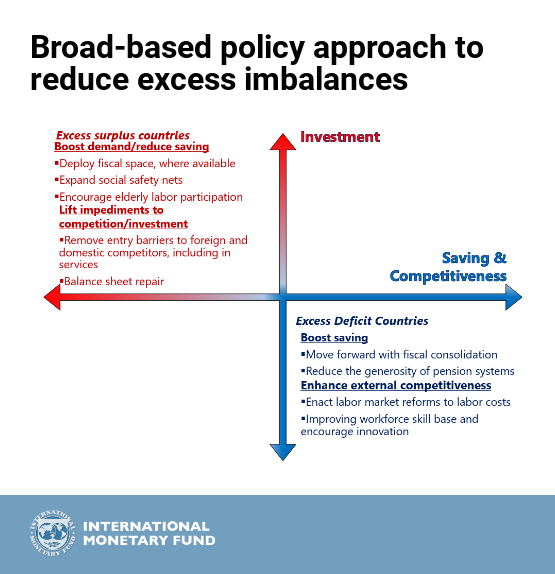
- Countries with lower-than-warranted external current account balances should:
- Reduce fiscal deficits.
- Encourage household saving.
- Allow monetary normalization to proceed gradually.
- Countries with higher-than-warranted current account balances should:
- Use fiscal space, if available, to reduce excess surpluses.
- Well-tailored structural policies should play a more prominent role in tackling external imbalances while boosting domestic potential growth:
- For excess surplus countries: reforms that encourage investment and discourage excessive saving — for example, removal of entry barriers or stronger social safety nets.
- For excess deficit countries: reforms that improve productivity and workers’ skill base.
- Trade and multilateral cooperation:
- All countries should work toward reviving trade liberalization efforts while modernizing the multilateral trading system — for example, to promote trade in services.
- Such efforts may have small effects on excess current account imbalances, but can have big positive effects on productivity and welfare and reduce the risk that imbalances trigger protectionist responses.
- Emphasis on cooperation:
- Both surplus and deficit countries must work together to reduce excess global imbalances in a manner supportive of global growth and stability.
Maurice Obstfeld — July 24, 2018