The Long-Term Impact of Brexit on the European Union
IMF Blog, August 10, 2018
Source details
- Canonical URL
- The Long-Term Impact of Brexit on the European Union
Other formats
Bibliographic details
- Authors: Jiaqian Chen, Christian Ebeke, Li Lin, Haonan Qu, Jesse Siminitz
- Published: August 10, 2018
Overview
- Authors: Jiaqian Chen, Christian Ebeke, Li Lin, Haonan Qu, Jesse Siminitz
- Publication date: August 10, 2018
- Core message: Reversing deep EU–UK economic integration will reduce long-term output and employment in the EU-27; the magnitude depends on the final post-Brexit relationship.
Channels of EU–UK integration highlighted
- Trade:
- The U.K. accounts for about 13 percent of the EU-27’s trade in goods and services.
- Substantial supply chain trade links between the EU-27 and the U.K. involve several countries.
- Capital flows:
- Gross bilateral capital flows totaled around 52 percent of EU-27 GDP in 2016.
- Migration:
- Migration flows have grown over time and are very large for some countries, such as Ireland.
- Composite indicator:
- A constructed index capturing all these channels indicates growing EU–UK bilateral integration over the past 30 years.
Aggregate long-term impact under alternative scenarios
- FTA (standard free trade agreement: low tariffs on goods but higher non-tariff barriers):
- EU-27 real output: lower by 0.8 percent in the long run relative to a no-Brexit scenario.
- EU-27 employment: lower by 0.3 percent in the long run relative to a no-Brexit scenario.
- WTO rules (default to World Trade Organization rules):
- EU-27 real output: lower by 1.5 percent in the long run relative to a no-Brexit scenario.
- EU-27 employment: lower by 0.7 percent in the long run relative to a no-Brexit scenario.
- “Norway” (EEA) scenario (access to the single market preserved; membership in the customs union lost):
- Decline in output and employment for the EU-27: appears negligible.
Country-by-country estimates from trade-channel model
- Model scope: country-specific framework capturing direct and indirect trade effects from higher tariffs and non-tariff barriers for goods and services. Results are relatively smaller than aggregate estimates because only trade links are modeled.
- FTA scenario (long run, relative to no-Brexit):
- EU-27 real output: lower by 0.2 percent.
- Largest country hit: Ireland — about 2.5 percent lower compared to the no-Brexit scenario.
- Other notably affected countries: the Netherlands, Denmark, Belgium, and Czech Republic (ranked after Ireland by size of impact).
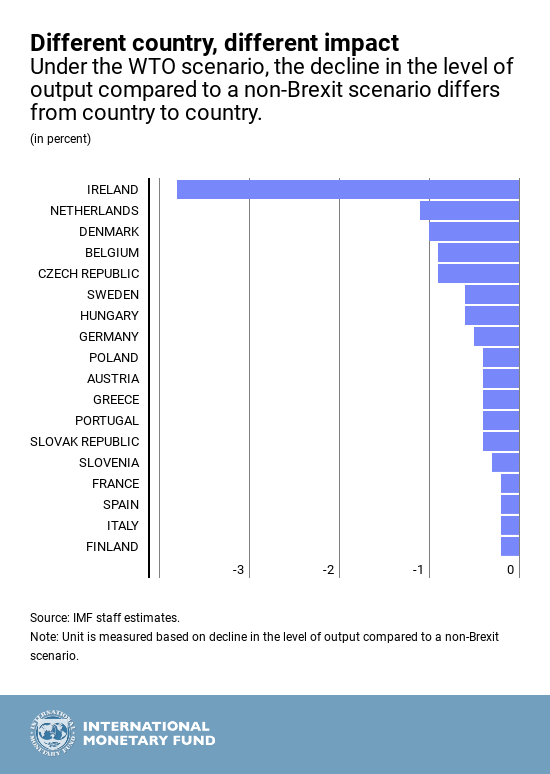
- WTO rules scenario (long run, relative to no-Brexit):
- EU-27 real output: lower by 0.5 percent.
- Ireland: output loss of 4 percent given substantial increases in both tariff and non-tariff barriers.
Scope and limitations noted by the study
- Focus: the study focuses entirely on the long-term impact after full adjustment to the new relationship.
- Exclusions:
- The study does not analyze the effect of uncertainty about the future relationship between the EU-27 and the U.K.
- The study does not analyze the transitional dynamics during the move to the new relationship.
- Timing: The ultimate consequences will take years to materialize and will depend on the eventual deal between the EU-27 and the U.K.
Source: The Long-Term Impact of Brexit on the European Union, August 10, 2018
Content in this bundle
- Country Report
References
- Português
- https://www.imf.org/wp-content/uploads/2018/08/BLOG-1024x600-EUR-blog-containor-exports-ships-Gerard-Bottino-Crowd-spark-Newscom-nzphotos080635.jpg
- https://www.imf.org/wp-content/uploads/2018/08/eng-august-1-brexit2-1.png
- https://www.imf.org/wp-content/uploads/2018/08/eng-august-1-brexit3-2.png
- UK economy must get more efficient
- UK Article IV
- UK and the IMF
- Brexit and the city