Give Today’s Children a Chance
IMF Blog, September 24, 2018
Source details
- Canonical URL
- Give Today’s Children a Chance
Other formats
Bibliographic details
- Authors: Christine Lagarde, Vitor Gaspar
- Published: September 24, 2018
The long road towards development
- Since 1990 alone, over a billion people have lifted themselves out of extreme poverty.
- Example contrasts:
- Sri (grandmother): annual income was US$1,500; high maternal and infant mortality risk described.
- Tuti (granddaughter): annual income of US$11,200; low risk of dying during childbirth or losing a child.
- Indonesia is progressing: government plans to fund education, health, and infrastructure by increasing tax revenues.
- Boosting revenues by an additional five percentage points of GDP over five years would ensure that Indonesia is on track to meet the SDGs by 2030.
- A contrasting case: Benin
- A girl born in Benin today has the same life expectancy as an Indonesian woman born 40 years ago.
- Benin has about the same income per capita as Indonesia did at that time.
- Even if Benin were to replicate Indonesia’s fast progress, it would be 2050 before Benin’s girls would reach the development standards available to Indonesian girls in 2030.
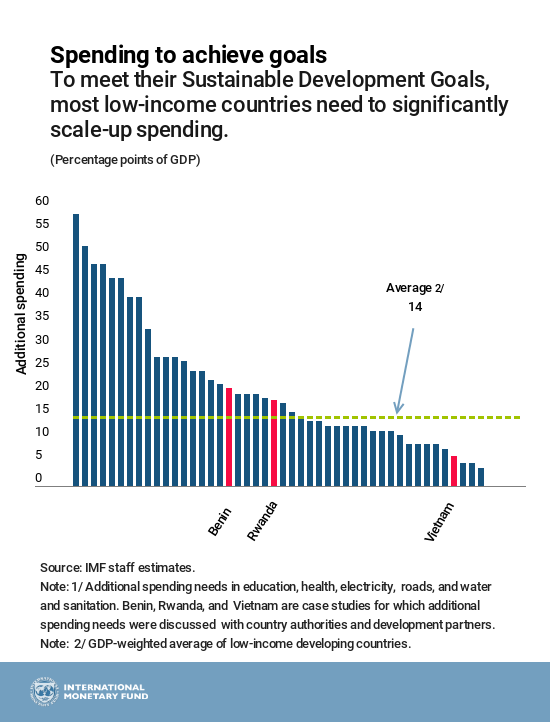
- Low-income countries need to increase spending in education, health, water and sanitation, roads, and electricity.
The big challenge: SDG financing gap for low-income developing countries
- The IMF analyzed five critical areas: education, health, water and sanitation, roads, and electricity.
- Estimated additional spending needs:
- Low-income developing countries need additional annual outlays of 14 percentage points of GDP on average.
- Across 49 low-income developing countries, additional spending needs amount to about US$520 billion a year.
- The US$520 billion a year estimate is stated as being in the same ballpark as other institutions’ estimates.
- Conclusion: Significant new spending is needed to give all children a fair chance by 2030.
Addressing SDG spending needs — policy priorities for countries
- Primary responsibility: low-income developing countries must own the SDG agenda and prioritize reforms to support sustainable, inclusive growth.
- Key country-level actions:
- Strengthen macroeconomic management.
- Enhance tax capacity.
- Tackle spending inefficiencies.
- Address corruption that undermines inclusive growth.
- Foster business environments where the private sector can thrive.
- Role of the IMF: work closely with member countries to actively support this reform agenda.
Revenue mobilization and external financing
- Domestic revenue:
- Many countries have substantial scope to raise tax revenues.
- An ambitious but reasonable target for many countries is to increase their tax ratio by 5 percentage points of GDP; achieving this will require strong administrative and policy reforms, with IMF and development partner support.
- Boosting tax revenues by this amount may be sufficient for emerging market economies such as Indonesia, but not for most low-income developing countries including Benin.
- External financing sources:
- Bilateral donors, international financial institutions, and philanthropists.
- Private investors can contribute, especially in infrastructure and clean energy, if business climates and reforms improve (examples include initiatives such as the Compact with Africa).
- International financial markets and lenders: borrowing on commercial terms is a double-edged sword if funding is not used for high-return projects.
- Debt risk:
- Forty percent of low-income developing countries are now assessed by the IMF and World Bank to be at high risk of debt distress or in debt distress.
- Debt distress would significantly disrupt economic activity and employment growth essential for SDG progress.
- Foreign aid:
- Foreign aid, preferably in the form of grants, remains crucial for poorer countries.
- Advanced economies can do more, including by moving towards 0.7 percent of gross national income in aid, and better target aid budgets to countries most in need.
- The piece notes budget constraints in advanced economies but emphasizes high economic returns on well-targeted aid in terms of poverty reduction, job creation, and improving security and stability.
Beyond spending — enabling conditions and global public goods
- Development and growth reinforce each other; sustaining stable growth requires broader enabling conditions.
- Critical global public goods and foundations for development:
- Geo-political stability.
- Open trade.
- Climate initiatives.
- Good governance, which requires tackling both supply and demand elements of corruption.
- Realizing the SDGs will require joint action by individual countries, international organizations, official donors and philanthropists, the private sector, and civil society.
Call to action
- Quoting Kofi Annan: “We have the means and the capacity to deal with our problems, if only we can find the political will.”
- Final appeal: summon the political will to give all children a chance by 2030.
Source: Give Today’s Children a Chance — IMF blog, Christine Lagarde and Vitor Gaspar, September 24, 2018.
Content in this bundle
- Fiscal Policy and Development — Spending Needs for Achieving Selected SDGs