Chart of the Week: Sub-Saharan Africa’s Growth—A Tale of Different Experiences
IMF Blog, December 13, 2018
Source details
- Canonical URL
- Chart of the Week: Sub-Saharan Africa’s Growth—A Tale of Different Experiences
Other formats
Bibliographic details
- Authors: The Editors
- Published: December 13, 2018
Overview
- Average growth for sub-Saharan Africa is expected to reach about 3.1 percent in 2018, up from 2.7 percent in 2017.
- Prior to 2014, the region enjoyed a sustained period of strong growth, averaging 5.6 percent during 2000–13.
- Since the 2014 commodity shock, regional growth dipped to 1.4 percent in 2016—the lowest level in more than two decades.
- One-third of the population of sub-Saharan Africa lives in countries where GDP per capita fell in 2017 and is expected to fall further in 2018 and 2019.
Growth and commodity dependence
- Key to the tale is the degree of dependence on commodities: the greater a country’s reliance on commodities, the more dramatic the impact of the 2014 commodity shock.
- The more dramatic the shock, the more challenging the recovery.
- Non-resource-intensive countries continued to enjoy high growth—at about 6 percent on average, notwithstanding a slight dip after 2014, supported by public infrastructure investment, good agricultural seasons, improved business environment and positive impact from lower oil prices.
Country experiences and heterogeneity
- Most oil exporters—countries like Angola and Nigeria—fell into recession after 2014, resulting in a dramatic “V-shaped” dip.
- Other resource-intensive countries, such as Ghana, South Africa and Zambia, faced difficulties due to falls in energy and metal prices and policy uncertainty.
- Since then, resource-intensive countries have seen some pickup but remain below pre-2014 levels; growth momentum has improved most notably for oil exporters, mainly in Nigeria, while remaining subdued in South Africa.
- A few countries continue to deal with security problems imposing a severe human and economic toll.
- In contrast, several countries including Ethiopia, Senegal, and Tanzania are poised to see their per capita income rise faster than would be expected given their level of income, due in part to strong public investment.
Medium-term outlook and jobs
- Over the medium term, and with current policies in place, growth is expected to improve to about 4 percent, or 1½ percent per capita.
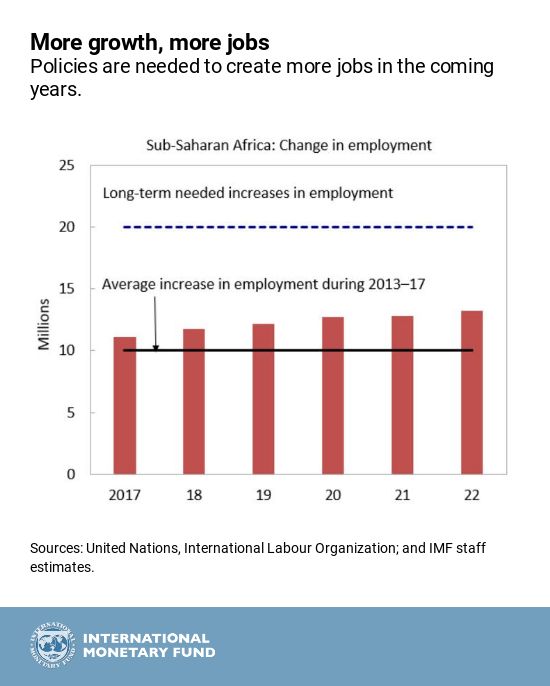
- This pace is described as respectable but not enough for the region to fully harness Africa’s demographic dividend, as illustrated in the original bar chart.
- The region needs to raise growth to create the additional 20 million jobs per year needed to absorb new entrants to labor markets.
- In general, most economies in sub-Saharan Africa are projected to grow far below the rates expected in countries from other regions at similar levels of per capita income; several large economies, including Nigeria and South Africa, are expected to see their real per capita income fall or stagnate over the medium term.
Policy implications and priorities
- Shielding the recovery and creating enough jobs to fully harness the demographic dividend will require strong, sustainable, and inclusive growth.
- Achieving this will demand policies to strengthen resilience and facilitate the reallocation of labor and capital into more productive sectors.
Source: Chart of the Week: Sub-Saharan Africa’s Growth—A Tale of Different Experiences (The Editors, December 13, 2018).
References
- https://www.imf.org/wp-content/uploads/2018/12/BLOG-1024x600-south-africa-mining-siphiwe-sibeko-newscom-rtrlten236207.jpg
- https://www.imf.org/wp-content/uploads/2018/12/eng-december-11-afrgrowth1.png
- https://www.imf.org/wp-content/uploads/2018/12/AFR-GROWTH-Chart-2.jpg
- Realizing the Potential of the G20 Compact with Africa
- Trade and Remittances Within Africa