How Much Should You Save for Retirement?
IMF Blog, January 16, 2019
Source details
- Canonical URL
- How Much Should You Save for Retirement?
Other formats
Bibliographic details
- Authors: David Amaglobeli, Era Dabla-Norris, Vitor Gaspar
- Published: January 16, 2019
Overview
- Research uses data from 80 countries to map public (government) and private savings over the next 30 years, given aging populations and the design of pension systems.
- Findings emphasize the interaction between saving and pension systems in an aging world.
- Public spending on pensions will increase by just over 2 percentage points of GDP by 2050, assuming unchanged policies.
Key findings on saving and aging
- Private saving trends drive the development of national saving.
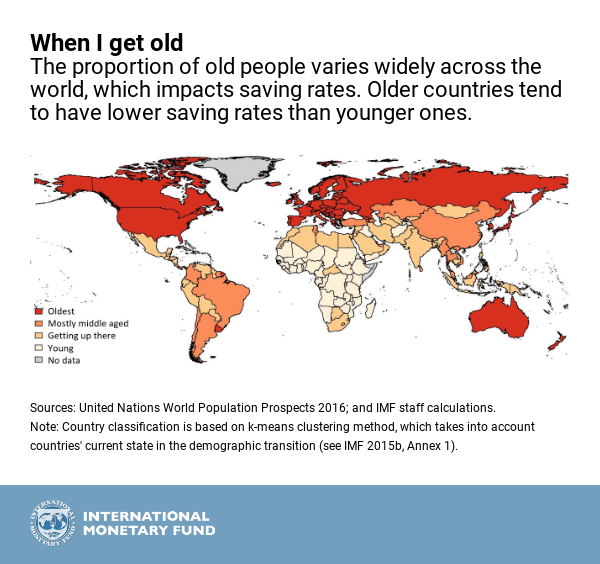
- In emerging markets and low-income developing countries collectively, relatively young populations lead to increased private saving.
- In aging advanced economies, private saving rates are expected to contract sharply.
- Public spending on pensions will increase in emerging markets and low-income countries where governments have yet to reform pension benefits.
- Generous public pensions lower:
- public saving—through more pension spending, and
- private saving—by reducing the incentive to save.
- Low public pensions can drive up private saving as households prepare for mainly self-funded retirement.
- Presence of dedicated pension saving accounts (e.g., Individual Retirement Accounts (IRAs) in the United States, 401(K) style accounts) is associated with higher private saving; in countries with such accounts, private saving is projected to increase, in contrast to countries without them.
Differences across example countries
- Russia and Australia are both aging and offer dedicated pension saving accounts; however:
- Pensions in Australia are less generous relative to national income, and
- Saving in Australia is projected to increase much faster than in Russia.
Policy simulations and what would allow similar living standards in retirement
- Two simulated policy actions that would allow people to retire at a living standard similar to today’s:
- A gradual increase in the retirement age from today’s average of 63 to 68 by 2050—at which time life expectancy is also projected to have increased by some 3 years.
- Saving an additional 6 percent of earnings each year.
Policy recommendations and considerations
- In countries with generous public pensions:
- Curtail early retirement or adjust the size of pension benefits to address future funding shortfalls.
- Governments can support retirement preparedness by:
- Stimulating development of financial sector instruments to encourage voluntary saving.
- Adopting policies to encourage people to lengthen their productive working lives.
- In emerging markets and low-income countries:
- Stimulate work in the formal sector to broaden pension coverage and sustainability.
- In countries where private saving is already very high and pension systems are weak (for example, China and Korea):
- Consider increasing pension system generosity to reduce precautionary saving, and to reduce inequality and old-age poverty.
- Taken together, these policies can:
- Damp projected declines in national saving,
- Improve the sustainability of pension systems, and
- Ensure people have decent living standards in retirement.
Source: How Much Should You Save for Retirement? — David Amaglobeli, Era Dabla-Norris, Vitor Gaspar, January 16, 2019
Content in this bundle
- 你该为退休储蓄多少?IMF博客; 2019年1月16日
- 退職後の生活に必要な貯蓄額 ダビッド・アマグロベリ エラ・ダブラ=ノリス ヴィトール・ガスパール著 2019年1月15日
- Сколько сбережений нужно для выхода на пенсию?