A Weakening Global Expansion Amid Growing Risks
IMF Blog, January 21, 2019
Source details
- Canonical URL
- A Weakening Global Expansion Amid Growing Risks
Other formats
Bibliographic details
- Authors: Gita Gopinath
- Published: January 21, 2019
Global outlook and key projections
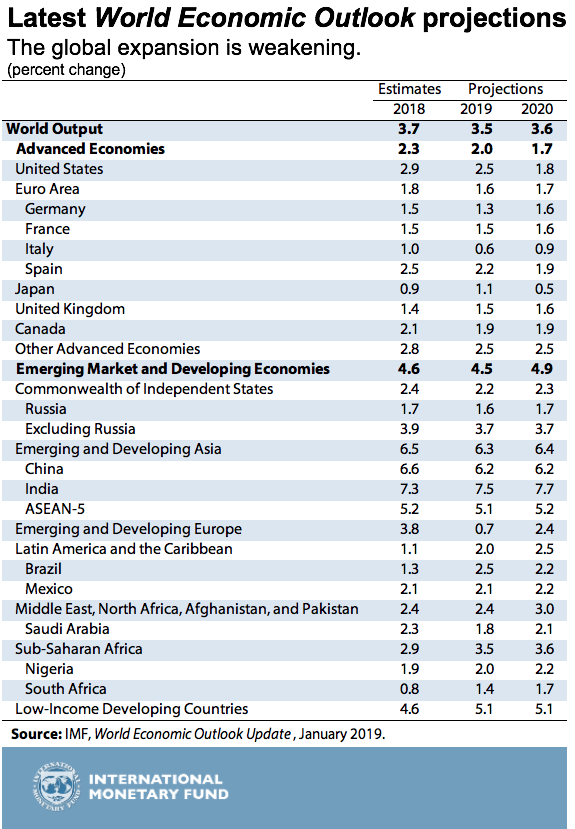
- Global growth projected at 3.5 percent in 2019 and 3.6 percent in 2020, 0.2 and 0.1 percentage point below last October’s projections.
- Global expansion is weakening somewhat faster than expected; risks of larger downward corrections are rising.
- Financial markets in advanced economies have become intertwined with trade tensions, tightening financial conditions and escalating risks to global growth.
Advanced economies: outlook and inflation
- Forecast for advanced economies: growth slows from 2.3 percent in 2018 to 2 percent in 2019 and 1.7 percent in 2020.
- Euro area revisions are the main reason for downward adjustments among advanced economies:
- Germany: production difficulties in the auto sector and lower external demand weigh on 2019 growth.
- Italy: sovereign and financial risks—and the connections between them—are adding headwinds to growth.
- United States: expansion continues but expected to decelerate with the unwinding of fiscal stimulus.
- Inflation dynamics:
- Core inflation is close to target in the United States where growth is above trend.
- Core inflation remains significantly below target in the euro area and Japan.
Emerging and developing economies
- Economic activity projected to tick down to 4.5 percent in 2019, with a rebound to 4.9 percent in 2020.
- Projection for 2019 lowered by 0.2 percentage point from October, mainly due to:
- A large projected contraction in Turkey amid policy tightening and adjustment to more restrictive external financing conditions.
- A significant downgrade to growth in Mexico in 2019–20, reflecting lower private investment.
- Projected rebound in 2020 driven by expected recovery in Argentina and Turkey.
- Headwinds include weaker capital flows following higher US policy rates and exchange rate depreciations; some pickup in inflation in emerging economies reversed toward the end of 2018.
Indicators of weakening momentum
- Trade and investment have slowed.
- Industrial production outside the United States has decelerated.
- Purchasing managers’ indices have weakened, flagging softening momentum.
- These cyclical forces that propelled broad-based growth since the second half of 2017 may be weakening faster than expected in October.
Main downside risks
- Escalation of trade tensions and worsening financial conditions:
- Higher trade uncertainty will further dampen investment and disrupt global supply chains.
- A more serious tightening of financial conditions is particularly costly given high levels of private and public sector debt.
- China: a faster-than-expected growth slowdown—especially if trade tensions continue—could trigger abrupt sell-offs in financial and commodity markets as in 2015–16.
- Europe: ongoing Brexit uncertainty and costly spillovers between sovereign and financial risk in Italy remain threats.
- United States: a protracted US federal government shutdown poses downside risks.
Policy priorities and recommendations
- Resolve trade disagreements cooperatively and quickly to reduce policy uncertainty rather than raising harmful barriers; implement the call of Group of Twenty leaders to reform the World Trade Organization in Buenos Aires.
- Where fiscal space is low, adjust fiscal policy in a growth-friendly manner to ensure public debt is on a sustainable path while protecting the most vulnerable.
- Monetary policy in advanced economies should continue to normalize carefully; major central banks should calibrate next steps in line with slowing momentum.
- Use macroprudential tools where financial vulnerabilities are building up.
- Across all economies, implement measures to boost potential output growth and enhance inclusiveness.
- Strengthen multilateral cooperation and ensure multilateral institutions like the IMF have adequate resources, given more limited policy space than in 2008.
Gita Gopinath, January 21, 2019