Cashing In: How to Make Negative Interest Rates Work
IMF Blog, February 5, 2019
Source details
- Canonical URL
- Cashing In: How to Make Negative Interest Rates Work
Other formats
Bibliographic details
- Authors: Ruchir Agarwal, Signe Krogstrup
- Published: February 5, 2019
Context and motivation
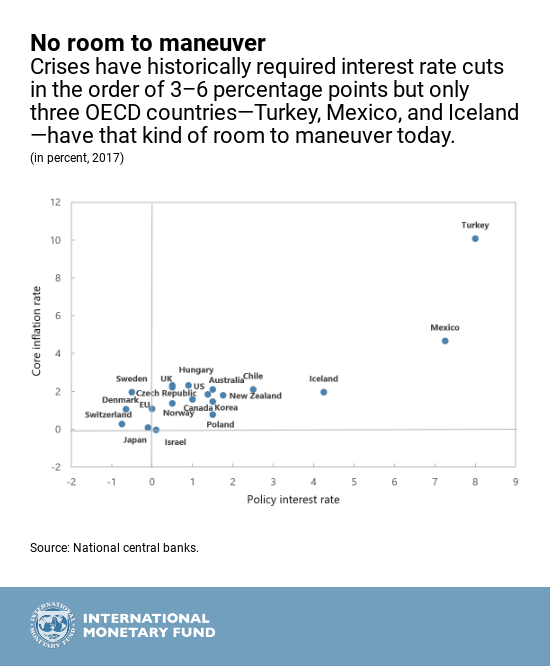
- Many central banks reduced policy interest rates to zero during the global financial crisis to boost growth.
- Ten years later, interest rates remain low in most countries.
- Severe recessions have historically required 3–6 percentage points cut in policy rates.
- If another crisis happens, few countries would have that kind of room for monetary policy to respond.
Constraints imposed by cash
- In a cashless world, there would be no lower bound on interest rates; a central bank could reduce the policy rate from, say, 2 percent to minus 4 percent to counter a severe recession.
- When cash is available, cutting rates significantly into negative territory becomes impossible because:
- Cash has the same purchasing power as bank deposits, but at zero nominal interest.
- Cash can be obtained in unlimited quantities in exchange for bank money.
- Therefore, instead of paying negative interest, one can simply hold cash at zero interest.
- Cash acts as an interest rate floor — a "free option" on zero interest.
- Because of this floor, central banks have resorted to unconventional monetary policy measures.
- The euro area, Switzerland, Denmark, Sweden, and other economies have allowed interest rates to go slightly below zero, which has been possible because taking out cash in large quantities is inconvenient and costly (for example, storage and insurance fees).
- Such policies have helped boost demand, but they cannot fully make up for lost policy space when interest rates are very low.
Dual local currency proposal to "break through zero"
- Core idea: divide the monetary base into two separate local currencies—cash and electronic money (e-money).
- E-money would be issued only electronically and would pay the policy rate of interest.
- Cash would have an exchange rate—the conversion rate—against e-money.
- Key mechanism: when setting a negative interest rate on e-money, the central bank would let the conversion rate of cash in terms of e-money depreciate at the same rate as the negative interest rate on e-money. The value of cash would thereby fall in terms of e-money.
- Illustrative example:
- Suppose your bank announced a negative 3 percent interest rate on your bank deposit of 100 dollars today.
- Suppose also that the central bank announced that cash-dollars would now become a separate currency that would depreciate against e-dollars by 3 percent per year.
- The conversion rate of cash-dollars into e-dollars would hence change from 1 to 0.97 over the year.
- After a year, there would be 97 e-dollars left in your bank account.
- If you instead took out 100 cash-dollars today and kept it safe at home for a year, exchanging it into e-money after that year would also yield 97 e-dollars.
- Expected behavioral and market outcomes:
- Shops would start advertising prices in e-money and cash separately.
- Cash would be losing value both in terms of goods and in terms of e-money.
- There would be no benefit to holding cash relative to bank deposits.
- The dual local currency system would allow the central bank to implement as negative an interest rate as necessary for countering a recession, without triggering any large-scale substitutions into cash.
Advantages and implementation considerations
- Pros:
- Would completely free monetary policy from the zero lower bound.
- Its introduction would reconfirm the central bank’s commitment to the inflation target, rather than raise doubts about it.
- Could be implemented with relatively small changes to central bank operating frameworks compared to alternative proposals.
- Cons and challenges:
- Would require important modifications of the financial and legal system.
- Fundamental questions pertaining to monetary law would have to be addressed and consistency with the IMF’s legal framework would need to be ensured.
- Would require an enormous communication effort.
- The pros and cons of the system are country specific and should be carefully compared to other proposals, such as higher inflation targets, for increasing monetary policy space in a low-interest environment.
Source: IMF blog post "Cashing In: How to Make Negative Interest Rates Work" by Ruchir Agarwal and Signe Krogstrup, February 5, 2019.
Content in this bundle
References
- IMF staff study
- https://www.imf.org/wp-content/uploads/2019/02/eng-september-5-negative-interest-rates.png
- https://www.imf.org/wp-content/uploads/2019/02/eng-september-5-negative-interest-rates2.png
- Building Defenses Against the Next Economic Downturn
- Ten Years After Lehman—Lessons Learned and Challenges Ahead
- A Dip into Subzero Policy Rates