How to Keep Corporate Power in Check
IMF Blog, April 3, 2019
Source details
- Canonical URL
- How to Keep Corporate Power in Check
Other formats
Bibliographic details
- Authors: Federico Dez, Romain Duval
- Published: April 3, 2019
Research scope and central question
- Study uses data for nearly 1 million companies from 27 advanced and emerging market economies since the early 2000s.
- Central question: Are concerns that rising power of big successful companies is behind sluggish economic growth and rising income inequality justified?
Rise in market power
- Preferred metric: price markup — how much a company charges compared with how much it costs to produce, expressed as a ratio.
- Findings on markups:
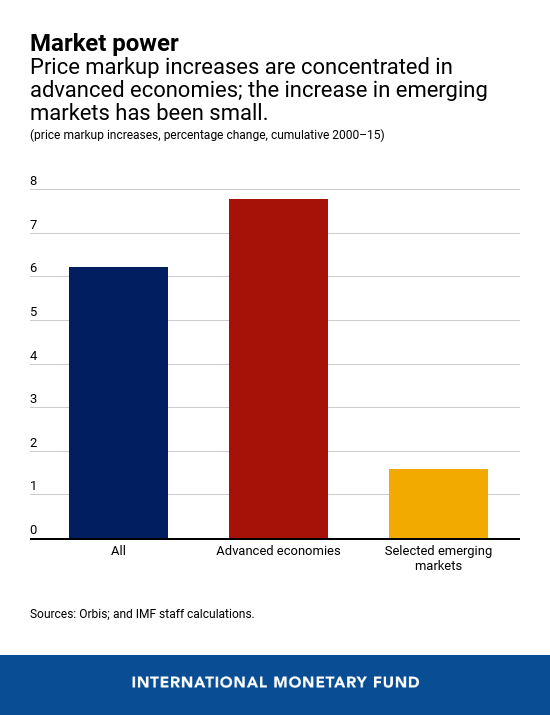
- Firms’ average markup has increased by close to 8 percent in advanced economies since 2000.
- Firms’ average markup has increased by less than 2 percent in the emerging economies covered by the analysis.
- Increase has taken place in most industries, largest among nonmanufacturing companies and in those that use digital technologies most intensely.
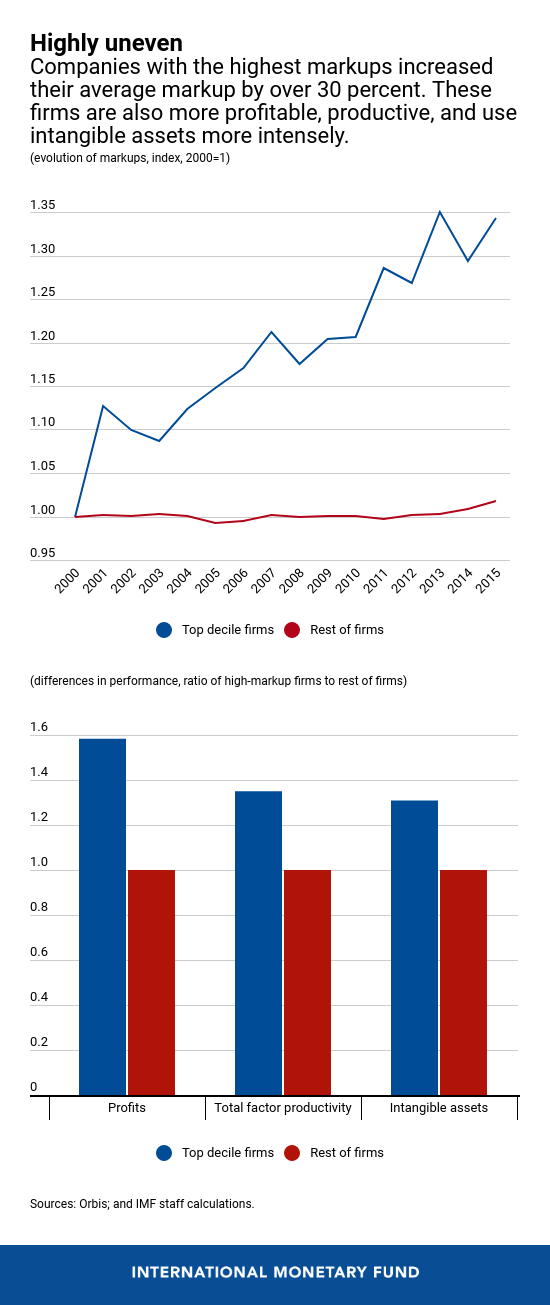
- Within industries, higher markups have been concentrated among a small fraction of companies.
- Companies with the highest markups (in the top 10 percent) raised theirs by over 30 percent since 2000, while markups have been largely flat among the remaining 90 percent.
- Characteristics of high-markup companies:
- On average about 50 percent more profitable than others.
- On average over 30 percent more productive than others.
- On average use 30 percent more intangible assets (like patents or software) than others.
- Most are rather small (can dominate niche markets), but the larger ones in the group account for most of the group’s total sales.
- Underlying forces:
- “Winner-takes-most” dynamic: more productive and innovative companies exploit proprietary intangible assets, network effects, and economies of scale.
- In the United States, high-markup companies have also expanded in size relative to low-markup counterparts, contributing to a larger increase in aggregate markups compared with Europe.
Worrisome macroeconomic and distributional trends
- Investment and growth:
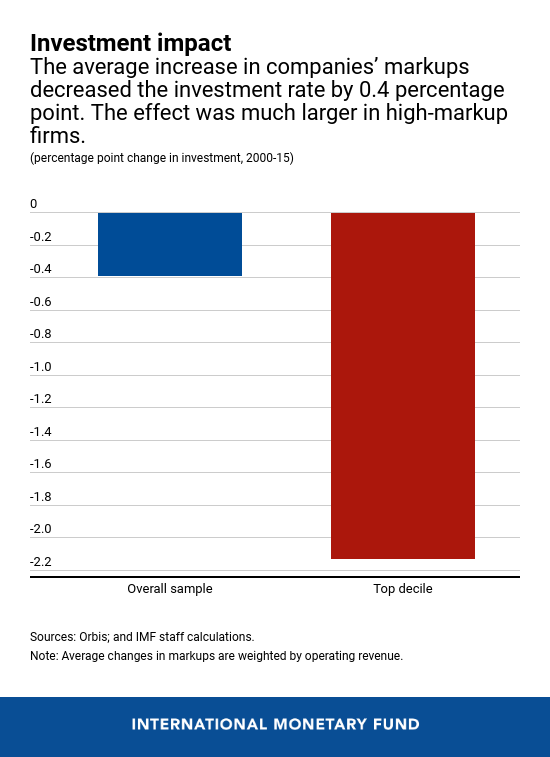
- Rising markups have contributed to some reduction in companies’ investment.
- Mechanism: higher market power → charge higher price and reduce output → reduce demand for capital → reduce investment.
- Effect was large for companies whose markups increased the most, but more moderate for the group of advanced economies.
- Counterfactual estimates: if markups had remained at their 2000 levels, the stock of capital goods today would be on average about 3 percent higher and GDP about 1 percent higher.
- By reducing investment, rising market power weakened aggregate demand and slightly amplified the impact of the 2008 financial crisis.
- Labor share and inequality:
- Increased market power since 2000 has accounted for at least 10 percent of the overall decline (0.2 out of 2 percentage points) in the share of national income paid to workers in advanced economies.
- This has contributed to greater earnings inequality between workers since rising capital income tends to mostly benefit high-income individuals.
Policies to strengthen competition (policy recommendations)
- Overarching policy goal: ensure a level playing field among all companies, including possible new ones, particularly in nonmanufacturing industries where markups have increased the most.
- Recommended actions:
- Lower domestic barriers to entry (for example, by reducing administrative burdens on start-ups).
- Reduce barriers to trade and foreign direct investment in services.
- Strengthen some features of competition law and policies—such as the role of market examinations.
- Reform corporate taxes so as to tax the excess returns on capital derived from market power.
- Ensure that intellectual property rights encourage groundbreaking innovations more than incremental ones.
- Rationale for action:
- Macro effects so far have been modest but could become increasingly negative if left unchecked (further declines in investment and labor income share, and potential stifling of innovation beyond a threshold).
- Technological forces driving market power do not justify policy inaction; weakening pro-competition policies could amplify winner-takes-most dynamics.
- Dominant companies that achieved market position through innovation may try to entrench positions by erecting barriers to entry, such as high customer switching costs.
Federico Díez, Romain Duval — April 3, 2019 — How to Keep Corporate Power in Check