The Impact of US-China Trade Tensions
IMF Blog, May 23, 2019
Source details
- Canonical URL
- The Impact of US-China Trade Tensions
Other formats
Bibliographic details
- Authors: Eugenio Cerutti, Gita Gopinath, Adil Mohommad
- Published: May 23, 2019
Overview
- US-China trade tensions have negatively affected consumers and many producers in both countries.
- The tariffs have reduced trade between the US and China, but the bilateral trade deficit remains broadly unchanged.
- While the impact on global growth is relatively modest at this time, the latest escalation could significantly dent business and financial market sentiment, disrupt global supply chains, and jeopardize the projected recovery in global growth in 2019.
- Publication date: May 23, 2019.
Evolution of trade in the US and China
- The raising of US tariffs to 25 percent on $200 billion of annual Chinese imports on May 10, together with the announced Chinese retaliation, marks the latest escalation.
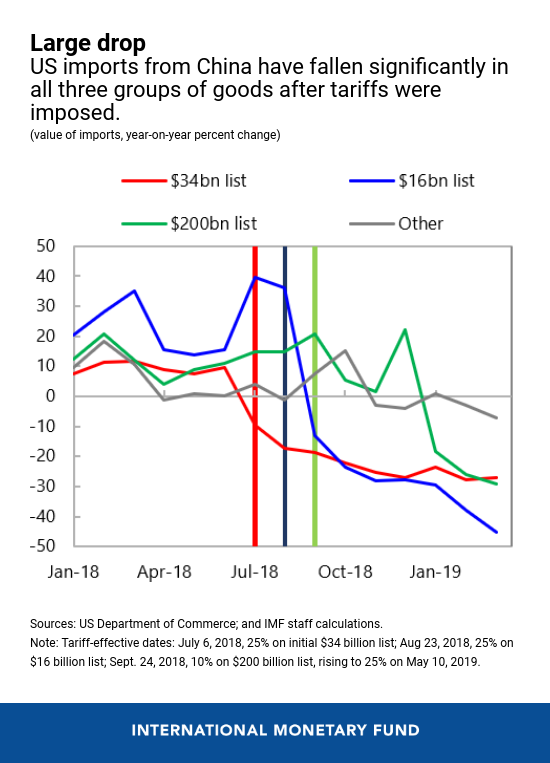
- In 2018, the US imposed tariffs sequentially on three “lists” of goods from China: first $34 billion of annual imports, then $16 billion more, and finally an additional $200 billion.
- US imports from China declined sharply in all three groups of goods on which tariffs were imposed.
- Where there was a delay between announcement and implementation of tariffs (the $16 billion and $200 billion lists) or plans to phase in an increase (the $200 billion list), import growth rose in advance of effective dates, consistent with importers front-loading inventories.
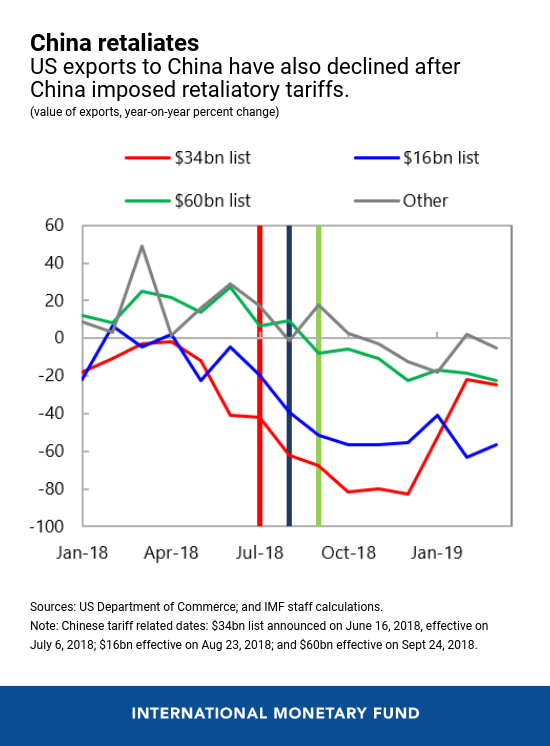
- As China imposed retaliatory tariffs, US exports to China also declined; US export growth to China has been generally weaker since the trade tensions began.
Effects on consumers
- Research using Bureau of Labor Statistics price data finds that tariff revenue collected has been borne almost entirely by US importers.
- There was almost no change in (ex-tariff) border prices of imports from China, and a sharp jump in post-tariff import prices matching the magnitude of the tariff.
- Some tariffs have been passed on to US consumers (example: washing machines); others have been absorbed by importing firms via lower profit margins.
- A further increase in tariffs will likely be similarly passed through to consumers.
- While the direct effect on inflation may be small, tariffs could lead to broader effects through higher prices for domestic competitors.
Effects on producers
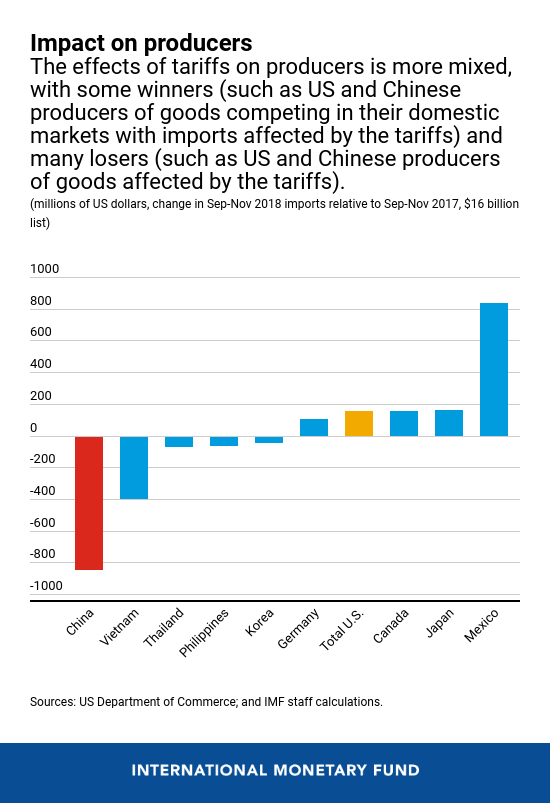
- Outcomes are mixed: some producers win (firms competing with affected imports, third-country exporters), many lose (producers of affected goods and firms using those goods as inputs).
- Trade diversion evidence:
- Aggregate bilateral US data suggests the decline in imports from China has been offset by increased imports from other countries.
- Example: After the $16 billion list was implemented in August, a sharp decline of nearly $850 million in imports from China was almost offset by about $850 million increase from Mexico, leaving overall US imports broadly unchanged.
- For Japan, Korea, and Canada, smaller increases in US imports are observed relative to levels in September-November 2017.
- Aggregate data may mask other factors (e.g., inventories); some products (photosensitive semiconductor devices) showed little or no change in imports from third countries.
- Market segmentation example:
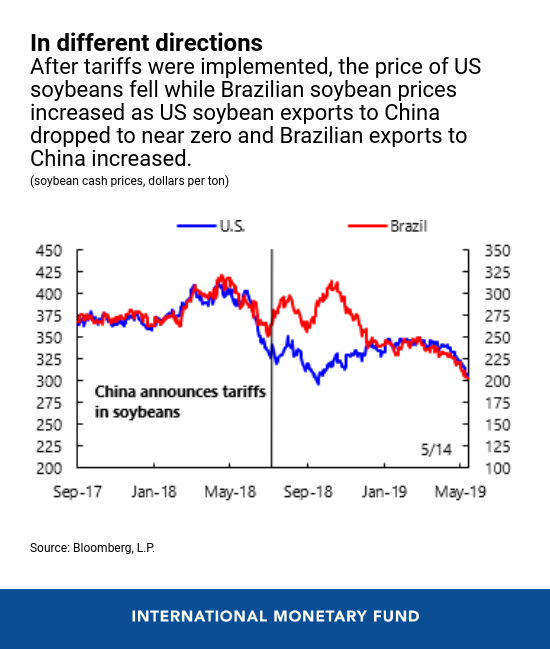
- US soybean exports to China fell dramatically in 2018 after Chinese tariffs; US soybean prices fell while Brazilian soybean prices increased as US exports to China dropped to near zero and Brazilian exports trended higher.
- Prices later re-converged and exports resumed to some extent, but US soybean farmers suffered while Brazilian farmers benefited.
- Financial market evidence:
- Equity price performance of US companies with high sales to China underperformed relative to US businesses exposed to other international markets after China’s $34 billion retaliation list was implemented.
- The performance gap narrowed at the beginning of 2019 with the trade truce, then reopened after the US tariff increase to 25 percent on the $200 billion list was announced on Twitter.
Macroeconomic effects
- Bilateral tariffs have had limited effect on the US-China bilateral trade balance; in 2018 the US trade deficit increased as imports from China rose (partly reflecting front-loading).
- As of March 2019, a small decline in the deficit can be observed, but US exports to China are also falling.
- Macroeconomic factors—relative aggregate demand and supply in partner countries and their underlying drivers—play a much bigger role than tariffs in determining bilateral trade balances.
- At the global level, the additional impact of the recently announced and envisaged new US-China tariffs, expected to extend to all trade between those countries, will subtract about 0.3 percent of global GDP in the short term, with half stemming from business and market confidence effects.
- These additional effects come on top of tariffs implemented in 2018.
- Further escalation (including in areas such as the auto industry) could:
- Further dent business and financial market sentiment.
- Negatively impact emerging market bond spreads and currencies.
- Slow investment and trade.
- Higher trade barriers would disrupt global supply chains, slow the spread of new technologies, lower global productivity and welfare, and make tradable consumer goods less affordable—harming low-income households disproportionately.
- The discussion frames 2019 as a delicate year for the global economy.
Source: The Impact of US-China Trade Tensions (May 23, 2019).
References
- Português
- https://www.imf.org/wp-content/uploads/2019/05/eng-may-21-chinatrade1.png
- https://www.imf.org/wp-content/uploads/2019/05/eng-may-21-chinatrade2-4.png
- https://www.imf.org/wp-content/uploads/2019/05/eng-may-21-chinatrade3.png
- https://www.imf.org/wp-content/uploads/2019/05/eng-may-21-chinatrade4.png
- https://www.imf.org/wp-content/uploads/2019/05/eng-may-21-chinatrade5.png
- https://www.imf.org/wp-content/uploads/2019/05/eng-may-21-chinatrade6-1.png
- macroeconomic factors
- https://www.imf.org/wp-content/uploads/2019/05/eng-may-21-chinatrade7.png
- World Economic Outlook
- World Economic Outlook