China Deepens Global Finance Links as It Joins Benchmark Indexes
IMF Blog, June 19, 2019
Source details
- Canonical URL
- China Deepens Global Finance Links as It Joins Benchmark Indexes
Other formats
Bibliographic details
- Authors: Sally Chen, Dimitris Drakopoulos, Rohit Goel
- Published: June 19, 2019
Overview / Background
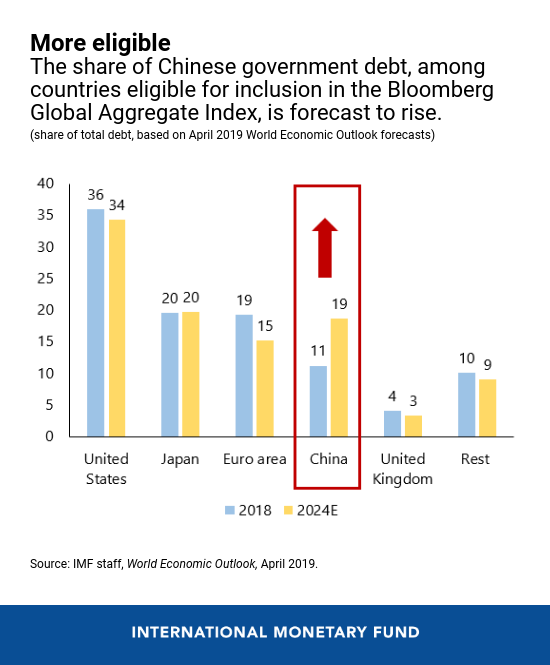
- China is entering the next stage of integration into global financial markets, driven by inclusion of Chinese stocks and bonds in a larger number of global financial-market indexes.
- Inclusion in benchmark indexes will prompt investment managers who track or aim to outperform these indexes to adjust portfolios to include Chinese securities, accelerating foreign portfolio flows and ownership.
Estimated inflows and index inclusion scenarios
- Bloomberg Barclays Global Aggregate Index inclusion (announced in April): local currency-denominated bonds issued by the central government and by state-owned policy banks.
- Assets tracking the Bloomberg Barclays index could total $2 trillion to $2.5 trillion.
- Assuming an expected weighting of 6 percent, China can expect to see an additional $150 billion of inflows by 2020.
- Wider index inclusion (FTSE and JP Morgan indexes plus Bloomberg Barclays and MSCI equity inclusion) could produce:
- Benchmark-driven portfolio inflows of as much as $450 billion, or 3 percent to 4 percent of GDP, in the next two to three years.
- Reasons these preliminary estimates may be conservative:
- More securities may become eligible for index inclusion (e.g., local government and corporate bonds).
- Currently, only government and policy bank bonds, which account for about 40 percent of the $12 trillion Chinese market, are included in a major global bond index.
- China’s onshore A-shares: only 20 percent of these will be included in the MSCI equity index by November 2019.
Drivers making Chinese bonds attractive
- Scale and characteristics cited as attractive to foreign investors:
- Large size of the local currency bond market.
- A+ credit rating.
- High yield relative to similarly rated sovereigns.
- Low correlation with other bond markets.
- Consequences:
- Some investors might hold more than benchmark target weights.
- Managers of central bank reserves and sovereign wealth funds, which have invested relatively little in Chinese assets, may increase allocations as liquidity and accessibility improve.
Implications for China
- Greater foreign investor participation may:
- Subject Chinese markets to greater scrutiny and stricter governance standards.
- Lead to improved market liquidity.
- Expand the range of instruments, including those for hedging foreign exchange risks, benefiting local and foreign investors.
- Recent portfolio flows and market access developments:
- Foreign ownership of Chinese government bonds quadrupled to almost 8 percent in the past five years.
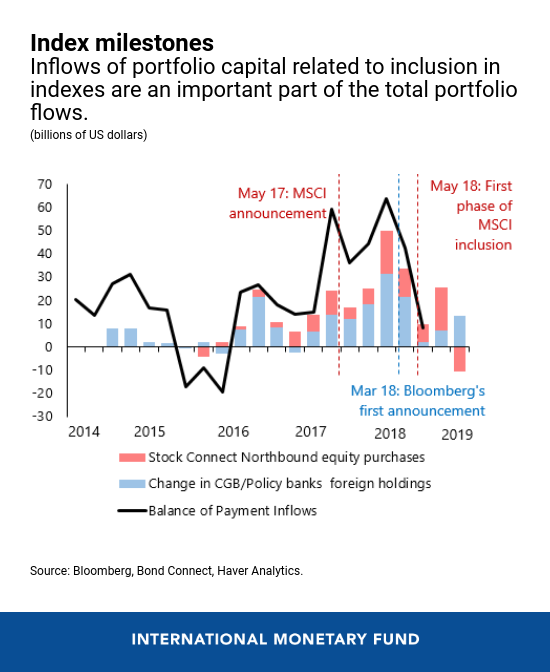
- Portfolio flows to China increased sharply after MSCI equity index inclusion in 2018: aggregate portfolio inflows rose to $159 billion in 2018 from $50 billion in 2016.
- Overseas purchases of A-shares through the Stock Connect program were especially strong in 2018.
- Bond flows from asset managers were relatively subdued ahead of Bloomberg index inclusion in April but have picked up recently.
- The number of investors registered and participating in the Bond Connect program increased sharply in the last 12 months, suggesting medium-term increases in flows.
Implications for other emerging markets
- Potential negative rebalancing effects:
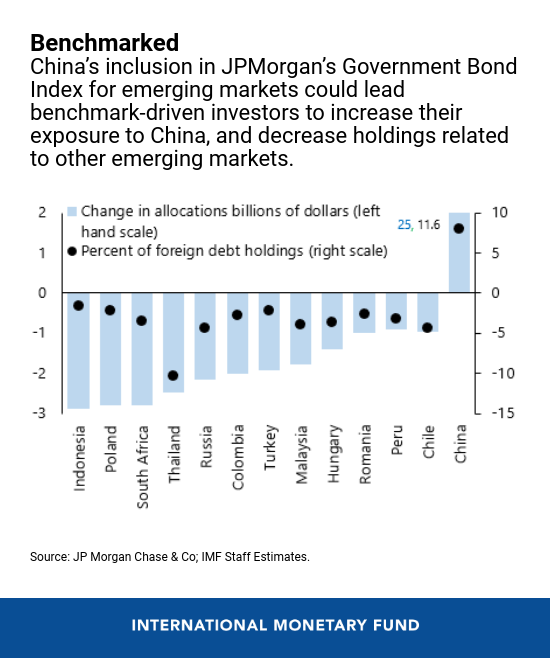
- Investors may reduce purchases of other emerging-market assets as they re-balance portfolios to reflect China’s inclusion.
- Emerging market government issuers could see an average reduction of allocations by $1 billion to $3 billion each.
- Effects could be larger for countries where benchmark-driven holdings represent a significant share of foreign debt.
- Broader systemic implications:
- Because benchmark-driven investors tend to be more sensitive to changes in global financial conditions, their greater role may cause external shocks to propagate to medium-sized emerging and frontier market economies faster than in the past.
- Offsetting factors:
- Benchmark-driven investors who actively manage portfolios can substantially deviate from benchmark weights to try to outperform the index, complicating a simple rebalancing story.
- Inclusion of China will likely alter risk-return characteristics of main indexes for emerging-market local currency debt: Chinese bonds have a better than average rating and lower yields, so the average index will have a relatively higher rating and lower yield.
Key statistics and figures (verbatim)
- Foreign ownership of Chinese government bonds quadrupled to almost 8 percent (past five years).
- Assets tracking the Bloomberg Barclays index could total $2 trillion to $2.5 trillion.
- Expected weighting: 6 percent.
- Additional inflows expected by 2020: $150 billion.
- Potential broader benchmark-driven inflows: as much as $450 billion, or 3 percent to 4 percent of GDP (next two to three years).
- Government and policy bank bonds account for about 40 percent of the $12 trillion Chinese market.
- Only 20 percent of onshore A-shares will be included in the MSCI equity index by November 2019.
- Aggregate portfolio inflows to China: $159 billion in 2018, $50 billion in 2016.
- Emerging market government issuers could see average reductions of allocations by $1 billion to $3 billion each.
Source: IMF blog post "China Deepens Global Finance Links as It Joins Benchmark Indexes" (June 19, 2019).
Content in this bundle
- World Bank Document
References
- 日本語
- https://www.imf.org/wp-content/uploads/2019/06/china1.png
- projections
- https://www.imf.org/wp-content/uploads/2019/06/china2.png
- Global Financial Stability Report
- https://www.imf.org/wp-content/uploads/2019/06/china3.png
- https://www.imf.org/wp-content/uploads/2019/06/China4.png
- Weak Spots in Global Financial System Could Amplify Shocks
- The Impact of US-China Trade Tensions
- Chart of the Week: China’s Digital Dividend