Growing Through Education in Nigeria
IMF Blog, June 24, 2019
Source details
- Canonical URL
- Growing Through Education in Nigeria
Other formats
Bibliographic details
- Authors: Vivian Malta, Monique Newiak
- Published: June 24, 2019
Key findings
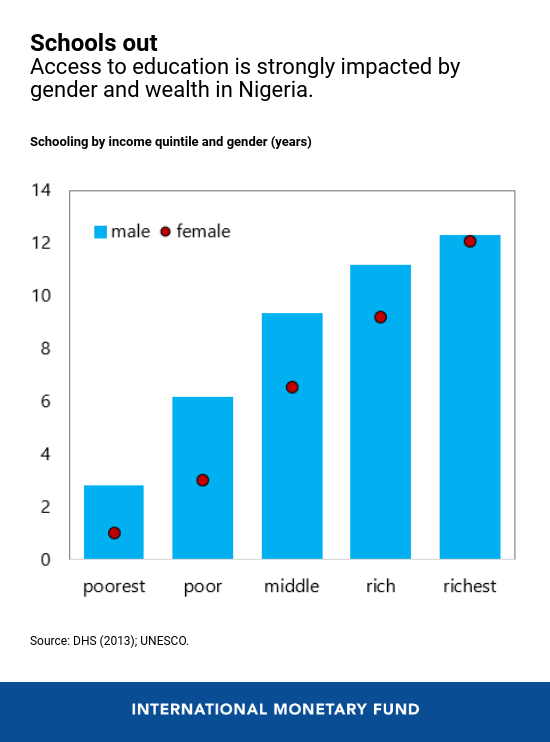
- A survey conducted by the Nigeria Bureau of Statistics finds that a girl born into a Nigerian family in the poorest fifth of society spends about 1 year in school.
- That 1 year is described as approximately a third of the already limited schooling enjoyed by, say, her brother.
- Access to education improves as a family gets richer, but gender inequality in education is entrenched and barely disappears for the richest 20 percent of households.
- Closing gender gaps in education across all income groups is projected to boost GDP by 5 percent in one generation.
- The same reform is projected to lower income inequality by 2¼ points as measured by the Gini coefficient.
Analysis and rationale
- Addressing educational gaps yields rapid and large benefits for children, their families, communities, and the country more broadly.
- Adequate funding for teachers and schools is necessary to raise the quality of education.
- Investments beyond the classroom—such as safe access to water and sanitation facilities—improve health and therefore learning opportunities, and give an extra boost to school attendance.
- Mobilizing revenue is critical to fund education and complementary investments; examples cited include comprehensive VAT reform and improved tax administration.
Policy recommendations
- Increase resources and enact structural changes to improve access to education and make it more equitable.
- Ensure adequate funding for teachers and schools to raise education quality.
- Invest in water and sanitation facilities to improve health and school attendance.
- Mobilize additional revenue through measures such as comprehensive VAT reform and improved tax administration to finance education and related investments.
- Advance legal reforms that require few additional resources but shape priorities, for example:
- Passing into law the Gender and Equal Opportunities Bill.
- Implementing a Children’s Rights Act.
- These legal changes would put equality of opportunity on the statute books and are expected to have a positive impact for generations to come.
Vivian Malta and Monique Newiak — June 24, 2019