Trade Balances Mostly Driven by Economic Forces, Not Tariffs
IMF Blog, July 10, 2019
Source details
- Canonical URL
- Trade Balances Mostly Driven by Economic Forces, Not Tariffs
Other formats
Bibliographic details
- Authors: The Editors
- Published: July 10, 2019
Key findings from IMF research
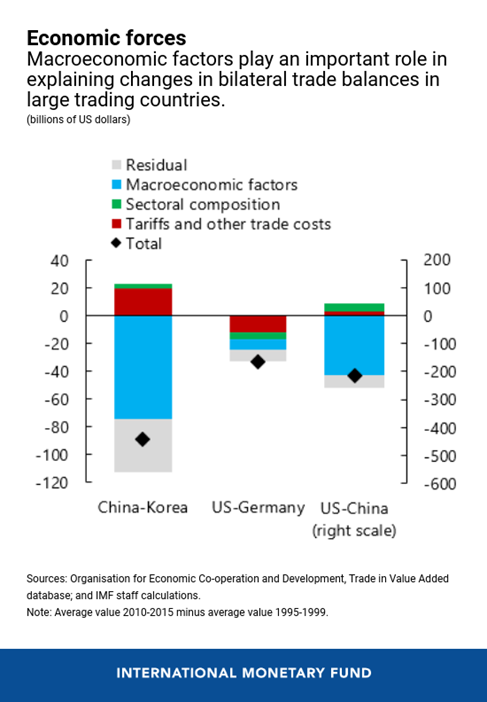
- Over the past two decades, most of the changes in bilateral trade balances were explained by macroeconomic factors.
- Macroeconomic factors include fiscal policy, demographics, and weak domestic demand; they may also include exchange rate policies and domestic supply-side policies, like subsidies to state-owned enterprises or to export sectors.
- Changes in tariffs played a much smaller role in influencing bilateral trade balances.
- The April World Economic Outlook chart quantifies contributions of: macroeconomic factors, tariffs, and production organization (the sectoral composition of countries’ production and demand) to changes in bilateral trade balances.
- Examples from the figure:
- Macroeconomic factors accounted for about 20 percent of the change in the US-Germany trade balance from 1995 to 2015.
- Macroeconomic factors accounted for over 95 percent of the change in the US-China trade balance from 1995 to 2015.
- Reciprocal tariff reductions offsetting each other and already low tariff levels in many countries help explain the small role of tariffs.
- Imposing a bilateral tariff on a trading partner is ineffective to address aggregate trade imbalances because consumers can switch demand to other trading partners that face no tariffs.
- Increases in tariffs would particularly hurt output, jobs, and productivity.
- The integrated nature of the current global trade system implies a sharp increase in tariffs would create ripple effects across countries and leave the world economy worse off.
Policy recommendations
- Continue to promote free and fair trade by undoing recently enacted tariffs and enhancing efforts to reduce existing barriers to trade.
- Avoid policies that distort the economy, such as:
- governments stimulating the economy with additional spending when demand is already strong, or
- heavily subsidizing exporting sectors,
that create excessive—and possibly unsustainable—imbalances.
Source: IMF blog post “Trade Balances Mostly Driven by Economic Forces, Not Tariffs”, The Editors, July 10, 2019.