Rebalancing the Global Economy: Some Progress but Challenges Ahead
IMF Blog, July 17, 2019
Source details
- Canonical URL
- Rebalancing the Global Economy: Some Progress but Challenges Ahead
Other formats
Bibliographic details
- Authors: Gita Gopinath
- Published: July 17, 2019
Overview and recent trends
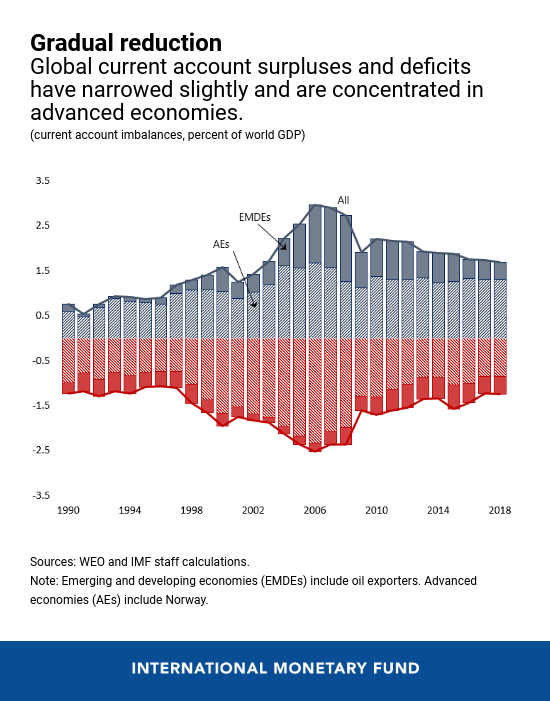
- Following the global financial crisis, overall current account surpluses and deficits fell from about 6 percent of global GDP in 2007 to about 3.5 percent in 2013.
- Global current account imbalances declined only slightly to 3 percent of world GDP in 2018.
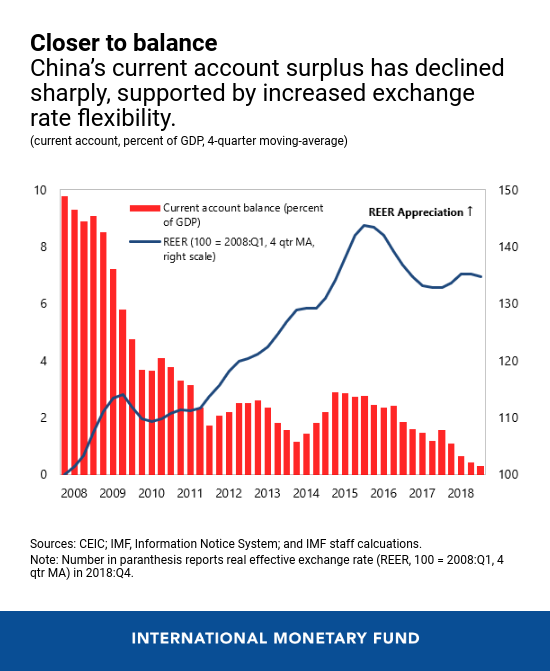
- Imbalances have rotated toward advanced economies and away from emerging economies, including China whose current account is now broadly in line with fundamentals.
- Trade actions and tensions have so far not significantly affected global current account imbalances, as trade has been diverted to other countries with lower or no tariffs.
- Despite narrowing of current account imbalances, stock imbalances (sum of countries’ net foreign assets and liabilities) continued to increase, reaching 40 percent of GDP in aggregate, a historical peak and four times larger than in the early 1990s.
- Gross external debt liabilities of sovereigns and corporates have risen sharply in some economies in recent years, supported by benign global financing conditions.
Risks from external imbalances
- External imbalances can be normal (e.g., young, fast growing economies borrowing from aging advanced economies) but can become risky if borrowing is too much or too rapid, creating vulnerability to sudden stops in capital flows.
- Sudden stops could negatively affect creditor economies through losses on their external assets.
- Using numerical tools and country-specific insights, about 35–45 percent of overall current account surpluses and deficits were estimated to be excessive in 2018.
- Excessive current account surpluses remained centered in the euro area (driven largely by Germany and the Netherlands) and in other smaller advanced Asian economies (Korea and Singapore).
- Excessive current account deficits remained concentrated in the United Kingdom, the United States, and some emerging market economies (Argentina and Indonesia).
- After many years of excess current account surpluses, China’s external position moved to become more broadly in line with fundamentals in 2018; this decline reflected structural factors, expansionary credit and fiscal policies, and greater exchange rate flexibility with associated real appreciation.
- Near-term risks from the current configuration of external imbalances are generally contained because current account deficits and debtor positions are largely concentrated in advanced economies that issue reserve currencies.
- An intensification of trade or geopolitical tensions—with negative repercussions for global growth and risk appetite—could affect economies highly dependent on foreign demand or external financing.
- Over the medium term, absence of corrective policies could entrench trade tensions; further increases in countries’ external debts in key countries could trigger costly disruptive adjustments with global spillovers.
Policy recommendations and adjustment strategies
- Both surplus and deficit countries must work together to reduce excess global imbalances in a manner supportive of global growth and stability.
- Many countries are near full employment and have limited fiscal room; governments need to carefully calibrate policies to achieve domestic and external objectives.
- Countries with excess current account deficits (e.g., the United Kingdom and the United States) should adopt or continue growth-friendly fiscal consolidation.
- Countries with excess current account surpluses (e.g., Germany and Korea) should use fiscal space to boost public infrastructure investment and potential growth.
- Carefully tailored and sequenced structural policies should play a more prominent role in tackling external imbalances while boosting domestic potential growth:
- Reforms that encourage investment and discourage excessive saving (for example through the removal of entry barriers or stronger social safety nets) would support external rebalancing in excess current account surplus countries.
- Reforms that improve productivity and workers’ skill base are appropriate to promote exports in countries with excess current account deficits.
- Even economies with external positions broadly in line with fundamentals (like China and Japan) need structural reforms that address domestic imbalances and prevent a resurgence of external imbalances; this includes facilitating competition in sectors like services.
- Exchange rate flexibility remains key to facilitating external adjustment, though its short-term benefits can be weakened by features such as integration into global value chains and trade invoicing in a dominant currency like the US dollar.
- Exchange rate flexibility may need to be supported with policies that bolster the export response, including improved access to credit and transportation infrastructure.
- All countries should avoid policies that distort trade, as they tend to come at the expense of global trade, investment, and growth.
- Surplus and deficit countries should work toward reviving international trade and strengthening the rules of the multilateral trading system that have served the global economy well over the past 75 years.
Key statistics and quantitative findings
- "About 6 percent of global GDP" (global surpluses and deficits in 2007).
- "About 3.5 percent" (global surpluses and deficits in 2013).
- "3 percent of world GDP in 2018" (global current account imbalances).
- "40 percent of GDP" (stock imbalances peak).
- "Four times larger than in the early 1990s" (comparison of stock imbalances).
- "About 35–45 percent" (share of overall current account surpluses and deficits estimated to be excessive in 2018).
- Specific countries cited for excessive surpluses: Germany, the Netherlands, Korea, Singapore.
- Specific countries cited for excessive deficits: the United Kingdom, the United States, Argentina, Indonesia.
- Mention of trade system durability: "past 75 years."
Gita Gopinath, July 17, 2019 — IMF Blog.
References
- 日本語
- Português
- External Sector Report
- earlier blog
- https://www.imf.org/wp-content/uploads/2019/07/eng-july-9-exr1.png
- https://www.imf.org/wp-content/uploads/2019/07/eng-july-9-exr2.png
- cause for concern
- https://www.imf.org/wp-content/uploads/2019/07/eng-july-9-exr3.png
- https://www.imf.org/wp-content/uploads/2019/07/eng-july-9-exr4.png
- Economic Forces, not Tariffs Drive Changes in Trade Balances