Monitoring Global Financial Stability
IMF Blog, August 26, 2019
Source details
- Canonical URL
- Monitoring Global Financial Stability
Other formats
Bibliographic details
- Authors: Tobias Adrian, Dong He, Nellie Liang, Fabio Natalucci
- Published: August 26, 2019
Motivation and background
- “It’s awful. Why did nobody see it coming?” asked Queen Elizabeth II in November 2008 during a visit to the London School of Economics, reflecting widespread bewilderment after the Global Financial Crisis.
- Ten years on, forecasting financial instability remains difficult, but understanding of how financial vulnerabilities amplify shocks and hurt output and employment has improved.
Framework overview: two-part approach
- The framework combines:
- A bottom-up monitoring matrix of indicators that maps types of vulnerabilities across types of lenders and borrowers in the financial system.
- A top-down summary measure of financial stability risk called “Growth at Risk” (GaR), which links the entire distribution of forecast GDP growth to financial conditions.
How it works (mechanics and transmission)
- Cyclical financial stability risks rise as lenders and borrowers increase risk-taking in response to loose financial conditions.
- Greater collective risk-taking produces a buildup of financial vulnerabilities, such as:
- inflated asset valuations;
- greater leverage and funding mismatches of banks and other financial firms;
- greater indebtedness among nonfinancial borrowers, including households, businesses, and governments.
- Vulnerabilities amplify shocks and lead to tighter financial conditions and reduced economic growth; the process is mutually reinforcing as vulnerable financial firms are forced to reduce debt when asset prices fall, causing further declines in asset prices and economic growth.
The bottom-up monitoring matrix
- Purpose: provide snapshots of the degree of vulnerabilities for lenders and borrowers at different points in time.
- Illustration: shows high vulnerabilities of banks and nonbank financial firms globally and high indebtedness of households in many countries at the time of the crisis, and substantially stronger positions now.
- The matrix is intended to evolve over time to capture vulnerabilities that may emerge in new forms.
The top-down measure: Growth at Risk (GaR)
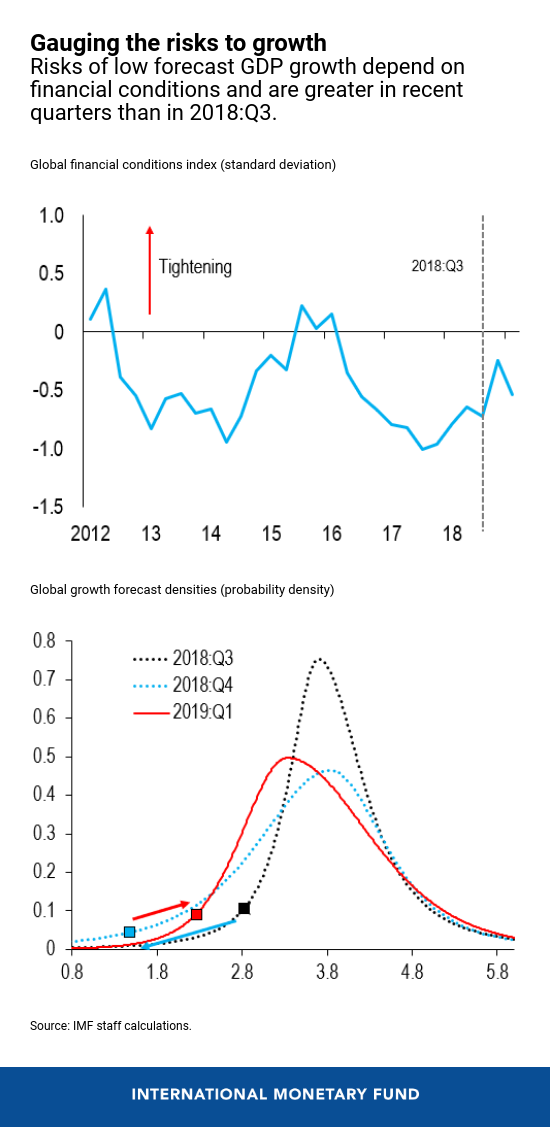
- GaR measures downside risks to projected GDP growth depending on financial conditions.
- Key innovation: links the entire distribution of forecast GDP growth to financial conditions, capturing the underlying price of risk in the economy.
- Conceptual point: When forecasting GDP growth, consider probabilities — not only expected growth but risks to expected growth.
- Example timing: Global financial conditions for the two quarters before the April 2019 GFSR were tighter than in 2018:Q3; as a result, the downside risks to forecast year-ahead GDP growth increased somewhat.
- Ongoing work: incorporate vulnerabilities to estimate GaR more fully.
Volatility paradox
- Looser financial conditions can raise growth and reduce volatility in the near term, but they can increase volatility in the medium term because vulnerabilities build up in response to looser financial conditions. This is called the volatility paradox.
Measuring financial stability risks for policymaking
- Complementarity:
- GaR provides a summary indicator of financial stability risks comparable to historical levels of risk to judge severity of potential downsides.
- Granular monitoring of specific vulnerabilities provides nuance to GaR estimates and highlights potential targets for macroprudential policies.
- Applications:
- The monitoring framework could improve indicators of financial conditions and vulnerabilities to estimate GaR for the global economy, regions, or countries.
- Useful for both multilateral and bilateral surveillance by the IMF.
- Macroprudential policy monitoring:
- The framework supports monitoring of macroprudential policy implementation across countries.
- The IMF has launched a new annual survey on the use of macroprudential policies, and policies can be mapped to the financial vulnerabilities in the matrices.
Policy implications and recommendations (implied by framework)
- Systematic, regular assessments of financial stability risks should be formalized and incorporated into decision-making frameworks for monetary policy and regulatory policy, rather than applied only when financial risks are already very high.
- Use GaR alongside granular vulnerability monitoring to:
- Judge severity of downside risks to output;
- Identify targets for macroprudential intervention;
- Inform multilateral and bilateral surveillance and policymaking.
- Adapt the monitoring matrix over time to detect vulnerabilities that emerge in new forms.
Source: Monitoring Global Financial Stability, Tobias Adrian, Dong He, Nellie Liang, Fabio Natalucci, August 26, 2019.