New Index Tracks Trade Uncertainty Across the Globe
IMF Blog, September 9, 2019
Source details
- Canonical URL
- New Index Tracks Trade Uncertainty Across the Globe
Other formats
Bibliographic details
- Authors: Hites Ahir, Nicholas Bloom, Davide Furceri
- Published: September 9, 2019
Overview
- Rising trade uncertainty is cited as a driving factor for “sluggish global growth” in the current issue of the IMF’s World Economic Outlook.
- The new World Trade Uncertainty (WTU) index finds trade uncertainty is surging not only in the United States and China but also in many other countries.
How we built it (methodology)
- Coverage: 143 countries starting in 1996.
- Source: Economist Intelligence Unit (EIU) country reports; chosen for standardized process, structure, and topical focus on economic and political developments.
- Measurement approach:
- Tally number of times “uncertain,” “uncertainty,” and “uncertainties” are mentioned in proximity to trade-related words.
- Trade-related target words: protectionism, North American Free Trade Agreement, tariff, trade, United Nations Conference on Trade and Development, World Trade Organization.
- For each country and quarter, raw counts are scaled by the total number of words in each report to make the WTU index comparable across countries.
- Interpretation: An increase in the index indicates that trade uncertainty is rising, and vice versa.
Global trends and timeline
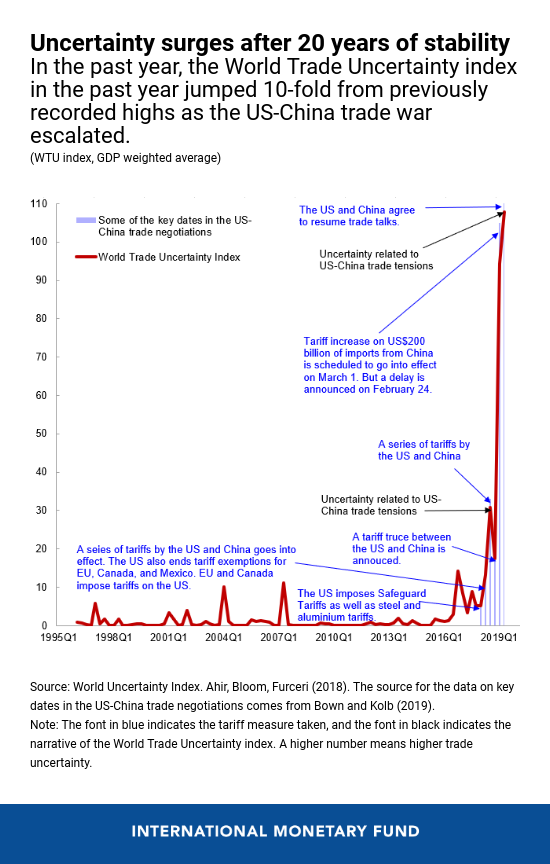
- The index was stable at low levels for about 20 years, then rose sharply.
- Increased uncertainty detected starting around the third quarter of 2018, coinciding with a series of tariff increases by the United States and China.
- Declined in the fourth quarter of 2018 as US and Chinese officials announced a deal to halt escalation of tariffs at the G-20 meeting in December in Buenos Aires.
- Significantly spiked again in the first quarter of 2019 following a substantial expansion of American tariffs on imports from China on March 1.
Economic impact
- Based on the authors’ estimates, the increase in trade uncertainty observed in the first quarter of 2019 could be enough to reduce global growth by up to 0.75 percentage point in 2019.
- The authors find that increases in uncertainty foreshadow significant output declines.
Geographic and income-group patterns
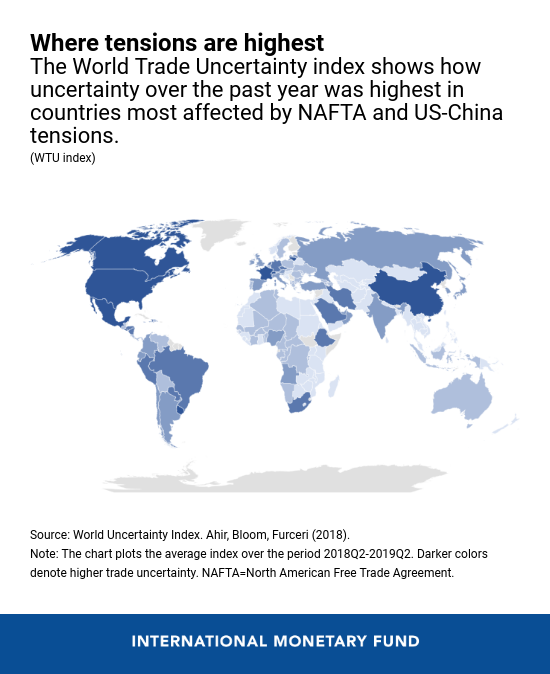
- Elevated trade uncertainty is recorded beyond the US and China, including key US trading partners: Canada, Mexico, Japan, and large European economies.
- Regions most affected by the recent rise in the uncertainty index:
- Western Hemisphere (felt the most)
- Asia-Pacific (second most)
- Europe (third)
- Regions with moderately low trade uncertainty: Middle East, Central Asia, Africa.
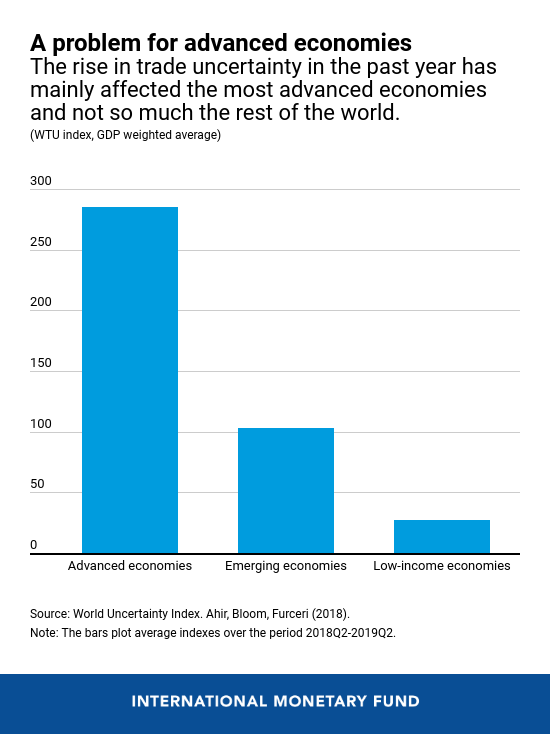
- By income group:
- Advanced economies show the highest trade uncertainty.
- Emerging markets show the next-highest levels.
- Low-income economies: trade uncertainty remains, on average, at low levels.
Index context
- The WTU index is part of a larger project to measure uncertainty around the world.
- The WTU index is one of the components of the World Uncertainty Index (WUI).
Source: New Index Tracks Trade Uncertainty Across the Globe — Hites Ahir, Nicholas Bloom, Davide Furceri; September 9, 2019.
References
- sluggish global growth
- World Economic Outlook
- https://www.imf.org/wp-content/uploads/2019/09/eng-august-21-wtui1.png
- https://www.imf.org/wp-content/uploads/2019/09/eng-august-21-wtui.png
- https://www.imf.org/wp-content/uploads/2019/09/eng-august-21-wtui3.png
- https://www.imf.org/wp-content/uploads/2019/09/eng-august-21-wtui4.png