Voting on Gender Parity
IMF Blog, September 17, 2019
Source details
- Canonical URL
- Voting on Gender Parity
Other formats
Bibliographic details
- Authors: Rasmane Ouedraogo
- Published: September 17, 2019
Overview
- Author: Rasmane Ouedraogo
- Date: September 17, 2019
- Context: Electoral violence occurs in many African countries, with thousands killed and displaced during election cycles.
- Near-term risk: Over the next year and a half, Presidential elections are scheduled in thirteen sub-Saharan African countries, raising fears that, as in the past, violent incidents or conflict may erupt again.
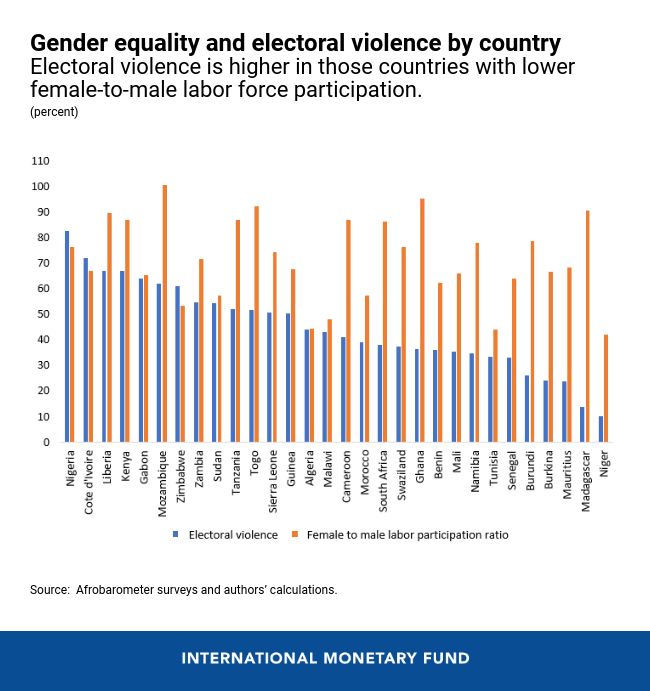
Chart insight and empirical finding
- Nearly half the individuals surveyed say that they fear becoming a victim of electoral violence.
- That figure declines by a quarter if the female-to-male labor force participation ratio increases by 5 percent points.
- Interpretation presented: Women’s participation in the workforce could make election-related violence less likely in Africa.
Analysis and rationale
- Any kind of exclusion is described as “suboptimal.”
- Women are framed as crucial partners in generating social cohesion and political legitimacy.
- Women’s participation in the workforce and at different levels of decision-making is said to help ensure that more and diverse members of the population are heard, and that those voices are engaged in electoral violence prevention and peacemaking.
- Current gap: The gender gap is very large in some African nations; women are still largely absent from peace processes and decision-making circles.
- Structural inequality in Africa is identified as a factor that could exacerbate electoral violence and its escalation.
Policy recommendations
- African leaders should pay more attention to gender inequality.
- Adopt appropriate policies to ensure equal opportunities for all citizens.
- Provide women the voice they deserve to harness the potential win-win of reduced electoral violence and increased social cohesion.
Source: Voting on Gender Parity — IMF blog, September 17, 2019