Lower for Longer: Rising Vulnerabilities May Put Growth at Risk
IMF Blog, October 16, 2019
Source details
- Canonical URL
- Lower for Longer: Rising Vulnerabilities May Put Growth at Risk
Other formats
Bibliographic details
- Authors: Tobias Adrian, Fabio Natalucci
- Published: October 16, 2019
Overview
- The pace of global economic activity remains weak, and financial markets expect rates to stay lower for longer than anticipated in early 2019.
- Financial conditions have eased further, helping contain near-term downside risks and supporting the global economy.
- Loose financial conditions, however, encourage investors to take more chances in a quest for higher returns, keeping risks to financial stability and growth high in the medium term.
- The Global Financial Stability Report highlights elevated vulnerabilities in the corporate and non-bank financial sectors in several large economies that could amplify the impact of shocks (for example, an intensification of trade tensions or a no-deal Brexit).
Recent market developments and scope
- Since April, global financial markets have been buffeted by twists and turns of trade tensions and significant policy uncertainty, weakening business sentiment and economic activity.
- Central banks, including the European Central Bank and the Federal Reserve, have eased policy in response.
- About 70 percent of economies, weighted by GDP, have adopted a more accommodative monetary stance.
- There has been a sharp decline in longer-term yields; in some major economies, interest rates are deeply negative.
- The amount of government and corporate bonds with negative yields has increased to about $15 trillion.
Elevated vulnerabilities — corporate sector
- Corporations in eight major economies are taking on more debt, and their ability to service it is weakening.
- Definition: "Corporate debt-at-risk" = debt owed by firms unable to cover interest expenses with earnings.
- Under a material economic slowdown—one that is as half as severe as the global financial crisis of 2007-08—corporate debt-at-risk could rise to $19 trillion.
- $19 trillion is almost 40 percent of total corporate debt in the economies studied (which include the United States, China, and some European economies).
- Recommended actions for corporate sector vulnerabilities:
- Stricter supervisory and macroprudential oversight.
- Targeted stress testing of banks.
- Prudential tools for highly levered firms.
Elevated vulnerabilities — non-bank financial institutions and institutional investors
- Vulnerabilities among nonbank financial institutions have risen since April and are now elevated in 80 percent of economies, by GDP, with systemically important financial sectors — a level similar to the height of the global financial crisis.
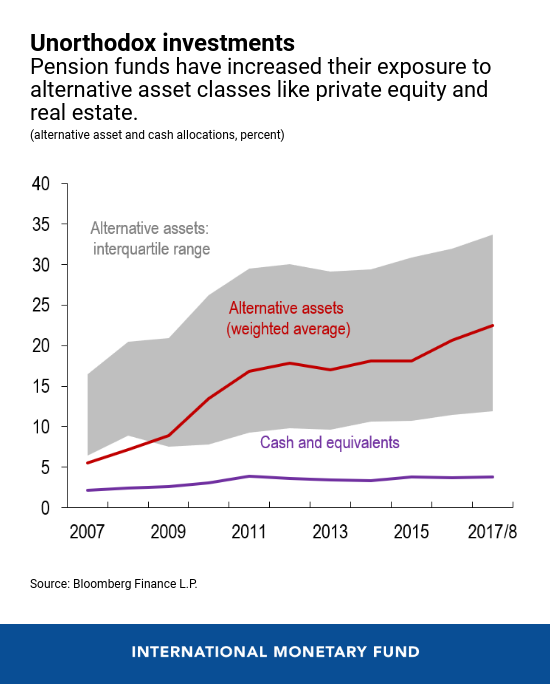
- Very low rates have prompted institutional investors (insurance companies, pension funds, and asset managers) to reach for yield and take on riskier and less liquid securities, including increased pension fund exposure to private equity and real estate.
- Potential consequences:
- Similarities in portfolios of investment funds could amplify a market sell-off.
- Illiquid investments by pension funds could constrain their traditional stabilizing role in markets.
- Cross-border investments by life insurers could provoke spillovers across markets.
- Recommended actions for institutional investors:
- Strengthened oversight and enhanced disclosures.
- Stepped-up efforts to mitigate leverage and other balance-sheet mismatches.
Emerging and frontier market vulnerabilities
- External debt is rising among emerging and frontier economies as they attract capital flows from advanced economies with lower interest rates.
- Median external debt has risen to 160 percent of exports from 100 percent in 2008 among emerging market economies.
- A sharp tightening in financial conditions and higher borrowing costs would make it harder for these economies to service their debts.
- Recommended actions for emerging and frontier markets:
- Prudent sovereign-debt management practices and frameworks.
Asset valuations and systemic risk
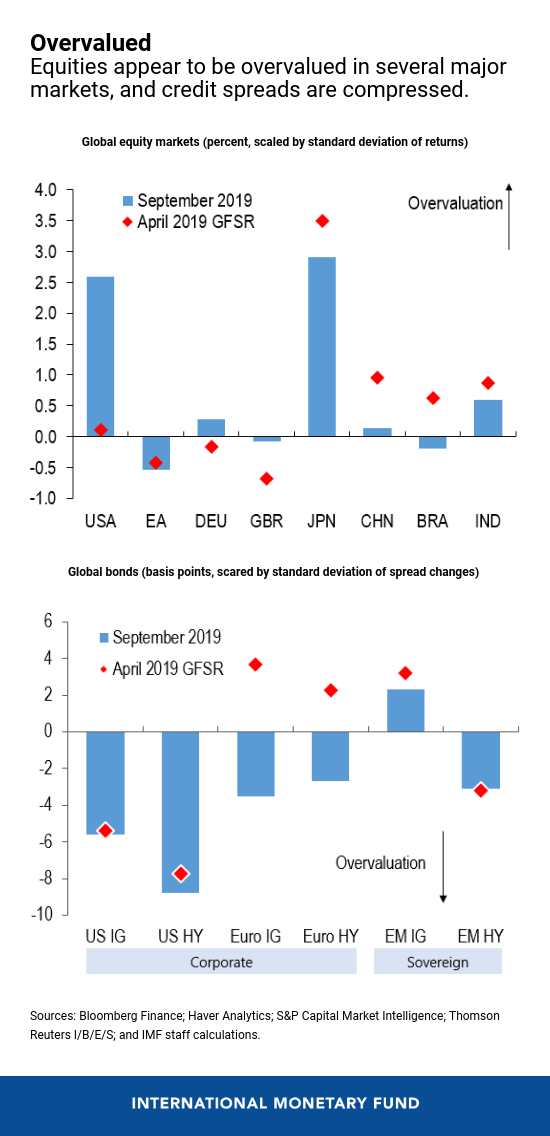
- Stretched asset valuations in some markets contribute to financial stability risks:
- Equity markets appear to be overvalued in the United States and Japan.
- In major bond markets, credit spreads also seem to be too compressed relative to fundamentals.
- A sharp, sudden tightening in financial conditions could unmask these vulnerabilities and put pressures on asset price valuations.
Policy dilemma and imperative
- Policymakers face a dilemma:
- Keep financial conditions easy to counter a deteriorating economic outlook.
- Guard against a further buildup of vulnerabilities that could threaten medium-term growth.
- With financial conditions still easy so late in the cycle and vulnerabilities building, the report urges quick policy action to avoid putting growth at risk in the medium term.
- The report highlights deploying and developing, as needed, new macroprudential tools for non-bank financial firms.
Source: Tobias Adrian and Fabio Natalucci, "Lower for Longer: Rising Vulnerabilities May Put Growth at Risk", October 16, 2019.
References
- Global Financial Stability Report
- https://www.imf.org/wp-content/uploads/2019/10/eng-october-1-gfsrch1-1-1.png
- https://www.imf.org/wp-content/uploads/2019/10/eng-october-10-_gfsrch1-2.png
- https://www.imf.org/wp-content/uploads/2019/10/eng-october-1-gfsrch1-3.png
- https://www.imf.org/wp-content/uploads/2019/10/eng-october-2-gfsrch1-4.png
- https://www.imf.org/wp-content/uploads/2019/10/eng-october-1-gfsrch1-5.png
- https://www.imf.org/wp-content/uploads/2019/10/eng-october-1-gfsrch1-6-1.png
- Monitoring Global Financial Stability
- Mapping the World’s Financial Weak Spots
- The Financial System Is Stronger, but New Vulnerabilities Have Emerged in the Decade Since the Crisis