For Venezuela’s Neighbors, Mass Migration Brings Economic Costs and Benefits
IMF Blog, November 21, 2019
Source details
- Canonical URL
- For Venezuela’s Neighbors, Mass Migration Brings Economic Costs and Benefits
Other formats
Bibliographic details
- Authors: Emilio Fernandez Corugedo, Jaime Guajardo
- Published: November 21, 2019
Overview
- The world’s newest migration crisis is unfolding in Latin America due to Venezuela’s economic collapse and humanitarian crisis.
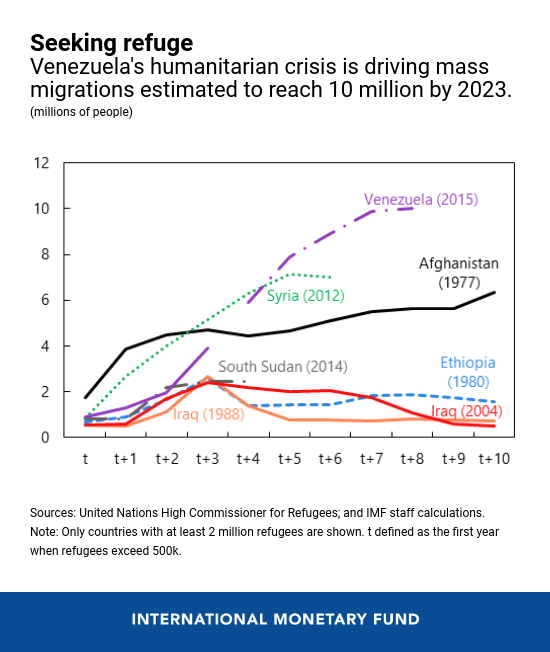
- According to the Response for Venezuelans (a joint International Organization for Migration and UNHCR platform), the total number of migrants leaving Venezuela reached about 4.6 million in November 2019—with about 3.8 million settled in Latin America and the Caribbean.
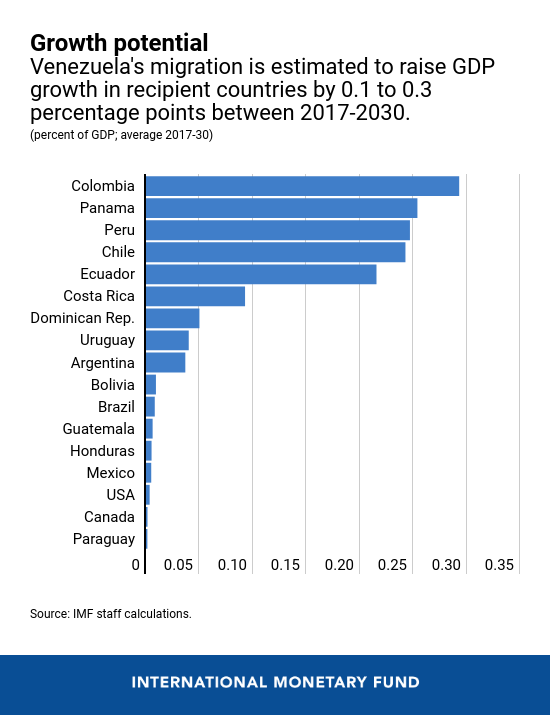
- Venezuela’s migration can potentially raise GDP growth in receiving countries by 0.1 to 0.3 percentage points during 2017–2030.
- Policies that support education and workforce integration could help migrants find better-paying jobs and raise growth prospects for recipient countries.
Crisis and Exodus
- Living conditions in Venezuela have severely deteriorated for its population of 31 million.
- Extreme poverty rose from 10 percent of the population in 2014 to 85 percent in 2018.
- Economic activity contracted by around 65 percent between 2013 and 2019, driven by plummeting oil production, worsening conditions in other sectors, and pervasive electricity blackouts.
- Hyperinflation continues with monthly price increases of about 100 percent.
- Based on current trends, research projects the total number of migrants could reach 10 million in 2023—although with a wide range of uncertainty around this figure.
- Colombia has received the largest share of migrants, followed by Peru, Ecuador, Chile, and Brazil; migration flows to some Caribbean and Central American countries have been larger relative to local populations.
Regional spillovers
- Immediate effects:
- Large migration flows place pressures on fiscal spending and labor markets in recipient economies.
- Receiving nations provide humanitarian aid, basic healthcare, education, validation of educational titles, and job search assistance.
- Using detailed data for Colombia as a benchmark, public spending related to growing migrant populations could reach around 0.6 percent of GDP in Colombia by 2023, 0.3 percent in Ecuador and Peru, and 0.1 percent in Chile.
- The overall impact on the fiscal deficit would be smaller than implied by higher spending because tax revenue would increase as the economy expands.
- Medium-to-long run effects:
- Real GDP growth is expected to increase as the size and skills of the labor force expand; many Venezuelan migrants bring relatively high levels of education and skills.
- Language and cultural proximity may ease integration compared with other migration episodes.
- Labor force expansion would also lead to higher investment.
- Near-term risks include pressure on labor markets, displacement of some local workers, and increases in informality depending on speed and scale of inflows.
- Taking into account age, size, and skill levels, and the current concentration of migrants in low-skilled informal jobs, Venezuela’s migration is estimated to raise GDP growth in recipient countries by 0.1 to 0.3 percentage points during 2017–2030.
- The growth impact could be larger and more immediate if migrants find jobs aligned with their educational level—a transition that can be facilitated by policy.
Policy Challenges and Recommendations
- Key challenges:
- Managing the transition while regional economies have slowed and many countries need to reduce fiscal deficits.
- Avoiding unilateral actions that complicate the situation for other partners; border restrictions can have regional spillovers.
- Near-term policy priorities:
- Facilitate integration of migrants into domestic labor markets.
- Ease validation of professional titles and processes to set up businesses.
- Maximize growth impact and minimize the need for public support by enabling migrants to work in line with their skills.
- Multilateral and regional actions:
- Consider international cooperation to assist main recipient countries with the costs of migrant assistance.
- Favor a coordinated regional approach to reduce complications from individual country actions.
- Longer-term investments:
- Provide migrants with access to education and healthcare to ensure they live long and productively and to benefit host economies.
For Venezuela’s Neighbors, Mass Migration Brings Economic Costs and Benefits — IMF Blog, November 21, 2019.