A Call for Vigilance After a Strong Year for Risky Assets
IMF Blog, January 28, 2020
Source details
- Canonical URL
- A Call for Vigilance After a Strong Year for Risky Assets
Other formats
Bibliographic details
- Authors: Tobias Adrian, Fabio Natalucci
- Published: January 28, 2020
Summary of 2019 market performance
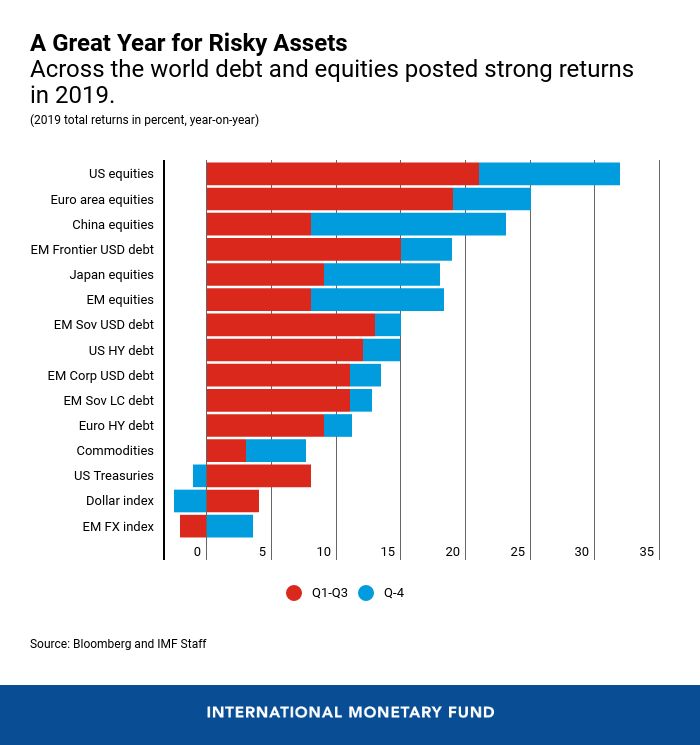
- Equity market indices were up "just over 30 percent" in the United States, "close to 25 percent" in Europe and China, and "over 15 percent" in emerging markets and Japan.
- Emerging-market sovereign debt, U.S. high-yield debt, and emerging-market corporate debt all had returns "in excess of 12 percent".
- The "fourth quarter of 2019" was especially strong in China and in emerging markets.
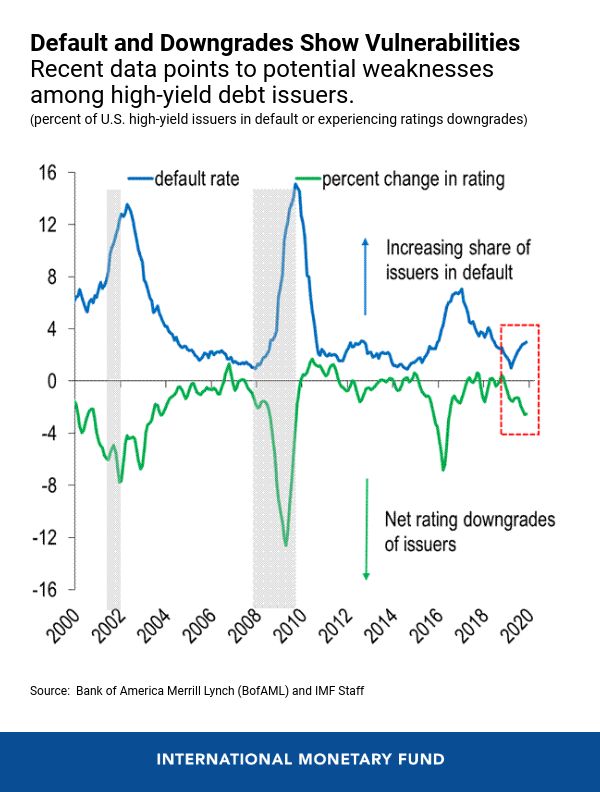
- Default rates have increased in the U.S. high-yield market and in Chinese on- and offshore corporate bond markets, "albeit from low levels".
- Emerging-market spreads are "very tight for most countries", though some specific cases show emerging-market debt trading at distress levels, "admittedly with no signs of spillovers so far".
Drivers of asset-price strength
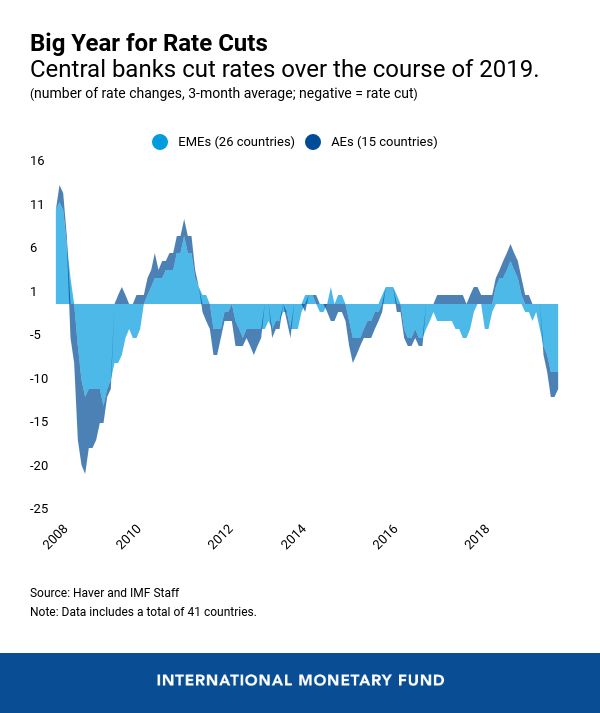
- Synchronized monetary policy easing throughout 2019 was an important driving force boosting asset prices.
- Central banks—including the U.S. Federal Reserve and the European Central Bank—eased monetary policy through rate cuts and unconventional tools.
- The combined number of policy rate cuts in advanced and emerging-market economies was the largest "since the global financial crisis in 2008".
- The forceful central bank response contributed to a sharp easing of financial conditions around the globe and helped contain downside risks to the global economic outlook.
- Market sentiment improvement is reflected in the "10-year–2-year yield curve slope" (difference between yields on 2- and 10-year government debt), which had flattened "since early 2018" but "started to steepen again in the fourth quarter of 2019" in the United States, United Kingdom, and Germany.
Macroeconomic impact
- The most recent WEO update discusses the easing of financial conditions and the reassessment of downside risks, and cautiously forecasts a slight rebound of global economic activity "this year and next", albeit to a lower level than previously forecast.
- The IMF estimates that global growth would have been "0.5 percentage point lower without global monetary policy stimulus".
Risks and vulnerabilities
- Easing of global financial conditions late in the economic cycle and continued buildup of financial vulnerabilities could threaten medium-term growth.
- Specific vulnerabilities highlighted:
- Rise in asset valuations to stretched levels in some markets and countries.
- Rise in debt.
- Large capital flows to emerging markets.
- Rising default rates in select high-yield and Chinese corporate bond markets, though from low bases.
- Instances of emerging-market debt trading at distress levels in some cases, without observed spillovers so far.
Policy recommendations
- Policy makers should continue to monitor the buildup of financial vulnerabilities and take steps to address them where appropriate to reduce the chance that such vulnerabilities may amplify the adverse impact of shocks to the global economy.
- While monetary easing in 2019 was important to contain near-term downside risks, deployment of cyclical macroprudential policy tools is now paramount to prevent rising vulnerabilities from putting growth at risk in the medium term.
- Example of a recommended cyclical macroprudential tool: the "countercyclical capital buffer".
Source: Tobias Adrian and Fabio Natalucci, January 28, 2020 — IMF blog "A Call for Vigilance After a Strong Year for Risky Assets".
References
- https://www.imf.org/wp-content/uploads/2020/01/Chart-1-eng-jan-22-2019-total-returns.jpg
- https://www.imf.org/wp-content/uploads/2020/01/Chart-2-copy-eng-jan-22-rate-cuts.jpg
- https://www.imf.org/wp-content/uploads/2020/01/Chart-3-eng-jan-22-key-drivers-of-financial-conditions.jpg
- https://www.imf.org/wp-content/uploads/2020/01/Chart-4-eng-jan-22-govt-yield-curve-renewed-optimism.jpg
- WEO update
- https://www.imf.org/wp-content/uploads/2020/01/eng-jan-22-us-high-yield-rating-downgrades-and-default-rates-4.jpg