Fiscal Policies For Women’s Economic Empowerment
IMF Blog, February 18, 2020
Source details
- Canonical URL
- Fiscal Policies For Women’s Economic Empowerment
Other formats
Bibliographic details
- Authors: Stefania Fabrizio, Daniel Gurara, Lisa Kolovich
- Published: February 18, 2020
Overview
- Making sure that opportunities to enter the workforce are fair and rewarding for women benefits everyone.
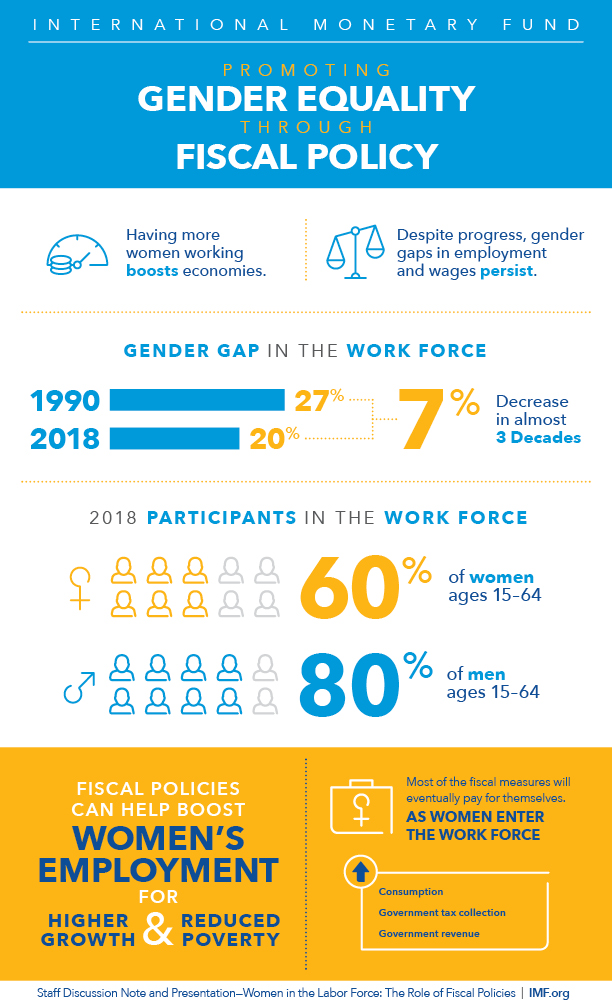
- The average female workforce participation rate across countries is still 20 percentage points lower than the male rate.
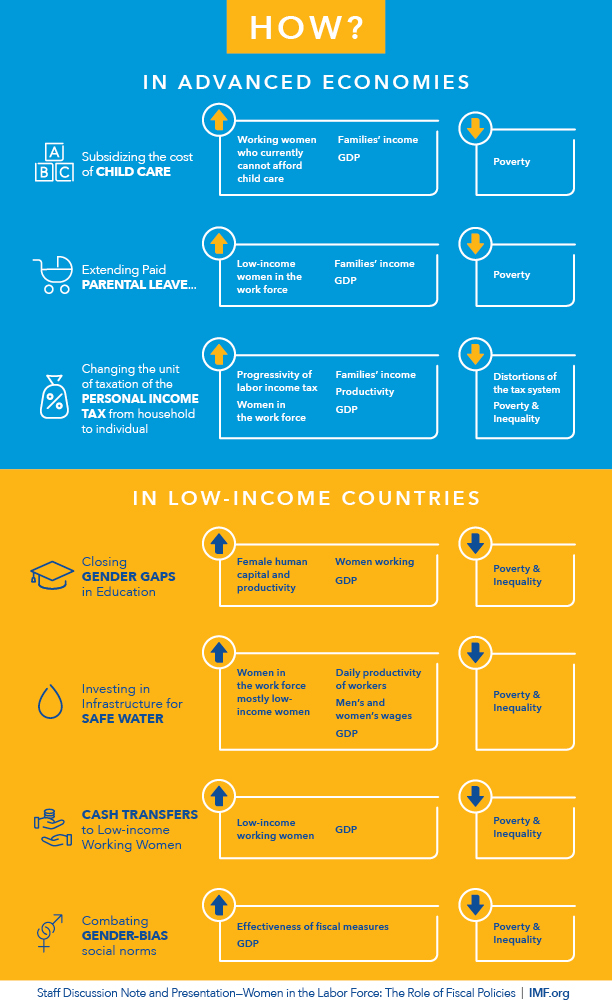
- Fiscal policy choices that address gender equality—such as investing in education or infrastructure, developing better sanitation facilities, implementing individual-based tax regimes, and offering parental leave—create more economic opportunities for women, increase growth, and reduce poverty and inequality.
- Most measures pay for themselves in the long run without additional costs for governments; a larger workforce leads to higher economic activity and growth, which generate additional tax revenue.
Inclusive fiscal policies: evidence and examples
- Since the mid-1980s, at least 80 countries across all levels of development and regions have adopted fiscal policies to promote gender equality.
- Previous IMF research suggests that in advanced economies, when governments actively promote policies to increase female labor force participation, more women join the labor force.
- Country examples:
- Canada, Czech Republic, and Sweden increased women’s paid work when switching from family to individual income taxation.
- For low-income and developing countries:
- Programs aimed at reducing gender gaps in education, particularly for secondary and university education, have supported more economic opportunities for women.
- Better infrastructure decreases the time spent on unpaid care work and provides more women the choice to enter paid employment.
- Greater gender parity across occupational levels can foster new ideas and higher productivity.
Competing demands and policy trade-offs
- Policymakers face limited budget room and competing demands: investing in schools or roads, introducing new revenue measures, or offering free, high-quality childcare.
- Decisions should consider effects on economic growth and how policies reduce income and gender inequality.
- Examples of measured impacts:
- Closing the gender gap in literacy rates in low-income countries: average literacy rate of men is about 70 percent while it is only 54 percent for women—closing this gap increases women’s productivity and equips more women for jobs in skill-intensive sectors.
- Labor-saving infrastructure: in Malawi, women on average spend 54 minutes a day collecting water; better access to infrastructure can free time and enable paid work.
- Tax structure: removing tax distortions for the lower-earning family member (usually the woman) by shifting from family to individual taxation creates incentives for more women to work and increases workforce diversity.
Securing the future: targeted measures and distributional effects
- Not all gender-responsive fiscal policies benefit women equally; some measures have larger effects on poorer women.
- Subsidizing childcare and providing paid maternity leave have greater impact on poorer women who face higher childcare costs relative to income.
- In the US, poorer women spend 17.4 percent of their income on childcare compared to 7.8 percent for richer women.
- Time horizons matter:
- Long-term measures: investing in education to equip girls with the same skills as boys boosts women’s human capital and future labor productivity.
- Short- to medium-term measures: cash transfers targeting poorer working women can help reduce poverty and inequality now.
- Tackling gender-biased social norms amplifies the positive effects of gender-responsive measures and improves human rights and women’s economic empowerment.
- According to the Organization for Economic Co-operation and Development:
- Discriminatory laws and social practices reduce women’s years of schooling by 16 percent.
- They decrease labor force participation by 12 percent.
- They result in a global income loss of 7.5 percent of the global GDP.
- Progress examples:
- Under the Promundo initiative, 34 countries have introduced programs to engage men and boys on gender norms with participants responding very positively.
Key findings and takeaways
- Fiscal policies that promote gender equality can:
- Increase female labor force participation.
- Raise growth, reduce poverty, and lower inequality.
- Often pay for themselves over time through higher economic activity and tax revenue.
- Policy design should consider distributional impacts, time horizons, and the role of social norms to maximize effectiveness.
- Coordinated efforts by policymakers and citizens can foster equality, equity, and brighter prospects for all.
Source: Fiscal Policies For Women’s Economic Empowerment, Stefania Fabrizio, Daniel Gurara, Lisa Kolovich, February 18, 2020
Content in this bundle
- Family Taxation and the Female Labor Supply: Evidence from the Czech Republic
- Staff Discussion Note