The Declining Fortunes of the Young
IMF Blog, February 27, 2020
Source details
- Canonical URL
- The Declining Fortunes of the Young
Other formats
Bibliographic details
- Authors: Era Dabla-Norris, Carlo Pizzinelli, Jay Rappaport
- Published: February 27, 2020
Trends and context
- Definition: millennials—those born between 1980 and 2000.
- Core concern: Despite being more educated than their parents, millennials may have less job stability during their working life.
- Structural shifts:
- Since the mid-1980s, the number of well-paid middle-skill jobs in manufacturing and clerical occupations has decreased substantially in the United States and Europe.
- Job opportunities are increasingly concentrated in relatively high-skill, high-wage jobs and low-skill, low-wage jobs.
- The “hollowing out” of the middle classes is linked to the disappearance of routine occupations—jobs with a higher share of tasks performable through a set of easily codified rules (such as bookkeeping, clerical work, and some manufacturing jobs)—driven by technological progress and global integration.
- Automation and artificial intelligence continue to replace workers and may also limit job creation in growing sectors.
- Recent shocks:
- The global financial crisis and the 2007 crisis contributed to widening earnings and income gaps between generations; in Europe, incomes declined for young people after the 2007 crisis due to unemployment and have since recovered but have not grown.
- The rise of the “gig” economy and increases in temporary contracts have further decreased job stability, particularly for the young.
- IMF staff research focus: labor force data from the United Kingdom over the period 2001–2018, with analysis by gender and education level.
Non-college educated workers (United Kingdom, 2001–2018)
- Routine jobs:
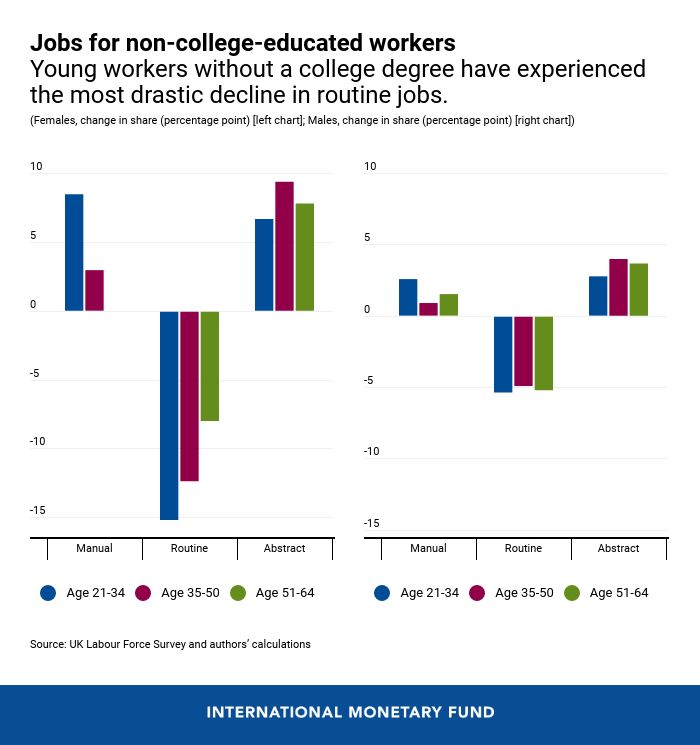
- Non-college-educated workers are 5 to 15 percentage points less likely to be employed in routine jobs now than they were two decades ago.
- This decline has particularly impacted younger generations as middle-wage, middle-skill job opportunities evaporate.
- Gender dimensions:
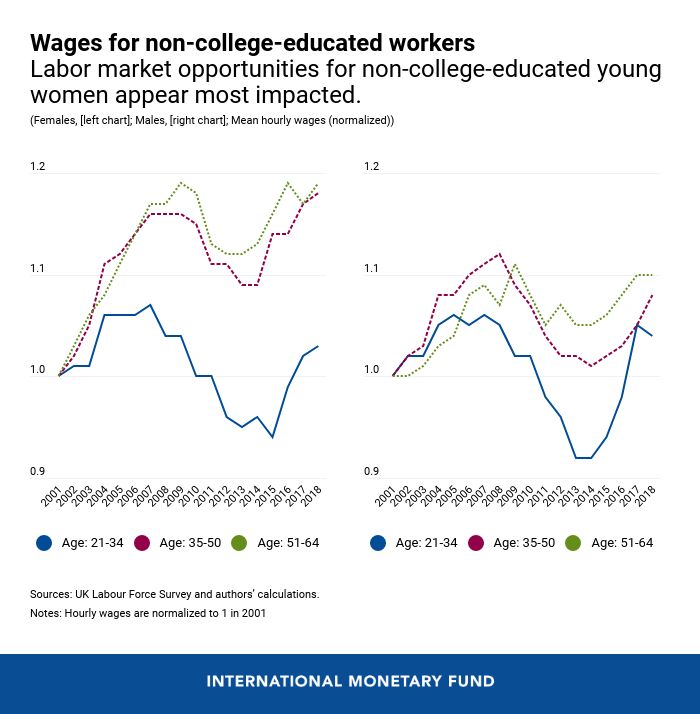
- Labor market opportunities for non-college educated young women appear most affected.
- They are increasingly likely to be employed in low-skill manual-based jobs.
- Their real wages over all occupations have fallen in the past two decades.
- Millennial women’s wages today are more than 10 percent lower than those of women in the baby boomer generation, almost double the gap that exists for their male counterparts.
College-educated workers (United Kingdom, 2001–2018)
- Education attainment and returns:
- The share of college-educated workers increased from 29 percent in 2001 to 45 percent in 2018.
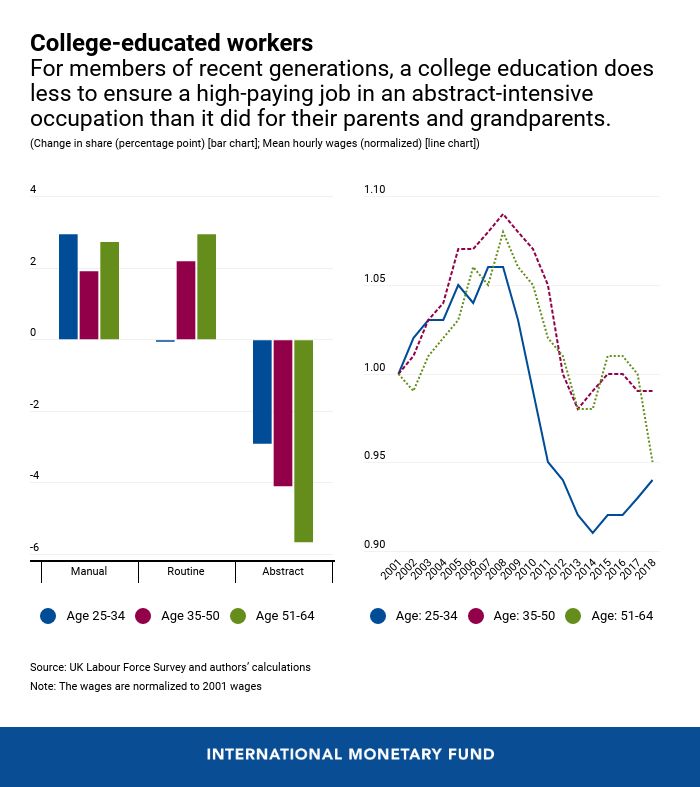
- As attainment of higher education rises for younger generations, the returns to a university degree are falling.
- An undergraduate degree still leads to a much higher likelihood of having a “good job,” but it presents less of a guarantee than it did in the past in the United Kingdom.
- Job task composition:
- The two criteria of a “good job” are wages and the extent of abstract-thinking in a job’s tasks, which can be complementary to technology.
- An abstract job is one that typically requires creative, problem-solving, and coordination tasks performed by professionals and managers.
- The share of abstract jobs among the highly-educated has fallen between 2001 and 2018.
- In recent years, both highly-educated male and female workers have become more likely to take middle-skill jobs compared to less-educated workers.
- For recent generations, a college education does less to ensure a high-paying job in an abstract job than it did for their parents.
- Additional concern: The widening gap between the wages of the young and those of older people since the Global Financial Crisis, although narrowing more recently, remains of concern.
Policy recommendations
- Short-term responses:
- Create new opportunities for people displaced by automation, particularly for low-skilled workers.
- Support research and development fields to help employ college-educated workers in areas such as science and technology.
- Remove legal barriers to employment and allow for more flexible contracts to help more young people get jobs.
- Long-term strategies:
- Education and skills training programs should prepare participants to meet the adjusted demands of the labor market.
- College graduates should be literate in, and easily capable of using, technology for their chosen sector.
- Overarching focus: Policies should build skills to complement automation and reduce the impact of job displacement on workers both in the short and long run.
The Declining Fortunes of the Young, Era Dabla-Norris, Carlo Pizzinelli, Jay Rappaport, February 27, 2020
References
- driven by technological progress and global integration.
- incomes declined for young people after the 2007 crisis
- New IMF staff research
- https://www.imf.org/wp-content/uploads/2020/02/eng-feb-19-jobs-for-non-college-5.jpg
- https://www.imf.org/wp-content/uploads/2020/02/eng-feb-19-wages-for-non-college-5.jpg
- https://www.imf.org/wp-content/uploads/2020/02/eng-feb-19-college-educated-workers-3.jpg