Monetary and Financial Stability During the Coronavirus Outbreak
IMF Blog, March 11, 2020
Source details
- Canonical URL
- Monetary and Financial Stability During the Coronavirus Outbreak
Other formats
Bibliographic details
- Authors: Tobias Adrian
- Published: March 11, 2020
Overview / Context
- The global spread of the coronavirus is described as "a human tragedy unfolding across the world."
- Quantifying the economic impact is complex, giving rise to significant uncertainty about the economic outlook and associated downside risks.
- "Such an abrupt rise in uncertainty can put both economic growth and financial stability at risk."
- The blog is part of a special series on the response to the coronavirus.
- Author and date: Tobias Adrian — March 11, 2020
Higher uncertainty and tighter financial conditions
- Measures of economic uncertainty such as equity market volatility "increased sharply in countries around the world."
- Stock markets in major economies, such as the United States, the Euro area, and Japan, "all fell sharply and witnessed a surge in implied volatility."
- Credit spreads have "widened broadly across markets" as investors reallocate from relatively risky to safer assets.
- "High-yield and emerging-market bonds are hit particularly hard."
- Spreads of emerging- and frontier-market bonds denominated in U.S. dollars "have widened sharply."
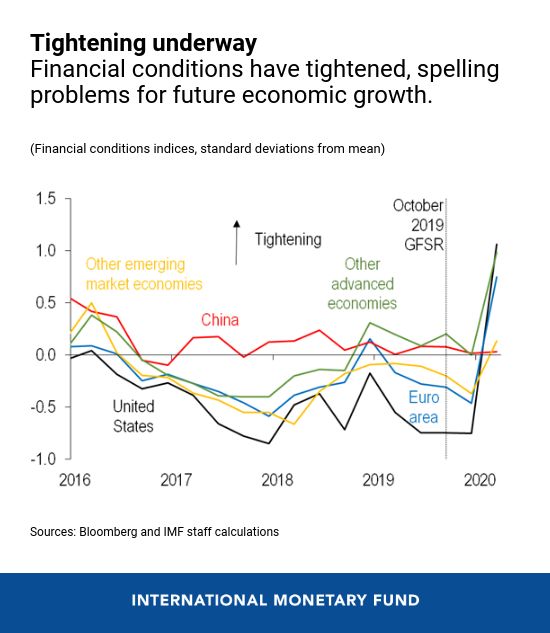
- Financial conditions "have tightened significantly in recent weeks," increasing funding costs for companies tapping equity and bond markets.
- Resulting economic behavior: firms postpone investment decisions and individuals delay consumption.
Monetary policy response
- Rationale: "The sharp tightening in financial conditions, along with expectations of low inflation, means that monetary policy has a role to play at the current juncture."
- Central banks can:
- inject liquidity,
- cut interest rates,
- provide emergency liquidity if liquidity pressures threaten market functioning.
- Markets have been anticipating "aggressive easing by central banks," reflected in "the sharp fall in sovereign bond yields in many countries around the world."
- Emphasis on coordination: "Synchronized actions across countries increase the power of monetary policy. Therefore, global cooperation to synchronize monetary policy must be high on the agenda."
- Cross-border liquidity: "Ample liquidity within countries, and across borders, is the prerequisite to the successful reversal of the rapid tightening in financial conditions."
- If conditions deteriorate further, policymakers could revert to tools developed during the financial crisis:
- Example: "The Federal Reserve launched the Term Asset-Backed Securities Loan Facility in 2009."
- Example: "The Bank of England and U.K. Treasury introduced the Funding for Lending Scheme, where a funding subsidy was provided to incentivize the expansion of lending to households, small and mid-sized enterprises and non-financial corporates."
- Other authorities have "deployed variants of such lending schemes that aim at lowering the costs of borrowing in certain sectors."
Financial stability policies
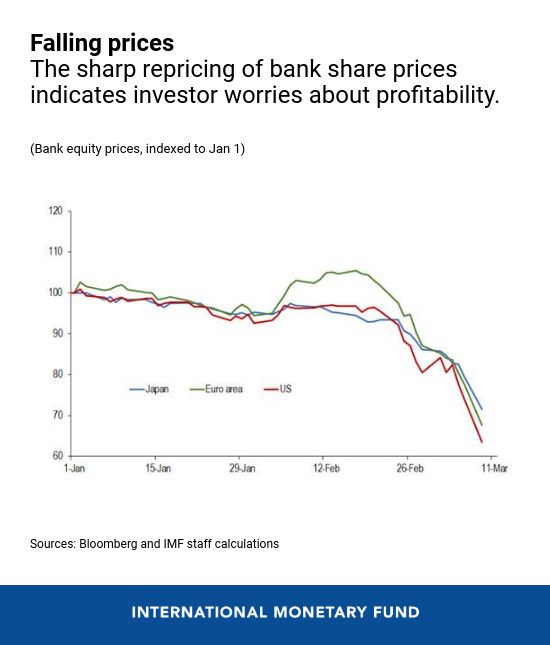
- Market signals: banks’ share prices "have fallen sharply," and banks' bond prices "have also come under some pressure."
- Balance-sheet resilience: "Banks are generally more resilient than before the 2008 financial crisis, because they have greater capital and liquidity cushions."
- Supervisory guidance:
- "Supervisory authorities should... monitor developments at banks very closely."
- Banks could consider "a temporary restructuring of loan terms for the most-affected borrowers," given the temporary nature of the outbreak.
- Supervisors should work closely with banks to ensure such actions are "both transparent and temporary."
- The goal: "to preserve banks’ financial strength and overall transparency across the financial sector."
- Nonbank risks:
- Authorities should be "alert to possible financial stability threats from outside the banking system."
- Increased focus on asset managers and exchange-traded funds, where investors might "liquidate risky investments suddenly."
- Market functioning and funding strains:
- "Anecdotal evidence suggests that liquidity has been tightening in many markets."
- There are "strains in U.S. dollar funding markets, where non-U.S. banks and corporates borrow in U.S. dollars."
- "Large swings in asset prices can quickly put markets and institutions under pressure."
Key policy recommendations and actions
- Act decisively and cooperate at the global level to preserve monetary and financial stability.
- Prioritize global cooperation to synchronize monetary policy.
- Ensure ample liquidity domestically and across borders; provide emergency liquidity if needed.
- Consider targeted lending schemes or funding facilities to lower borrowing costs in affected sectors, drawing on tools used in 2009 and other post-2008 innovations.
- Monitor banks closely and facilitate transparent, temporary loan-term restructuring for most-affected borrowers to preserve bank strength and transparency.
- Monitor nonbank sectors, including asset managers and exchange-traded funds, for abrupt liquidations and liquidity tightening.
- The IMF will act as needed to help its members face this extraordinary, but hopefully temporary, crisis.
Tobias Adrian — March 11, 2020
References
- targeted economic policies
- fiscal measures
- https://www.imf.org/wp-content/uploads/2020/03/chart-1.png
- https://www.imf.org/wp-content/uploads/2020/03/eng-mar-10-mcm-2-new-1.jpg
- https://www.imf.org/wp-content/uploads/2020/03/eng-mar-10-mcm-3-new.jpg
- https://www.imf.org/wp-content/uploads/2020/03/eng-mar-10-mcm-4-new.jpg
- https://www.imf.org/wp-content/uploads/2020/03/eng-mar-10-mcm-5-new.jpg
- preparing