COVID-19 Crisis Poses Threat to Financial Stability
IMF Blog, April 14, 2020
Source details
- Canonical URL
- COVID-19 Crisis Poses Threat to Financial Stability
Other formats
Bibliographic details
- Authors: Tobias Adrian, Fabio Natalucci
- Published: April 14, 2020
Pandemic impact and overall assessment
- The COVID-19 pandemic has caused an unprecedented human and health crisis; containment measures have triggered an economic downturn with great uncertainty about its severity and length.
- The financial system has already felt a dramatic impact; a further intensification of the crisis could affect global financial stability.
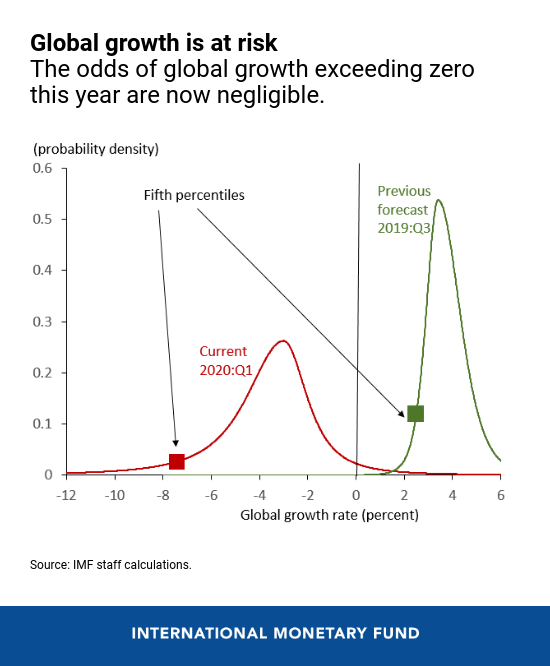
- The one-year-ahead distribution of global growth has shifted massively to the left, indicating a significant increase in downside risks to growth and financial stability.
- There is now a 5 percent likelihood (an event that happens once every 20 years) that global growth will fall below -7.4 percent. For comparison, this threshold was above 2.6 percent in October 2019.
Market strain and asset price moves
- Since the pandemic’s outbreak, prices of risk assets have fallen sharply.
- At the worst point of the recent selloff, risk assets suffered half or more of the declines they experienced in 2008 and 2009.
- Many equity markets—in economies large and small—have endured declines of 30 percent or more at the trough.
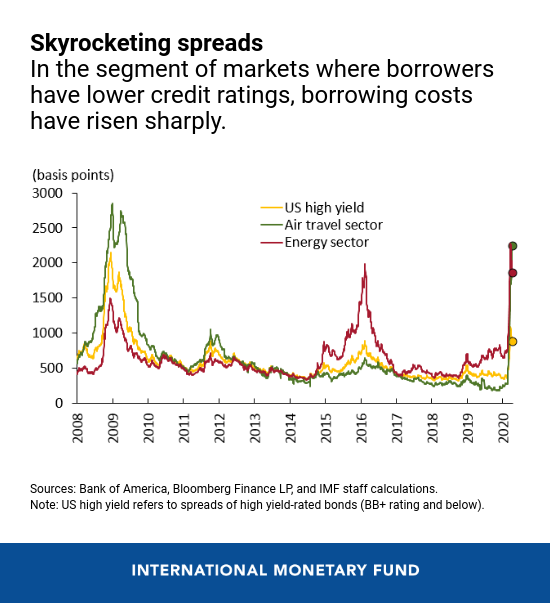
- Credit spreads have jumped, especially for lower-rated firms.
- Signs of stress have emerged in major short-term funding markets, including the global market for U.S. dollars.
- Volatility has spiked, in some cases to levels last seen during the global financial crisis; market liquidity has deteriorated significantly, including in traditionally deep markets like the U.S. Treasury market.
- Investor sentiment has stabilized in recent weeks and risk asset prices have recovered a portion of earlier declines, but sentiment remains fragile and global financial conditions are much tighter compared to the beginning of the year.
Central bank responses and liquidity provision
- Central banks have been the first line of defense to preserve global financial stability and support the global economy:
- Significantly eased monetary policy by cutting policy rates—in advanced economies to historic lows; half of the central banks in emerging markets and lower income countries have also cut policy rates.
- Reinforced rate cuts with guidance about the future path of monetary policy and expanded asset purchase programs.
- Provided additional liquidity to the financial system, including through open market operations.
- Agreed to enhance the provision of U.S. dollar liquidity through swap line arrangements.
- Reactivated programs used during the global financial crisis and launched new broad-based programs, including to purchase riskier assets such as corporate bonds—effectively stepping in as “buyers of last resort.”
- To date, central banks have announced plans to expand their provision of liquidity—including through loans and asset purchases—by at least $6 trillion and have indicated a readiness to do more if conditions warrant.
Financial vulnerabilities and nonbank sectors
- The global spread of COVID-19 and tougher containment measures may lead to further tightening of global financial conditions and expose financial vulnerabilities built in the low interest rate environment.
- Asset managers facing large outflows may be forced to sell into falling markets, intensifying downward price moves.
- Levered investors may face margin calls and be forced to unwind portfolios; financial deleveraging may aggravate selling pressures.
- Risky credit segments could come to a sudden stop as firms become distressed and default rates climb:
- High yield, leveraged loan, and private debt markets have expanded rapidly since the global financial crisis, reaching $9 trillion globally, while borrowers’ credit quality, underwriting standards, and investor protections have weakened.
- Since early March, high-yield spreads have skyrocketed notwithstanding recent declines, particularly in sectors most affected by the pandemic like air travel and energy.
- Leveraged loan prices have fallen sharply—about half the drop seen during the global financial crisis at one point.
- Ratings agencies have revised upward their speculative-grade default forecasts to recessionary levels, and market-implied defaults have also risen sharply.
- Emerging markets have experienced the sharpest portfolio flow reversal on record—about $100 billion or 0.4 percent of their GDP—posing stark challenges to more vulnerable countries.
Banking sector resilience and risks
- Banks have more capital and liquidity than in the past, have been subject to stress tests and greater supervisory scrutiny, and central bank liquidity provision should help alleviate potential strains.
- Nonetheless, banks’ resilience may be tested by a sharp slowdown in economic activity that could be more severe and lengthy than anticipated.
- Large declines in bank equity prices since mid-January suggest investor concerns about profitability and prospects for the banking sector.
- Measures of bank capitalization based on market prices are now worse than during the 2008 global financial crisis in many countries.
- Concern that banks and other financial intermediaries may act as an amplifier should the crisis deepen further.
Policy priorities and outlook
- Central banks will remain crucial to safeguarding global financial markets and maintaining the flow of credit to the economy, but the crisis is primarily about solvency as large segments of the global economy have come to a complete stop.
- Fiscal policy has a vital role to play alongside monetary policy.
- Together, monetary, fiscal, and financial policies should:
- Aim to cushion the impact of the COVID-19 shock.
- Ensure a steady, sustainable recovery once the pandemic is under control.
- Close, continuous international coordination will be essential to support vulnerable countries, restore market confidence, and contain financial stability risks.
- The IMF is ready to assert the full weight of its resources—first, to help protect the world’s most vulnerable economies, and, for the long term, to strengthen the eventual recovery.
IMF blog post by Tobias Adrian and Fabio Natalucci, April 14, 2020.
References
- عربي
- 日本語
- Português
- Global Financial Stability Report
- https://www.imf.org/wp-content/uploads/2020/04/eng-apr-10-gfsr1.png
- https://www.imf.org/wp-content/uploads/2020/04/eng-apr-10-gfsr2.png
- economic outlook
- https://www.imf.org/wp-content/uploads/2020/04/eng-apr-10-gfsr3.png
- https://www.imf.org/wp-content/uploads/2020/04/eng-apr-10-gfsr4.png
- https://www.imf.org/wp-content/uploads/2020/04/eng-apr-10-gfsr5.png
- https://www.imf.org/wp-content/uploads/2020/04/eng-apr-10-gfsr6.png