The Great Lockdown: Worst Economic Downturn Since the Great Depression
IMF Blog, April 14, 2020
Source details
- Canonical URL
- The Great Lockdown: Worst Economic Downturn Since the Great Depression
Other formats
Bibliographic details
- Authors: Gita Gopinath
- Published: April 14, 2020
Overview and context
- Author: Gita Gopinath
- Date: April 14, 2020
- Context: Rapid onset of a global coronavirus pandemic and extensive quarantines/social distancing have produced a "Great Lockdown" with unprecedented collapse in economic activity.
Core projections and quantification of the shock
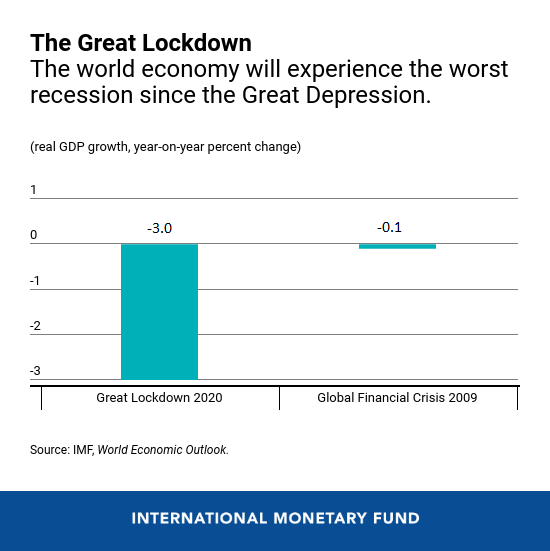
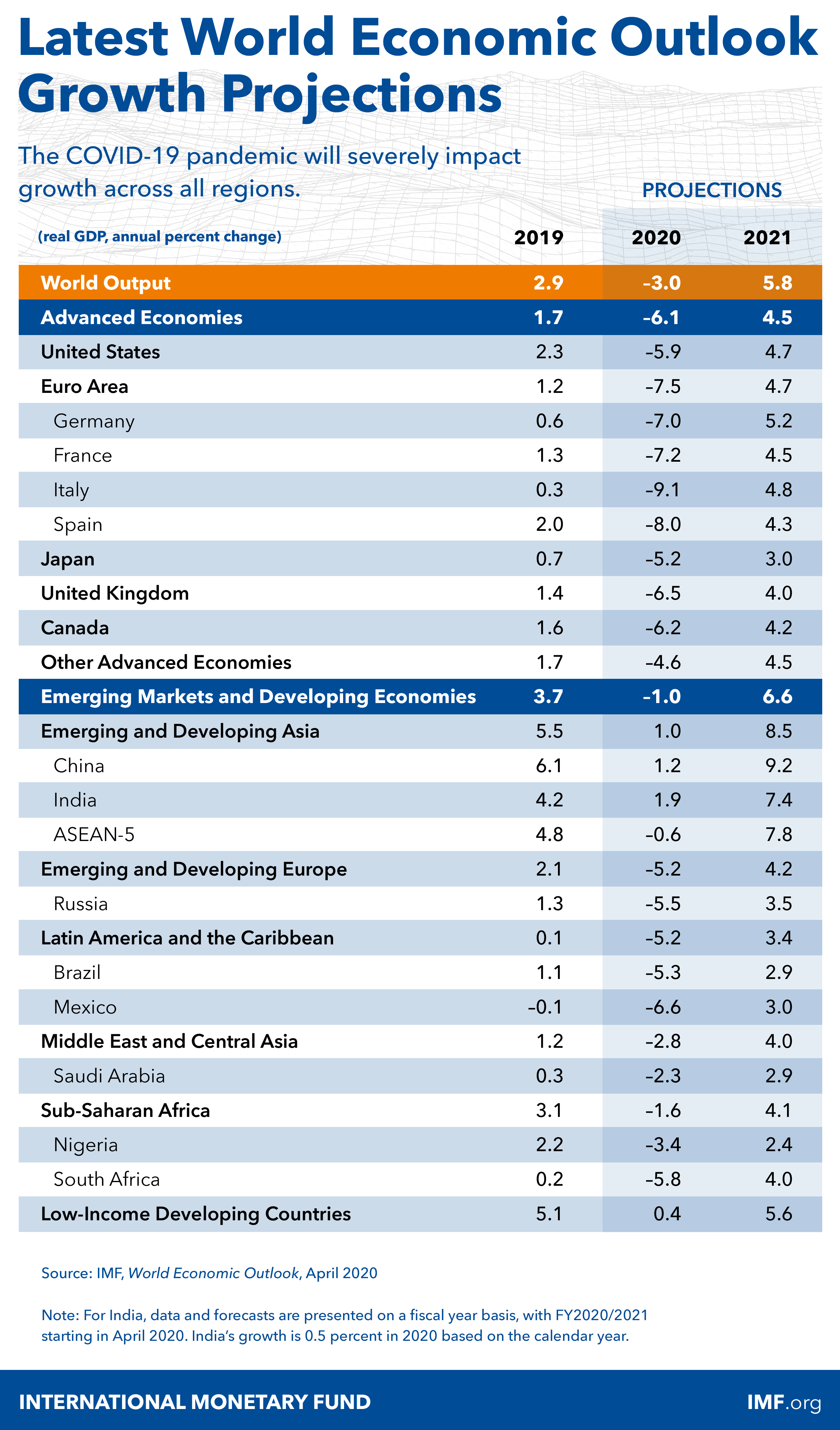
- April World Economic Outlook projection: global growth in 2020 to fall to -3 percent.
- Revision magnitude: downgrade of 6.3 percentage points from January 2020.
- 2021 baseline projection: global growth to rebound to 5.8 percent (assuming pandemic fades in the second half of 2020 and policy actions prevent widespread bankruptcies, extended job losses, and system-wide financial strains).
- Cumulative loss to global GDP over 2020 and 2021 from the pandemic crisis: could be around 9 trillion dollars.
- Geographic and income impacts:
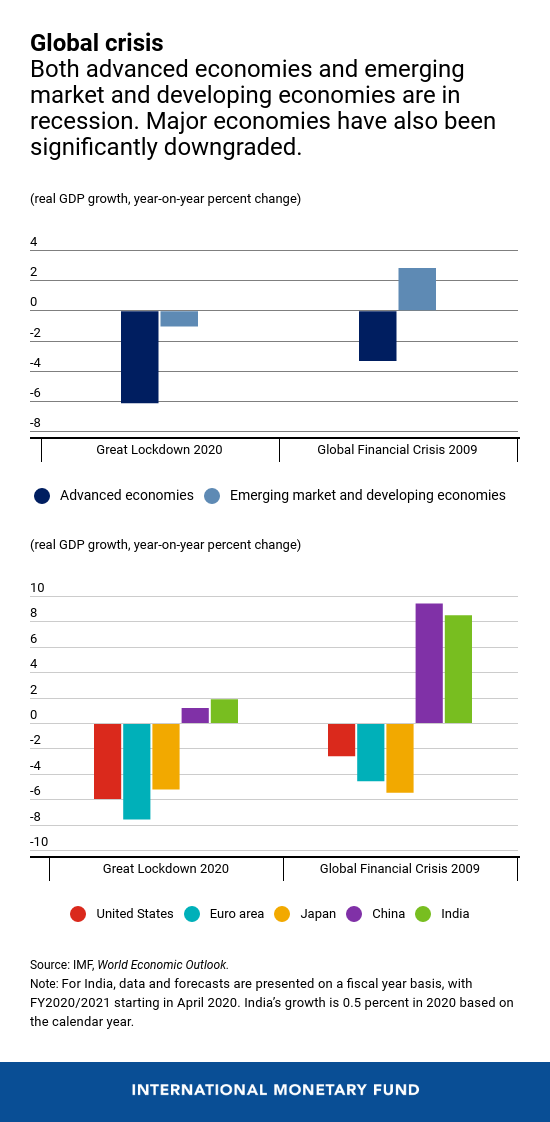
- Both advanced economies and emerging market and developing economies in recession for the first time since the Great Depression.
- Advanced economies projected growth in 2020: -6.1 percent.
- Emerging market and developing economies projected growth in 2020: -1.0 percent.
- Emerging market and developing economies projected growth in 2020 excluding China: -2.2 percent.
- Income per capita is projected to shrink for over 170 countries.
Alternative adverse scenarios (tail risks)
- If the pandemic is more protracted in 2020: global GDP would fall an additional 3 percent in 2020 relative to baseline.
- If the pandemic continues into 2021: global GDP may fall an additional 8 percent in 2021 relative to baseline.
Key channels of vulnerability
- Severe disruption to countries reliant on tourism, travel, hospitality, and entertainment.
- Emerging market and developing economies face:
- Unprecedented reversals in capital flows.
- Currency pressures.
- Weaker health systems.
- More limited fiscal space to provide support.
- Several economies entered the crisis with sluggish growth and high debt levels, increasing fragility.
Policy lessons and recommended actions
- Public health priorities:
- Flatten the spread using lockdowns to allow health systems to cope.
- Continue to spend generously on health systems, perform widespread testing.
- Refrain from trade restrictions on medical supplies.
- Global effort to ensure immediate access to therapies and vaccines for both rich and poor nations.
- While containment persists:
- Maintain large, timely, and targeted fiscal, monetary, and financial policies to support households, firms, and financial markets.
- Examples of policy measures already used: credit guarantees, liquidity facilities, loan forbearance, expanded unemployment insurance, enhanced benefits, and tax relief.
- Continue support throughout the containment phase to minimize persistent scars from subdued investment and job losses.
- Recovery phase policy priorities:
- Shift policies swiftly to support demand, incentivize firm hiring, and repair balance sheets in the private and public sectors.
- Coordinate fiscal stimulus across countries with fiscal space to magnify benefits.
- Consider continued moratoria on debt repayments and debt restructuring during recovery.
- Multilateral and international cooperation:
- Bilateral creditors and international financial institutions should provide concessional financing, grants, and debt relief to support spending in developing countries.
- Expand swap lines between major central banks to ease international liquidity shortages.
- Collaborative effort needed to prevent de-globalization and protect productivity during recovery.
- IMF actions:
- The IMF is actively deploying its 1-trillion-dollar lending capacity to support vulnerable countries, including through rapid-disbursing emergency financing and debt service relief to poorest member countries, and calls on official bilateral creditors to do the same.
Outlook and uncertainty
- Recovery is partial: 2021 level of economic activity projected to remain below pre-virus projections for 2021.
- Tremendous uncertainty remains about the epidemiology of the virus, effectiveness of containment measures, and timing of therapeutics and vaccines.
- Domestic and international policy responses need to be large, rapidly deployed, and speedily recalibrated as new data becomes available.
IMF Blog — The Great Lockdown: Worst Economic Downturn Since the Great Depression; Gita Gopinath; April 14, 2020
References
- World Economic Outlook
- https://www.imf.org/wp-content/uploads/2020/04/eng-apr-12-weo1.png
- https://www.imf.org/wp-content/uploads/2020/04/eng-apr-12-weo2.png
- https://www.imf.org/wp-content/uploads/2020/04/eng-apr-12-weo3-1.png
- https://www.imf.org/wp-content/uploads/2020/04/WEO-FINAL-projections-table.png