How the Great Lockdown Saved Lives
IMF Blog, June 2, 2020
Source details
- Canonical URL
- How the Great Lockdown Saved Lives
Other formats
Bibliographic details
- Authors: Pragyan Deb, Davide Furceri, Jonathan D Ostry, Nour Tawk
- Published: June 2, 2020
Summary of the study and context
- Since the COVID-19 outbreak was first reported in Wuhan, China in late December 2019, the disease has spread to more than 200 countries and territories.
- In the absence of a vaccine or effective treatment, governments implemented unprecedented containment and mitigation measures—the Great Lockdown—which produced large short-term economic losses and a decline in global economic activity not seen since the Great Depression.
- The Great Lockdown, despite its enormous short-term economic costs, has saved hundreds of thousands of lives.
Main empirical findings
- Containment measures reduced mobility and were very effective in flattening the “pandemic curve.”
- New Zealand: stringent containment measures (restrictions on gatherings and public events implemented when cases were in single digits, followed by school and workplace closings and stay-at-home orders a few days later) are likely to have reduced the number of fatalities by over 90 percent relative to a baseline with no containment measures.
- In other words, in a country like New Zealand, the number of confirmed COVID-19 deaths would have been at least ten times larger than in the absence of stringent containment measures.
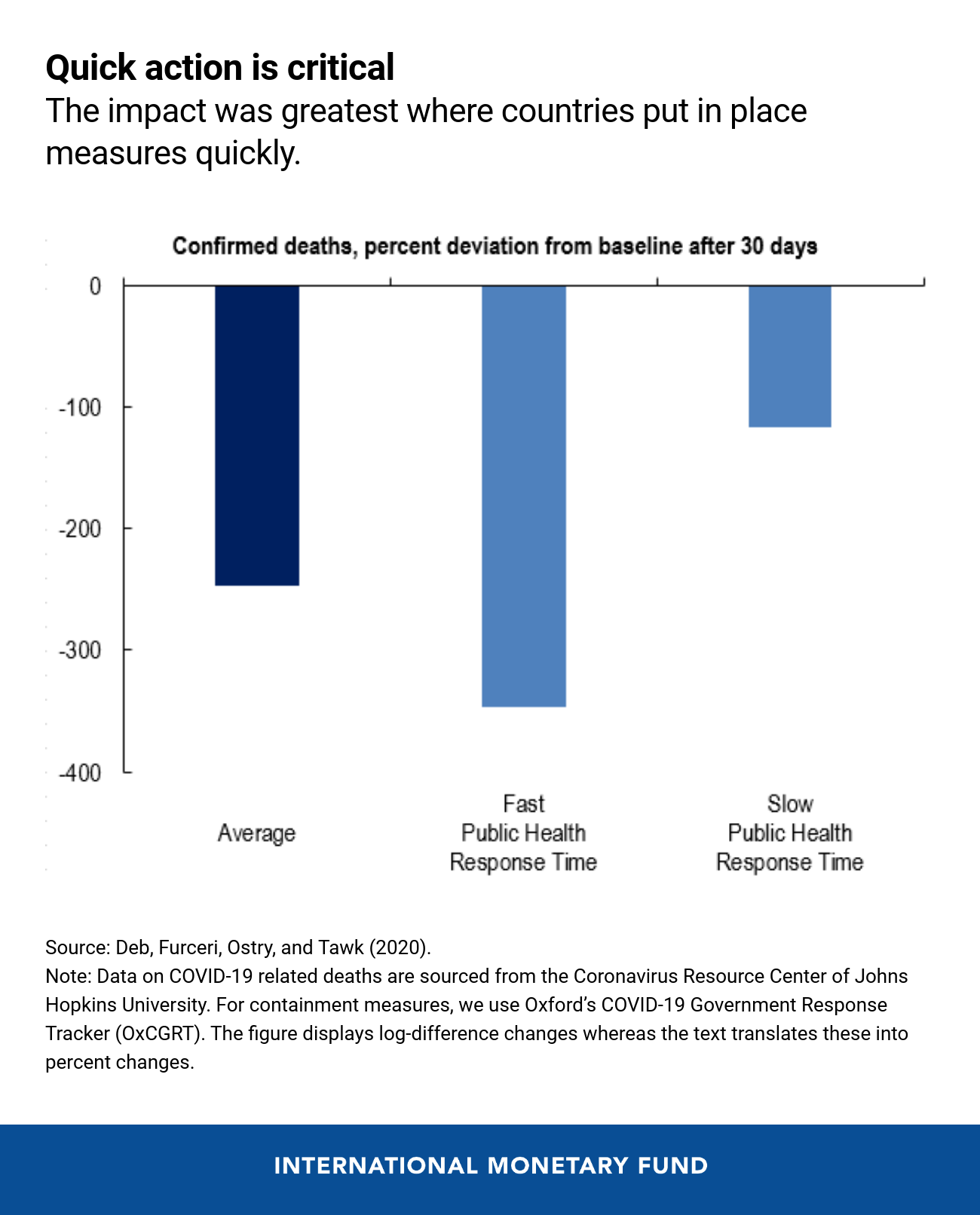
- Early intervention (public health response time measured as the number of days it took a country to implement containment measures after a significant outbreak) played a significant role in flattening the curve.
- Vietnam: faster containment measures witnessed a reduction in the average number of infections and deaths of 95 and 98 percent respectively.
- Effect heterogeneity:
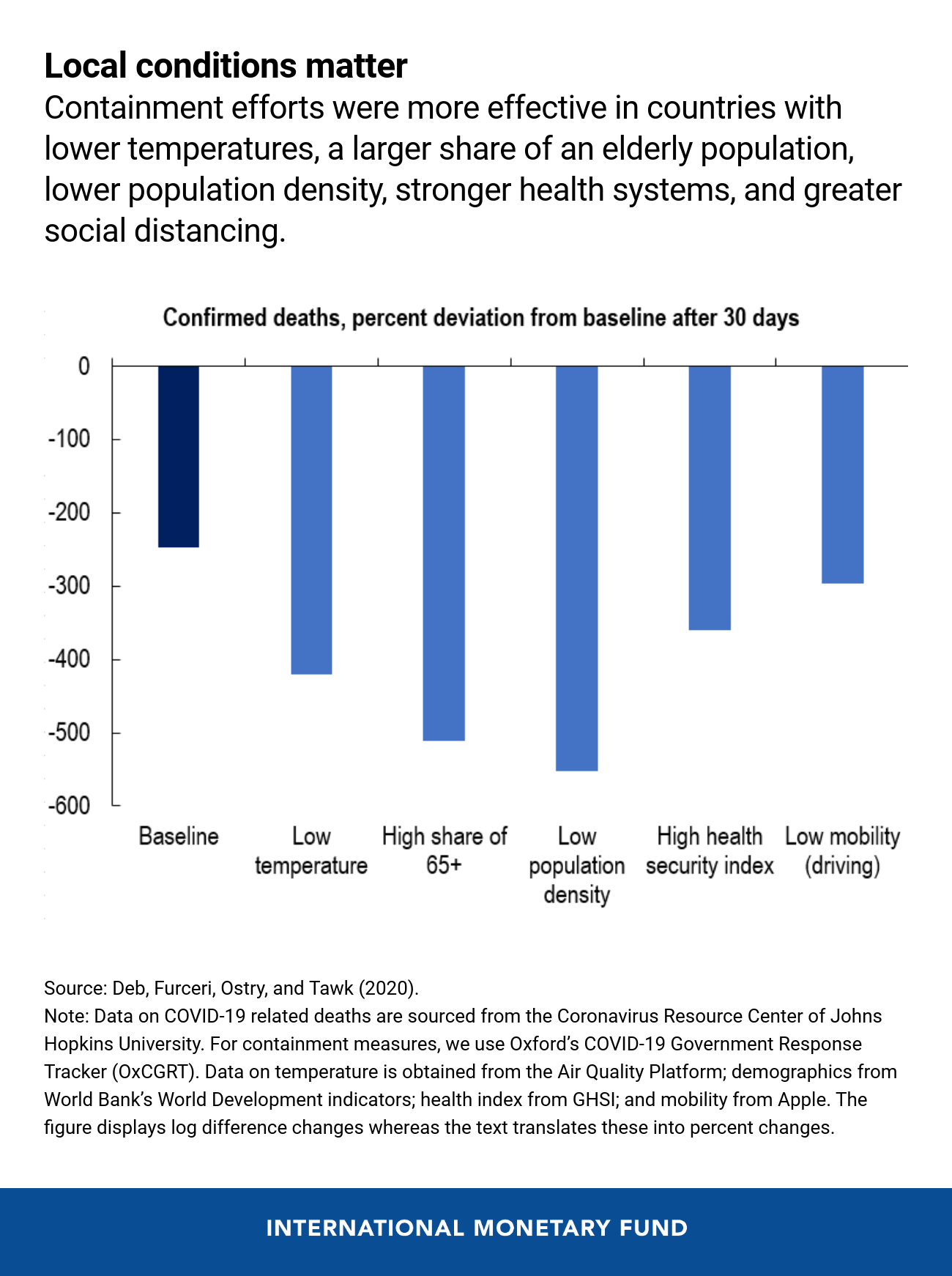
- Impacts were stronger where colder weather during the outbreak produced higher infection rates.
- Impacts were stronger where the population was older and hence more vulnerable to infection.
- A strong health system and lower population density enhanced the effectiveness of containment and mitigation strategies by making them easier to implement and enforce.
- Greater reductions in mobility (more social distancing) corresponded to greater reductions in infections and deaths.
Assessment of different containment measures
- Many measures were introduced simultaneously, complicating identification of the most effective single measure.
- Evidence suggests that while all measures contributed substantially to reducing COVID-19 cases and deaths, stay-at-home orders appear to have been relatively more effective.
Policy implication
- Fighting the pandemic is a necessity for the economy to rebound: the course of the global health crisis and the fate of the global economy are inseparably intertwined.
- Early, stringent containment measures that effectively reduce mobility can substantially lower infections and fatalities and lay the foundation for medium-term growth.
Source: How the Great Lockdown Saved Lives — IMF blog, June 2, 2020.
References
- the Great Lockdown
- https://www.imf.org/wp-content/uploads/2020/06/REVISED-eng-covid-containment-blog-may-27-chart-1.png
- https://www.imf.org/wp-content/uploads/2020/06/REVISED-eng-covid-containment-blog-may-27-chart-2.png
- https://www.imf.org/wp-content/uploads/2020/06/REVISED-eng-covid-containment-blog-may-27-chart-3.png
- necessity