Emerging Economies Must Prepare for Fed Policy Tightening
IMF Blog, January 10, 2022
Source details
- Canonical URL
- Emerging Economies Must Prepare for Fed Policy Tightening
Other formats
Bibliographic details
- Authors: Stephan Danninger, Kenneth Kang, Hlne Poirson
- Published: January 10, 2022
Context and recent developments
- Authors and date: Stephan Danninger, Kenneth Kang, Hélène Poirson; January 10, 2022.
- Inflation in the United States is rising at the fastest pace in almost four decades; the tight labor market has started to feed into wage increases.
- The Federal Reserve accelerated tapering of asset purchases, citing inflation developments as a key factor.
- The new Omicron variant has raised additional concerns of supply-side pressures on inflation.
- Average gross government debt in emerging markets is up by almost 10 percentage points since 2019, reaching an estimated 64 percent of GDP by end 2021.
- Several emerging markets, including Brazil, Russia, and South Africa, started raising interest rates in response to domestic inflation and concerns about stable foreign funding.
New risks to recovery: scenarios and possible spillovers
- Baseline (benign) scenario:
- Robust US growth is expected to continue.
- Inflation will likely moderate later this year as supply disruptions ease and fiscal contraction weighs on demand.
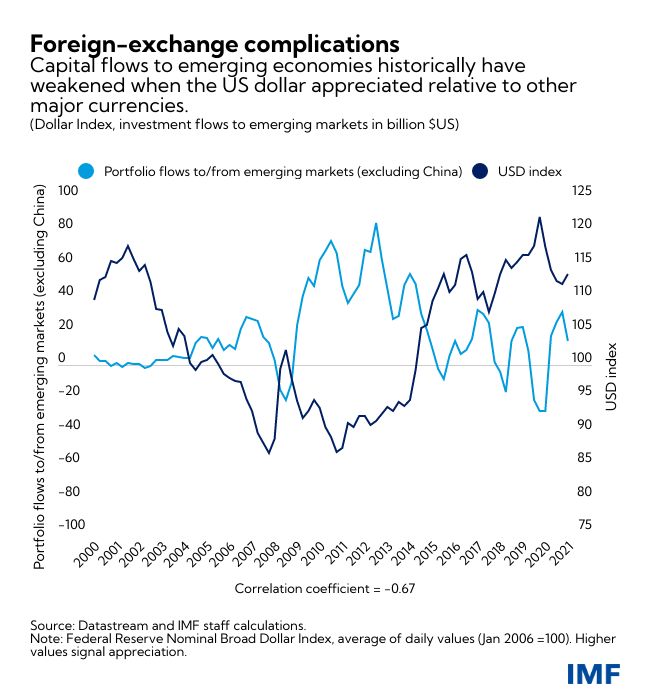
- If Fed tightening is gradual, well telegraphed, and in response to a strengthening recovery, history suggests benign effects for emerging markets: emerging-market currencies may depreciate, but foreign demand would offset the impact from rising financing costs.
- Adverse scenario:
- Broad-based US wage inflation or sustained supply bottlenecks could boost prices more than anticipated and raise expectations for more rapid inflation.
- Faster Fed rate increases in response could rattle financial markets, tighten global financial conditions, slow US demand and trade, and lead to capital outflows and currency depreciation in emerging markets.
- Countries with high public and private debt, foreign exchange exposures, and lower current-account balances have recently seen larger currency movements versus the US dollar.
- The combination of slower growth and elevated vulnerabilities could create adverse feedback loops for vulnerable emerging economies.
Difficult tradeoffs for policymakers
- Monetary and fiscal policy adjustments already underway:
- Some emerging markets have started to adjust monetary policy and are preparing to scale back fiscal support to address rising debt and inflation.
- Recommended tailoring of responses based on country circumstances:
- Countries with policy credibility on containing inflation can tighten monetary policy more gradually.
- Countries with stronger inflation pressures or weaker institutions must act swiftly and comprehensively.
- In either case, recommended measures include: letting currencies depreciate and raising benchmark interest rates.
- Central banks with sufficient reserves can intervene in disorderly foreign exchange markets provided intervention does not substitute for warranted macroeconomic adjustment.
- Tradeoffs highlighted:
- Supporting a weak domestic economy vs. safeguarding price and external stability.
- Extending support to businesses may increase credit risks and delay recognition of losses, weakening financial institutions over the longer term.
- Rolling back support could further tighten financial conditions and weaken the recovery.
Policy measures to reduce vulnerabilities and strengthen frameworks
- For central banks tightening to contain inflation pressures:
- Clear and consistent communication of policy plans to enhance public understanding of the need to pursue price stability.
- For countries with foreign currency debt:
- Reduce foreign currency mismatches and hedge exposures where feasible.
- Extend the maturity of obligations to reduce rollover risks, even if it increases costs.
- For heavily indebted countries:
- Start fiscal adjustment sooner and faster.
- Set a credible commitment to a medium-term fiscal strategy to boost investor confidence and regain room for fiscal support in a downturn.
- Possible elements of such a strategy: announce a comprehensive plan to gradually increase tax revenues, improve spending efficiency, or implement structural fiscal reforms such as pension and subsidy overhauls.
- Financial sector measures:
- Review continued financial policy support for businesses and calibrate normalization plans carefully to the outlook to preserve financial stability.
- Readiness of resolution regimes where corporate debt and bad loans were high before the pandemic, as weaker banks and nonbank lenders may face solvency concerns if financing becomes difficult.
Global financial safety net and IMF role
- The global financial safety net can be used, including swap lines, regional financing arrangements, and multilateral resources.
- The IMF contributed a $650 billion allocation of Special Drawing Rights in the prior year.
- The IMF has adapted its financial lending toolkit:
- Countries with strong policies can tap precautionary credit lines to help prevent crises.
- Other countries can access lending tailored to their income level, but programs must be anchored by sustainable policies that restore economic stability and foster sustainable growth.
Conclusion
- While the global recovery is projected to continue this year and next, risks to growth remain elevated due to the resurgent pandemic.
- Given the risk that the pandemic could coincide with faster Fed tightening, emerging economies should prepare for potential bouts of economic turbulence by strengthening policy frameworks, reducing vulnerabilities, and using available global financial safety-net options.
Emerging Economies Must Prepare for Fed Policy Tightening — Stephan Danninger, Kenneth Kang, Hélène Poirson; January 10, 2022.