Low Real Interest Rates Support Asset Prices, But Risks Are Rising
IMF Blog, January 27, 2022
Source details
- Canonical URL
- Low Real Interest Rates Support Asset Prices, But Risks Are Rising
Other formats
Bibliographic details
- Authors: Tobias Adrian, Nassira Abbas
- Published: January 27, 2022
Drivers of low real interest rates and asset valuation effects
- Supply disruptions coupled with strong demand for goods, rising wages and higher commodities prices have pushed inflation above central bank targets.
- Many economies have started tightening monetary policy, leading to a sharp increase in nominal interest rates, with long-term bond yields recovering to pre-pandemic levels in some regions such as the United States.
- Investors base decisions on real rates (inflation-adjusted rates); low real interest rates induce investors to take more risks.
- Longer-term real rates remain deeply negative in many regions, supporting elevated prices for riskier assets.
- Very low real interest rates reflect:
- pessimism about economic growth in coming years;
- a global savings glut due to aging societies;
- demand for safe assets amid higher uncertainty exacerbated by the pandemic and recent geopolitical concerns.
- Low long-term real rates are associated with historically elevated price-to-earnings ratios in equity markets because they are used to discount expected future earnings growth and cash flows.
- In credit markets, spreads are still below pre-pandemic levels despite some modest widening recently.
Differing outlooks between policymakers and markets
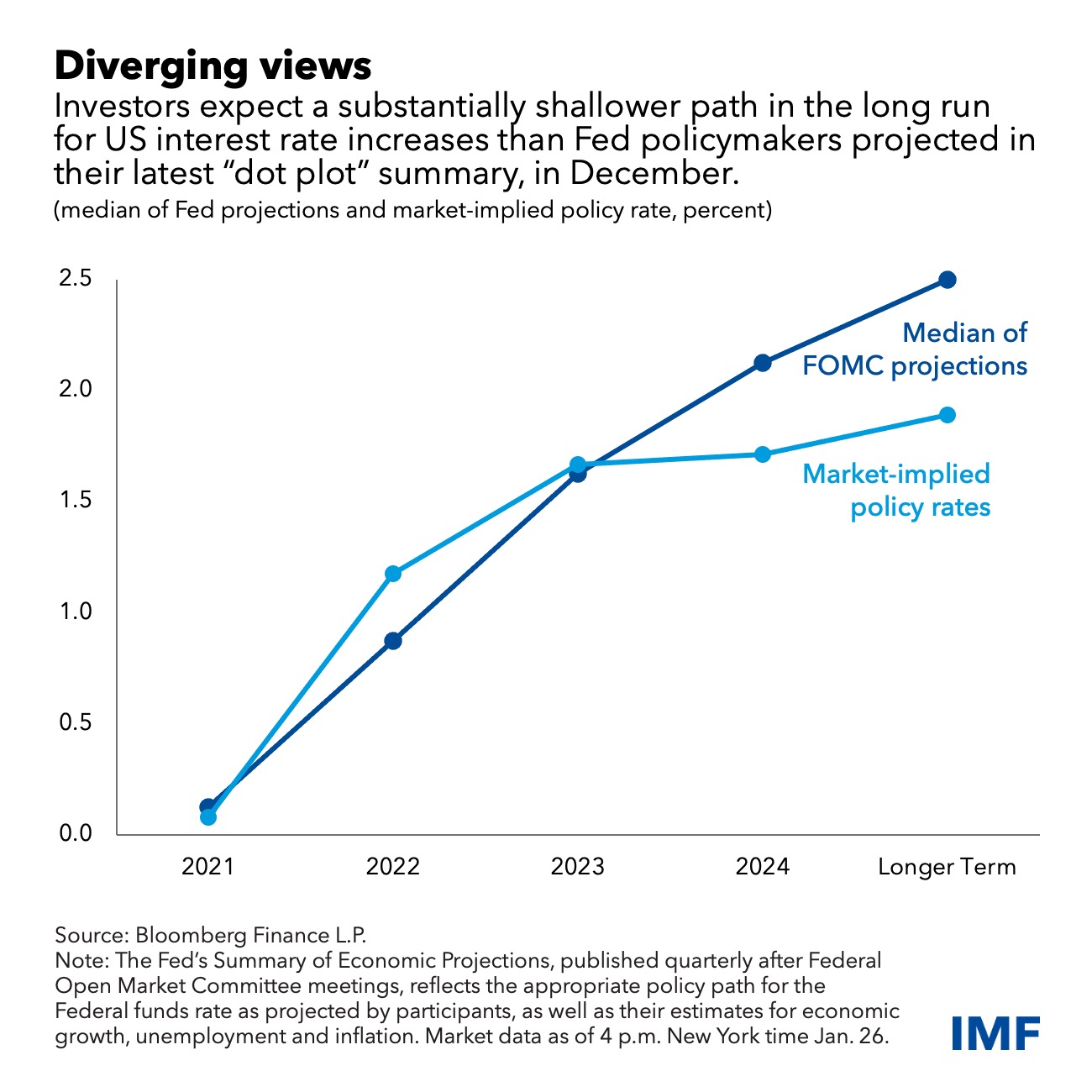
- Federal Reserve officials project that their main interest rate will reach 2.5 percent.
- That is more than half a point higher than what 10-year Treasury yields indicate.
- The divergence implies investors may adjust their expectations of Fed tightening upward both further and faster.
- Central banks might tighten more than they currently anticipate because of persistent inflation; for the Fed this could mean the main interest rate at the end of the tightening cycle might exceed 2.5 percent.
Implications of the rate-path divide for markets
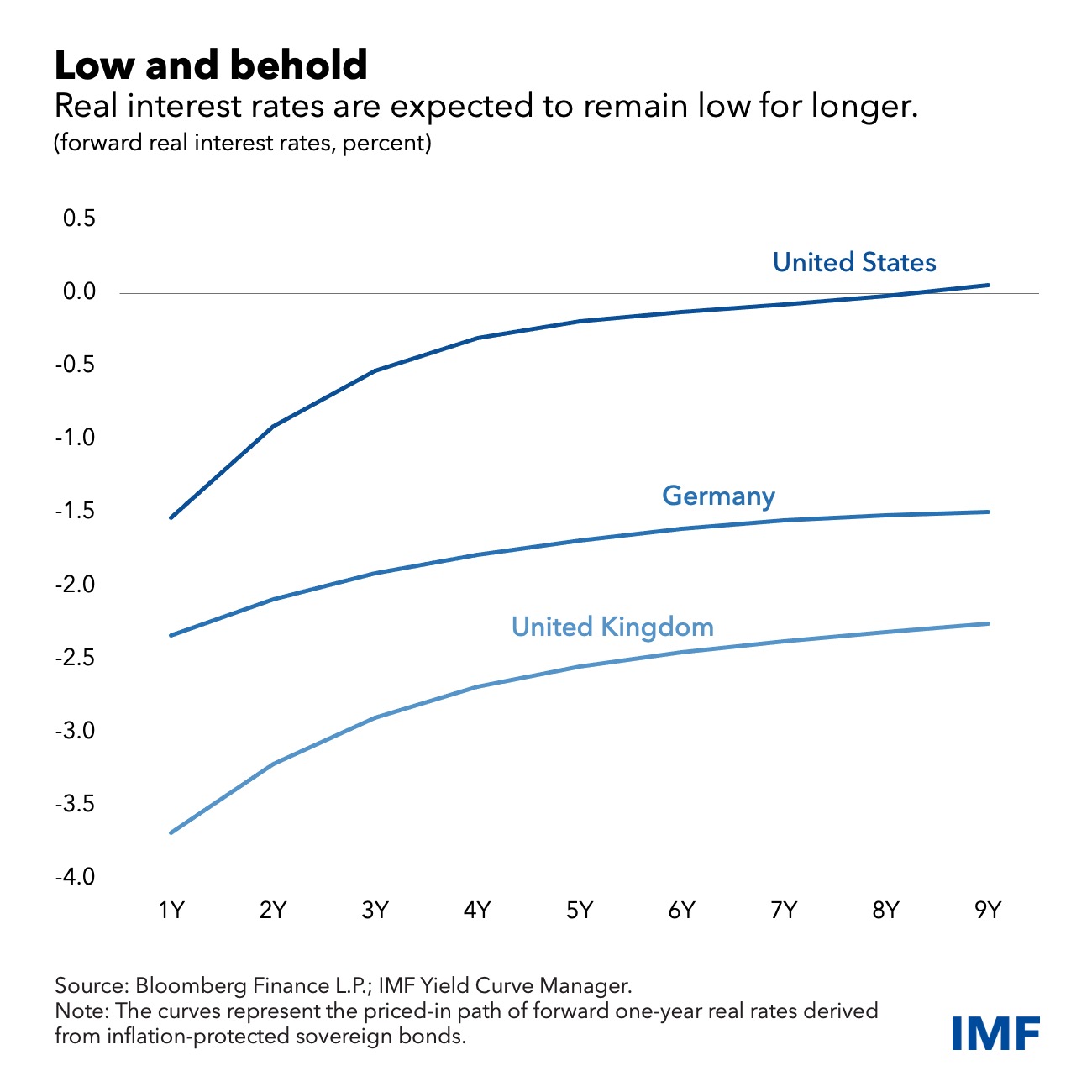
- As a result of high inflation, real rates are historically low despite the recent rebound in nominal interest rates:
- In the United States, long-term rates are hovering around zero while short-term yields are deeply negative.
- In Germany and the United Kingdom, real rates remain extremely negative at all maturities.
- Monetary policy tightening should trigger a real interest rate adjustment, leading to a higher discount rate and, all else equal, lower stock prices.
- After an exceptional year supported by solid earnings, the US equity market started 2022 with a steep retreat amid high inflation, uncertainty about growth and weaker earnings prospects.
- A sudden and substantial rise in real rates could cause a significant drop for US stocks, particularly in highly valued sectors such as technology.
- Already this year:
- the 10-year real yield has increased by nearly half a percentage point;
- stock volatility soared, with the S&P 500 down more than 9 percent for the year and the Nasdaq Composite measure tumbling 14 percent.
Impact on economic growth and emerging markets
- Growth-at-risk estimates, which link future economic growth downside risks to macrofinancial conditions, could increase substantially if real rates rise suddenly and broader financial conditions tighten.
- Easy financial conditions helped governments, consumers, and businesses withstand the pandemic; this resilience could reverse as monetary policy tightens to curb inflation, moderating economic expansions.
- Capital flows to emerging markets could be at risk: stock and bond investments in those economies are generally seen as being less safe, and tightening global financial conditions may cause capital outflows, especially for countries with weaker fundamentals.
Policy recommendations and risks
- With persistent inflation, central banks face a balancing act: monetary policy tightening must be accompanied by some tightening of financial conditions.
- There could be unintended consequences if global financial conditions tighten substantially—a higher and sudden increase in real interest rates could lead potentially to a disruptive price revaluation and an even larger selloff in stocks.
- As financial vulnerabilities remain elevated in several sectors, monetary authorities should provide clear guidance about the future stance of policy to avoid unnecessary volatility and safeguard financial stability.
Source: Tobias Adrian and Nassira Abbas, January 27, 2022.
Content in this bundle
- "Low for Long" and Risk-Taking; IMF Departmental Paper No. DP/20/15; November 2020