Global Inflation Pressures Broadened on Food and Energy Price Gains
IMF Blog, January 28, 2022
Source details
- Canonical URL
- Global Inflation Pressures Broadened on Food and Energy Price Gains
Other formats
Bibliographic details
- Authors: Jorge-Alvarez, Philip-Barrett
- Published: January 28, 2022
Summary of recent drivers
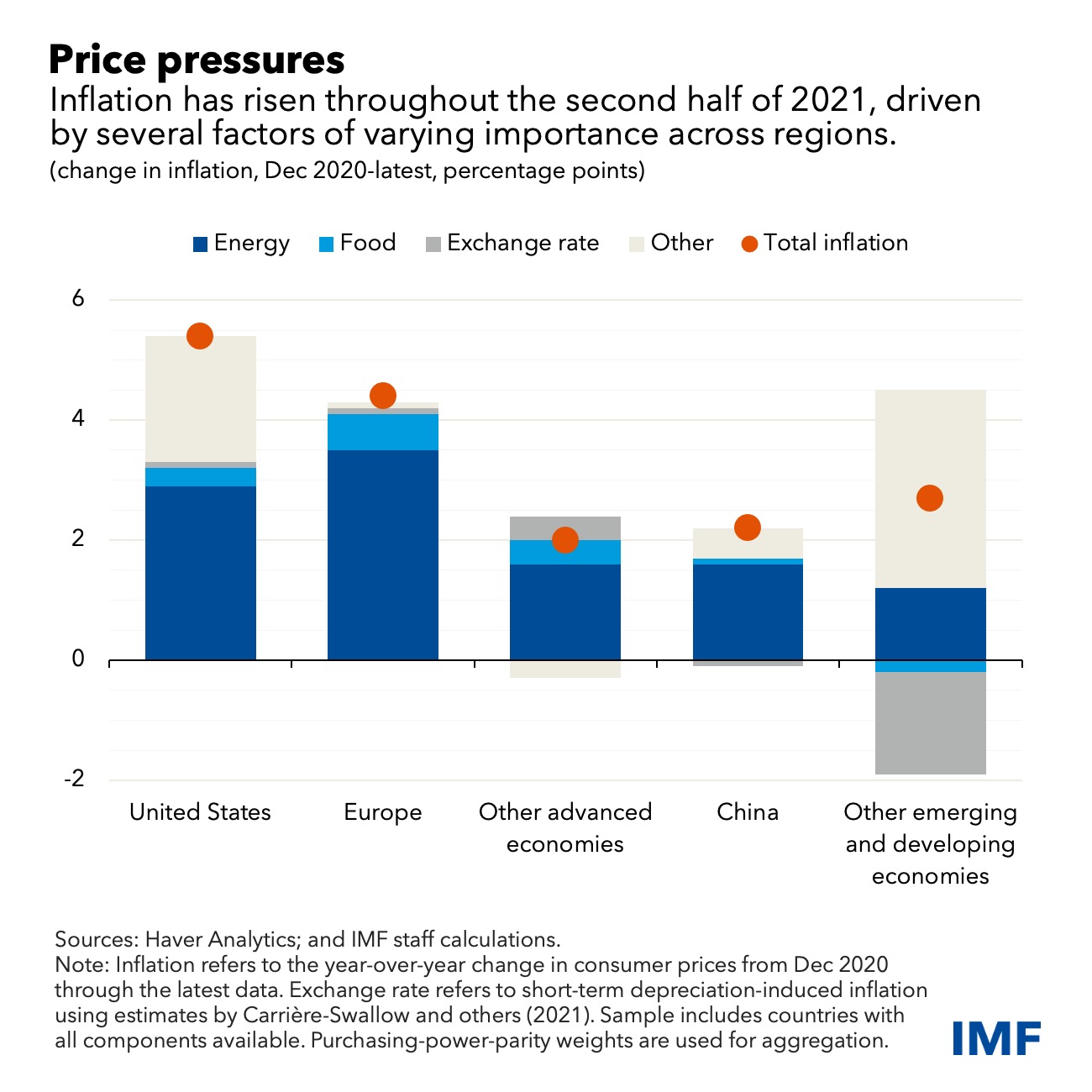
- Fossil-fuel prices nearly doubled in the past year, boosting inflation, especially in Europe.
- Rising food prices have also contributed to higher inflation globally.
- Continuing supply chain disruptions, clogged ports, logistics strains and strong demand for merchandise have broadened price pressures, especially in the United States.
- Higher imported goods prices have contributed to inflation in some regions, including Latin America and the Caribbean.
Projections and scenarios
- Inflation is likely to remain elevated:
- Price gains this year will average 3.9 percent in advanced economies.
- Price gains this year will average 5.9 percent in emerging market and developing economies.
- Under the assumptions that inflation expectations remain well-anchored and the pandemic eventually eases:
- Higher inflation should fade as supply chain woes ease, central banks raise interest rates, and demand tilts more toward services instead of goods-intensive consumption.
- Commodity price outlooks:
- Oil futures contracts indicate crude prices will rise about 12 percent this year.
- Natural gas prices are indicated to climb about 58 percent this year.
- Such increases for both commodities would be considerably less than their gains last year, and would likely be followed by falling prices in 2023 as supply-demand imbalances ease further.
- Food prices are likely to climb at a more moderate pace of about 4.5 percent this year and decline next year—after a rise of 23.1 percent last year, according to the United Nations Food and Agriculture Organization.
Distributional implications
- Rising food and energy prices impose heavier burdens on residents of emerging and low-income nations, where food typically makes up a third to half of consumer spending.
- The share of food in consumer spending is smaller in advanced economies; for example, food accounts for less than one-seventh of household shopping bills in the United States.
Source: Global Inflation Pressures Broadened on Food and Energy Price Gains (IMF, January 28, 2022).