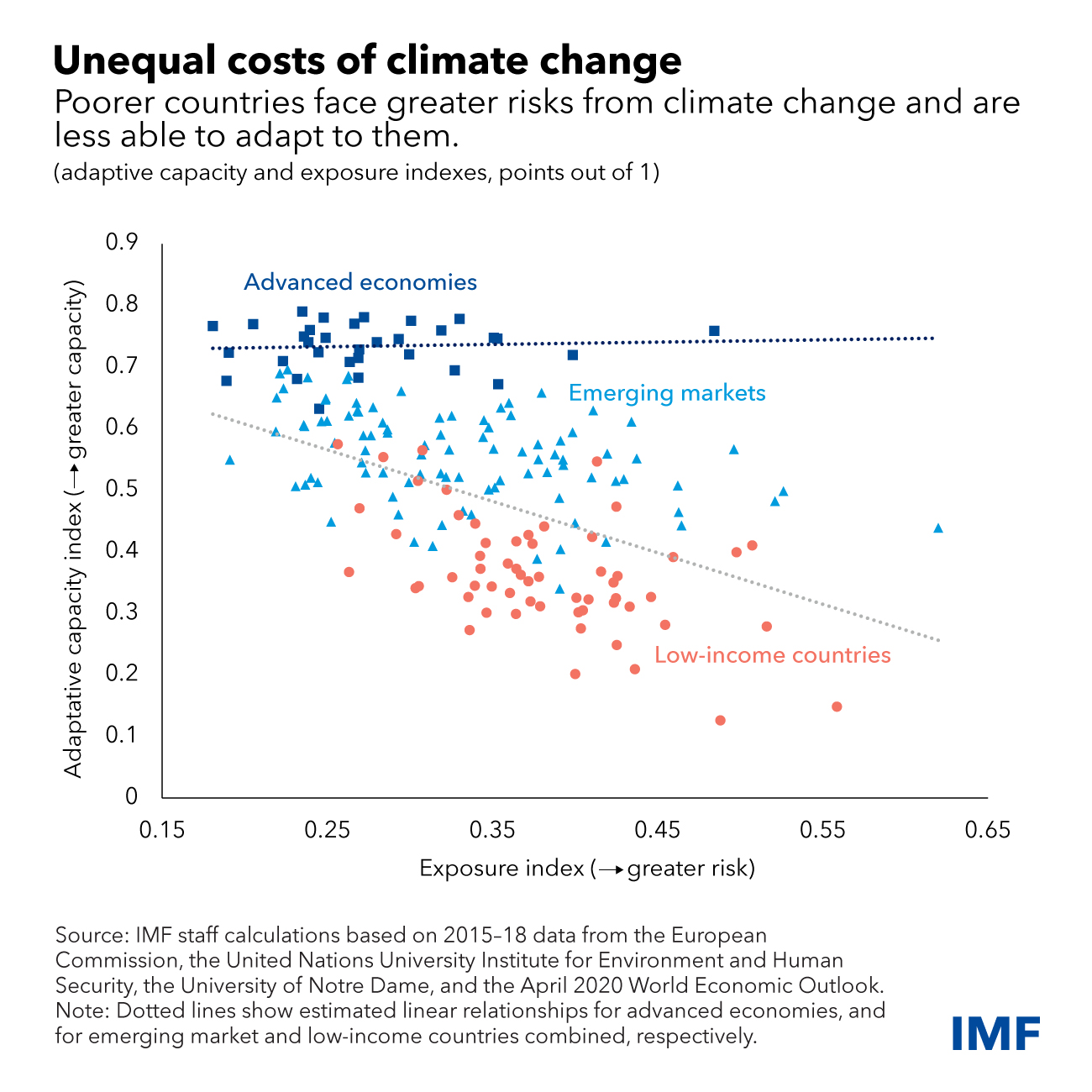
Poor and Vulnerable Countries Need Support to Adapt to Climate Change
IMF Blog, March 23, 2022
Source details
- Canonical URL
- Poor and Vulnerable Countries Need Support to Adapt to Climate Change
Other formats
Bibliographic details
- Authors: Kristalina Georgieva, Vitor Gaspar, Ceyla Pazarbasioglu
- Published: March 23, 2022
Main findings: risks, scope, and rationale for support
- The poorest countries face the greatest risks from climate change and require international support to finance adaptation.
- All countries, rich and poor, must adapt to climate change; adaptation should address risks from climate change and extreme weather, for example by safeguarding agriculture, managing the impact of rising seas, and making infrastructure more resilient.
- The benefits of adaptation depend on specific factors such as how well-adapted a country is to its current climate, but well-crafted policies can produce large returns.
- Sub-Saharan Africa experiences one-third of the world’s droughts and is particularly vulnerable to rising temperatures and extreme weather because of its dependence on rain-fed agriculture.
- A single drought can lower an African country’s medium-term economic growth potential by 1 percentage point.
- Some country-level adaptation successes:
- In Ethiopia, some farmers’ yields rose by up to 40 percent with the development of varieties of wheat that were resistant to rust.
- In Ghana, cocoa farmers made crops more resistant to drought with improved seed and irrigation and by planting trees to shade crops from the sun.
- Climate adaptation does not replace mitigation; without strong mitigation, stabilizing global temperature will be impossible and adaptation would become impossibly expensive.
Cost estimates and distributional challenges
- IMF and other research suggests public adaptation costs will reach around 0.25 percent of global gross domestic product per year in coming decades.
- Annual needs exceed 1 percent of GDP in about 50 low-income and developing economies for the next 10 years.
- Costs can be even larger for small, island nations exposed to tropical cyclones and rising seas, up to 20 percent of GDP.
- Countries most in need typically lack financing and institutional capacity to implement adaptation programs and often face other pressing development needs.
Policy implications and recommendations
- Invest in resilient growth with adaptation fully integrated with other sustainable development goals.
- International community actions:
- Provide financial support to poor and vulnerable countries.
- Develop institutional capacity in recipient countries.
- Ensure adaptation support supplements existing aid, with streamlined conditionality commensurate with the country’s institutional capacity.
- Reduce lengthy and complex requirements that hinder direct access to international climate funds (example: Pacific Island countries).
- Up-front investment in protection can be less expensive for development partners than humanitarian relief and reconstruction after disasters.
- Continue strong global mitigation efforts because adaptation costs would become impossibly expensive without stabilizing global temperature.
IMF actions and support modalities
- The IMF released three reports covering climate adaptation and fiscal policy, macro-fiscal implications, and mainstreaming adaptation into fiscal planning.
- The reports supplement and support work by the World Bank, the Intergovernmental Panel on Climate Change, and other international organizations, and build on existing IMF work.
- IMF operational and analytical support includes:
- Analysis of regional and country challenges of adapting to climate change in annual Article IV consultations and cross-country studies (examples noted for Maldives, Republic of Congo, Dominica, sub-Saharan Africa, the Western Hemisphere, and Asia and the Pacific).
- Capacity development support that now includes climate macroeconomic assessment programs, climate-focused public investment management assessments, and green public financial management.
- Development of financing solutions with member nations and partners, such as the proposed Resilience and Sustainability Trust, to channel financial resources from countries with strong external positions into affordable long-term financing for vulnerable countries.
- Financing support aims to help recipients address structural challenges such as climate change through policy reforms to foster balance of payments stability.
Article by Kristalina Georgieva, Vitor Gaspar and Ceyla Pazarbasioglu — March 23, 2022
Content in this bundle
- 1domea2019001
- Fpaccapea
- Executive Summary and Policy Implications
- Policy Paper
- Chapter 1
- Full Report
- Full Report
- Full Report
- Climate-Sensitive Management of Public Finances—"Green PFM”; August 11, 2021
References
- عربي
- 日本語
- Português
- climate change
- climate adaptation and fiscal policy
- macro-fiscal implications
- bringing climate adaptation into the mainstream
- Ethiopia
- adaptation
- small, island nations
- https://www.imf.org/wp-content/uploads/2022/03/Climate-Blog-Chart-v2.jpg
- Maldives
- Republic of Congo
- Resilience and Sustainability Trust