How Soaring Shipping Costs Raise Prices Around the World
IMF Blog, March 28, 2022
Source details
- Canonical URL
- How Soaring Shipping Costs Raise Prices Around the World
Other formats
Bibliographic details
- Authors: Yan Carrire-Swallow, Pragyan Deb, Davide Furceri, Daniel Jimenez, Jonathan D Ostry
- Published: March 28, 2022
Key findings and magnitudes
- The sea carries more than 80 percent of the world’s traded goods, most transported in 40-foot-long steel containers.
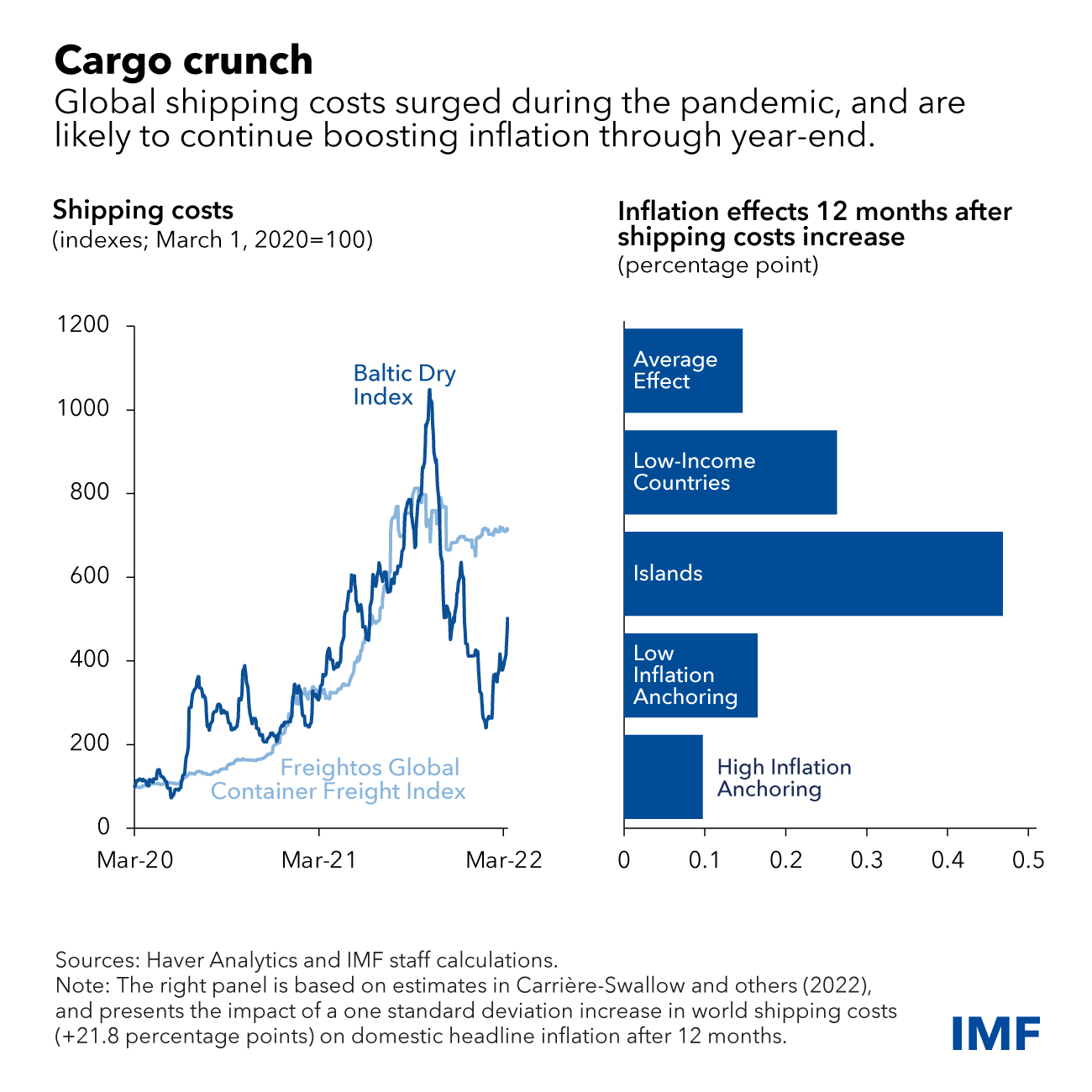
- In the 18 months following March 2020, the cost of shipping a container on the world’s transoceanic trade routes increased seven-fold, while the cost of shipping bulk commodities spiked even more.
- Using data from 143 countries over the past 30 years, the analysis finds:
- When freight rates double, inflation picks up by about 0.7 percentage point.
- The effects are persistent, peaking after a year and lasting up to 18 months.
- The increase in shipping costs observed in 2021 could increase inflation by about 1.5 percentage points in 2022.
Transmission mechanisms and timing
- Pass-through to import and producer prices:
- Higher shipping costs hit prices of imported goods at the dock within two months.
- These higher import costs quickly pass through to producer prices, reflecting reliance on imported inputs.
- Pass-through to consumer prices:
- The impact on consumer prices builds more gradually and hits its peak after 12 months.
- This slower pass-through to consumers contrasts with global oil-price shocks, which drivers feel at the pump within a couple of months.
- Volatility and contribution to inflation variation:
- While the pass-through to inflation from shipping costs is less than that from fuel or food prices (which account for a larger share of consumer purchases), shipping costs are much more volatile.
- Consequently, the contribution in the variation of inflation due to global shipping price changes is quantitatively similar to the variation generated by shocks to global oil and food prices.
Cross-country heterogeneity
- Structural and exposure factors that amplify inflationary effects:
- Countries that import more of what they consume see larger increases in inflation.
- Countries more integrated into global supply chains experience larger inflation effects.
- Countries that typically pay higher freight costs (landlocked countries, low-income countries, and especially island states) see more inflation when shipping costs rise.
- Policy framework interaction:
- A strong and credible monetary policy framework can mitigate second-round effects from import prices and inflation.
- Keeping inflation expectations well-anchored is key to containing the effect of soaring shipping costs on consumer prices, particularly core measures that exclude fuel and food.
Outlook and policy implications
- The analysis suggests the inflationary impact of shipping costs will continue to build through the end of 2022.
- Central bankers face complicated trade-offs: increasing inflation pressures from higher shipping costs amid still ample slack in economic activity.
- The war in Ukraine (noted as occurring after this analysis was prepared) is likely to cause further supply-chain disruptions, which could keep global shipping costs—and their inflationary effects—higher for longer.
Source: IMF Blog — How Soaring Shipping Costs Raise Prices Around the World (March 28, 2022)