First Global Bank Stress Test Highlights Increased Financial Resilience
IMF Blog, April 6, 2022
Source details
- Canonical URL
- First Global Bank Stress Test Highlights Increased Financial Resilience
Other formats
Bibliographic details
- Authors: Tobias Adrian, Vikram Haksar, Ivo Krznar
- Published: April 6, 2022
Overview of the Global Bank Stress Test
- The Global Bank Stress Test provides a first-of-its-kind assessment of potential shocks and spillovers to the world’s banks and is a major milestone in the IMF’s ability to gauge the impact of global shocks like the pandemic.
- Originally outlined in the October 2020 Global Financial Stability Report.
- Intended as a useful new tool for central banks and financial regulators to consider the effects of global shocks on domestic systems.
Data coverage and methodology
- Analysis includes a quarter century of bank-level data through 2020.
- Sample: 257 of the largest lenders from across 24 advanced economies and five emerging markets.
- Together, these institutions account for 70 percent of the world’s banking assets.
- In each economy, the stress test covers as many institutions as necessary to account for at least 80 percent of assets for the individual banking systems.
- The comprehensive global sweep addresses limitations of national-level stress tests that focus more on domestic risks and use differing data and methodologies.
Key findings and statistics
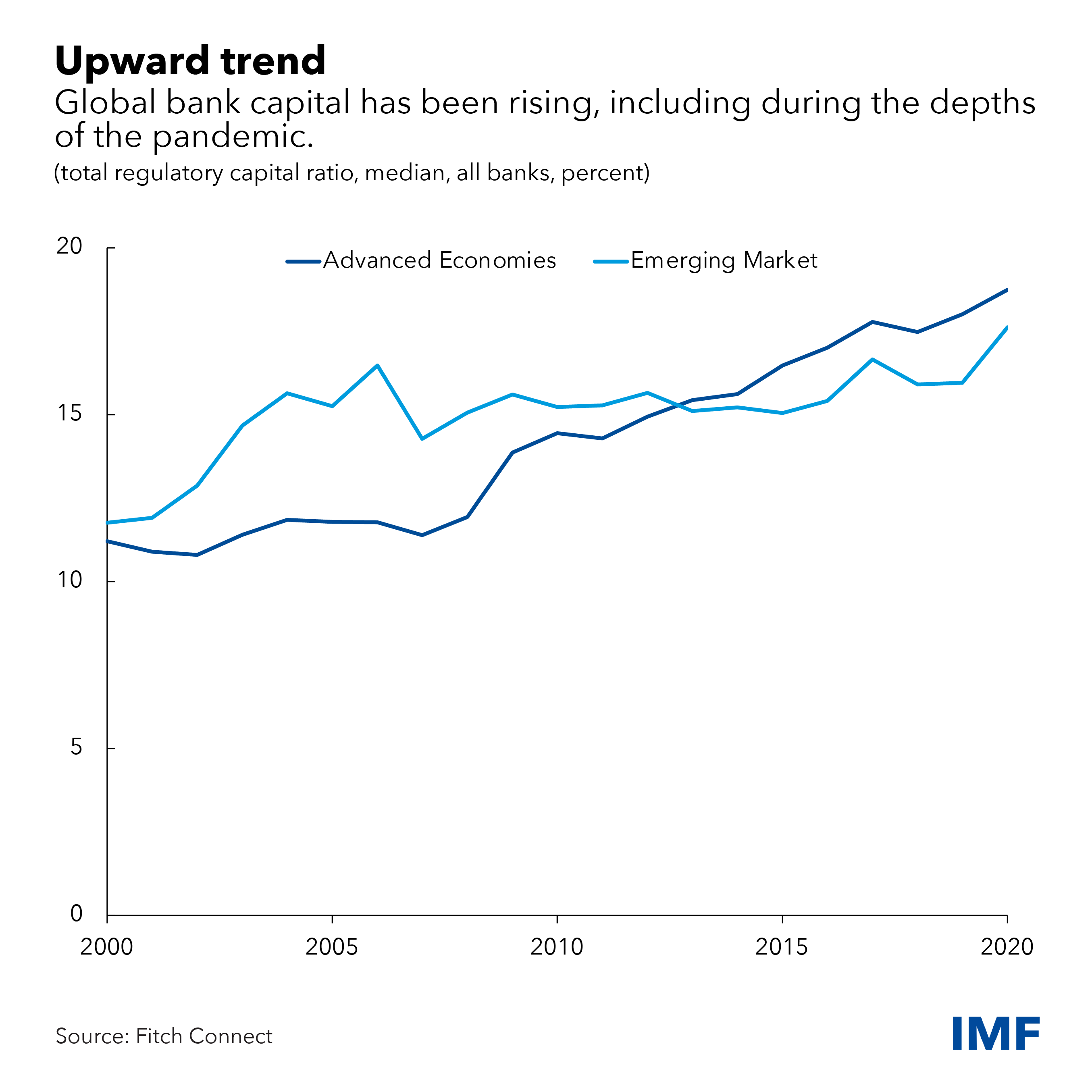
- Banking systems saw significant capital increases ahead of the pandemic, reflecting reforms launched after the 2008 Global Financial Crisis.
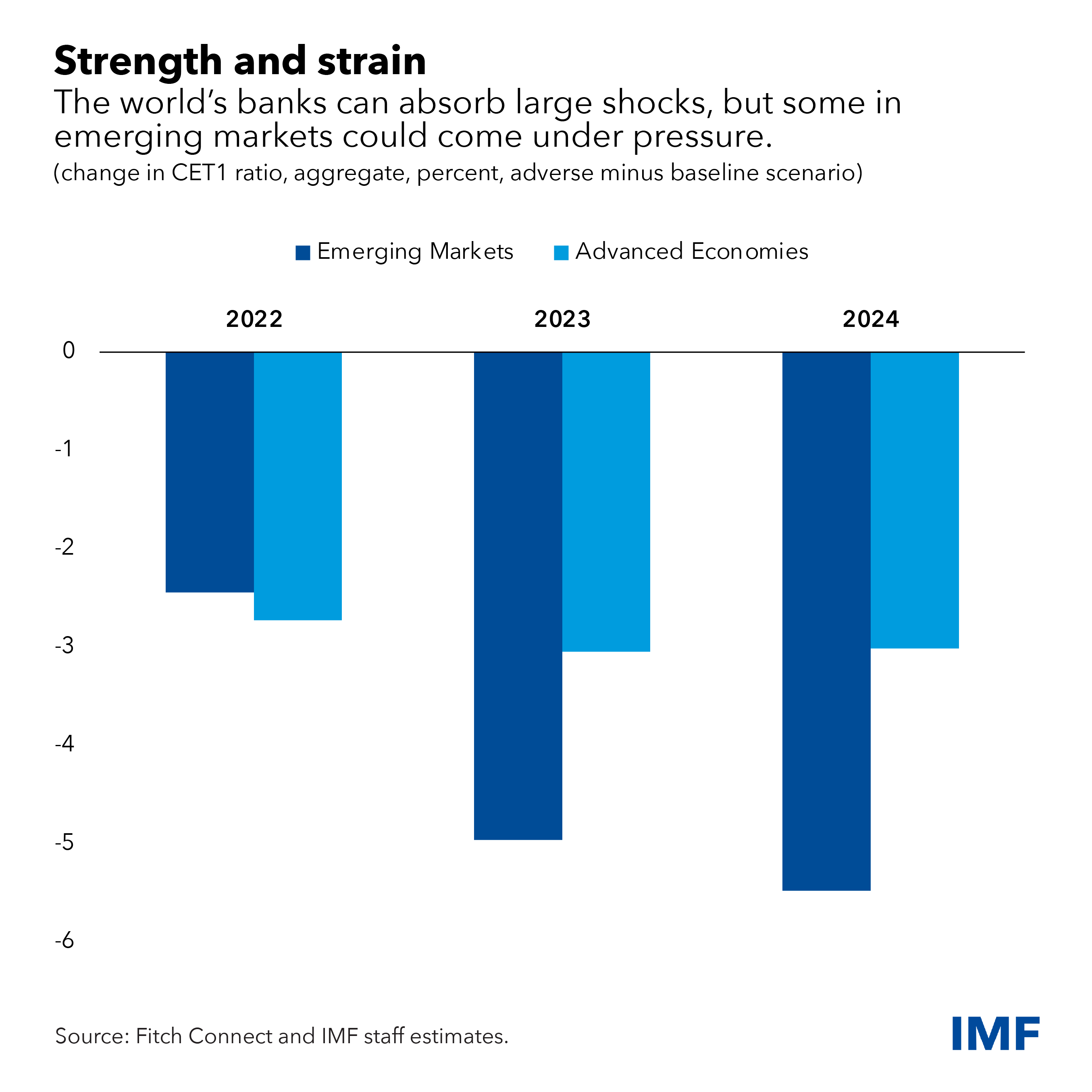
- The Global Bank Stress Test results applied to scenarios broadly in line with the pandemic shock show an encouraging picture of resilience.
- In the test’s adverse scenario:
- Global gross domestic product was about 5 percentage points lower than IMF fall 2021 baseline assumptions for 2022.
- Global gross domestic product was 2.5 percentage points less for 2023.
- Banks in emerging markets face greater risks in an adverse scenario, reflecting the higher sensitivity of their core equity capital to shocks.
- A sharper tightening in financial conditions for vulnerable businesses in emerging markets and developing economies results in a larger shock for those economies that also have a higher sensitivity of their core equity capital to shocks.
Implications, limitations, and policy guidance
- The results suggest that banking systems remain able to absorb shocks from adverse developments in global growth and risk premia broadly in line with those seen during the pandemic.
- Continued close monitoring is needed, especially in emerging economies that still have pockets of vulnerability and more constrained policy space to respond to new challenges.
- The stress test is a useful tool for central banks and financial regulators to consider cross-border spillovers and effects of global shocks on domestic systems.
- Analysis predates the war in Ukraine and current concerns about stagflation; these developments add uncertainty to the evolution of capital levels during 2021 and the policy space to absorb new shocks.
Research contributions
- Research contributions to the departmental paper from Xiaodan Ding, Marco Gross, Dimitrios Laliotis, Fabian Lipinsky, Pavel Lukyantsau, and Thierry Tressel are reflected in the blog.
Source: First Global Bank Stress Test Highlights Increased Financial Resilience — Tobias Adrian, Vikram Haksar, Ivo Krznar; April 6, 2022 (IMF Blog).