Tax Coordination Can Lead to a Fairer, Greener Global Economy
IMF Blog, April 12, 2022
Source details
- Canonical URL
- Tax Coordination Can Lead to a Fairer, Greener Global Economy
Other formats
Bibliographic details
- Authors: Vitor Gaspar, Shafik Hebous, Paolo Mauro
- Published: April 12, 2022
Overview
- Authors: Vitor Gaspar, Shafik Hebous, Paolo Mauro
- Date: April 12, 2022
- Central thesis: International tax coordination across three areas—taxing large corporations, sharing information on offshore holdings, and enacting fair carbon pricing—can raise revenue, tackle inequality, and fight climate change.
Key points on global tax challenges
- Technology, globalization, and global warming have increased mobility of income and factors of production, creating cross-border tax challenges.
- Tax evasion and avoidance reduce revenue available for social spending and infrastructure, exacerbate inequality, and generate perceptions of unfairness.
- Uncoordinated national tax policies can produce damaging cross-border spillovers and leave all countries worse off.
Coordinating on corporate taxation — Findings and implications
- Background: Widespread dissatisfaction with low tax payments by major multinationals despite annual profits of 9 percent of global gross domestic product.
- 137 countries reached a breakthrough in 2021 under the Two Pillars Solution of the Inclusive Framework.
- Pillar 1:
- Principle: A portion of multinationals’ profits must be taxed where goods or services are used or consumed.
- Finding: The agreed reallocation of tax revenue covers only 2 percent of global profit of multinationals.
- Benefit: Sets a principle better adapted to digital commerce than unilateral digital services taxes.
- Pillar 2:
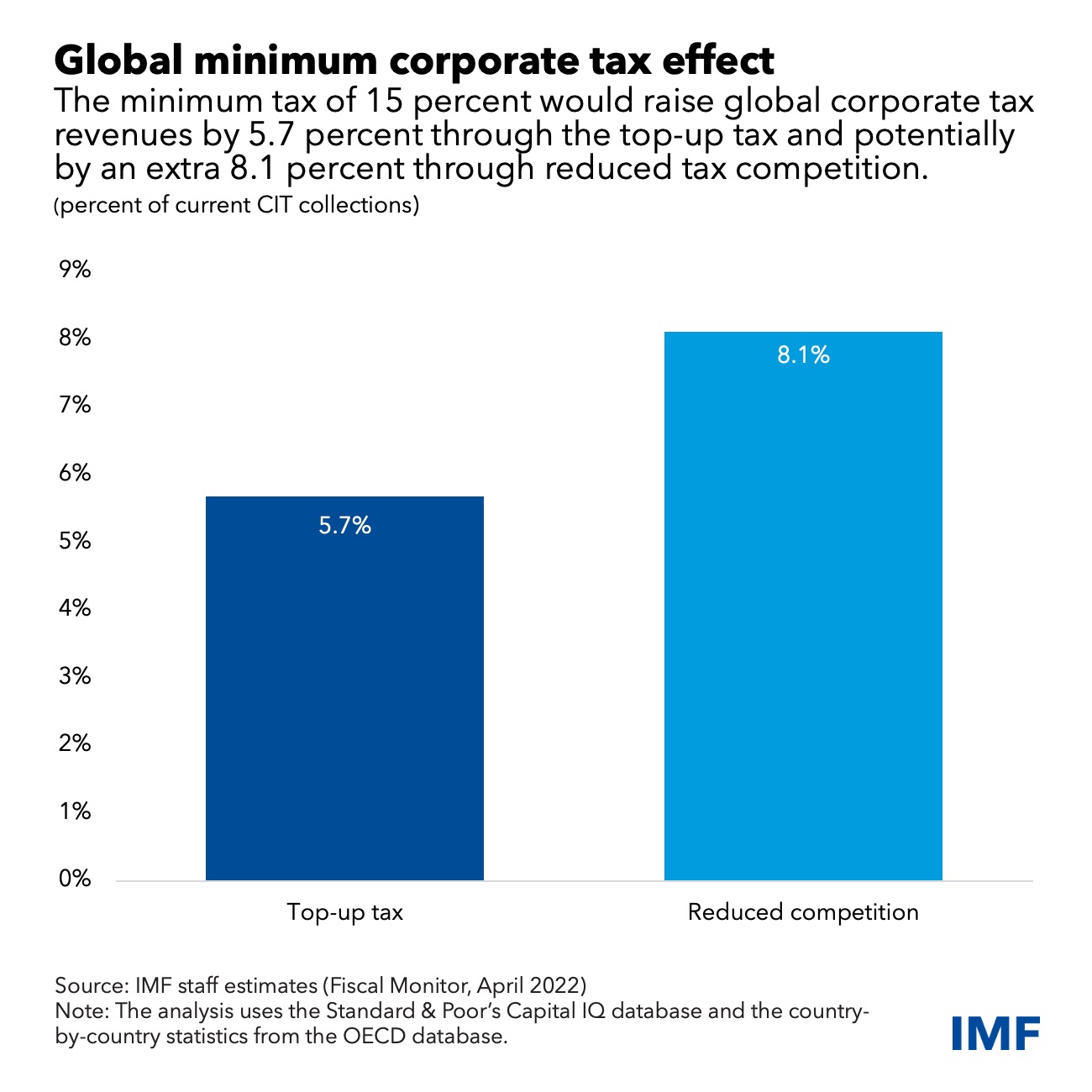
- Establishes a global minimum corporate tax of 15 percent.
- Impact estimates:
- Some nations topping up their tax on “undertaxed” profit could increase corporate tax revenues by up to 6 percent globally.
- Reversal of downward trend in corporate income tax rates could raise revenue by another 8 percent.
- Combined (topping up plus reduced tax competition) effect: 14 percent.
- Policy recommendations and caveats:
- Continue work to better adapt rules to low-income countries’ circumstances (examples: simplify aspects of corporate taxation, strengthen withholding taxes on cross-border payments, share more country-by-country information on multinationals).
- Low-income economies should adopt complementary reforms, such as removing wasteful tax incentives, to reap benefits.
Coordinating on personal taxation — Findings and recommendations
- Offshore wealth and tax loopholes exposed by leaks (Panama Papers, Paradise Papers) reveal a massive stock of offshore wealth and facilitate hiding of corrupt proceeds.
- Information sharing:
- 163 countries have agreed to exchange information under the Global Forum on Transparency and Exchange of Information for Tax Purposes.
- Need: Improve the reliability of exchanged information.
- Recommendation: Promote beneficial ownership registries and centralize information in a public database; effective use of information is critical for enforcement.
- Low-income countries need to develop more know-how to realize transparency benefits.
- Cross-border remote work:
- Phenomenon: Increasing mobility of labor and rise of digital-nomad visas.
- Estimate: Cross-border remote work reallocates personal income tax revenue between countries by 1.25 percent of global personal income tax revenue.
- Implication: Coordination will gain importance to ensure consistent tax treatment between countries where employers and employees reside.
Coordinating on carbon pricing — Findings and policy guidance
- Urgency: Rapid increase in greenhouse gas emissions risks global warming of more than double the tolerably safe limit.
- Proposal: An international carbon price floor analogous to a global minimum corporate tax.
- Benefits and features:
- A few key emitting countries can start coordination and produce significant effects.
- Discourages emissions and alleviates competitiveness concerns.
- Would limit global warming to 2 degrees Celsius or less while accommodating alternative approaches (for example, regulation via equivalent price calculations).
- Could allow differentiated responsibilities depending on income level.
- Near-term policy guidance amid energy price shocks:
- Prefer targeted transfers or lump-sum utility bill discounts to support people rather than subsidizing fossil fuel consumption.
- Near-term responses should not detract from investing in renewable energy and energy efficiency.
- Countries that have set gradual rising paths for carbon taxation should stay the course—envisaged increases are far smaller than recent price gyrations from global shocks.
- Use revenues to ensure workers and communities benefit from the green transition.
- International imperative: Agreeing on a carbon price floor (or equivalent measures) remains urgent.
Conclusion — Rationale for cooperation
- History shows collaboration increases effectiveness in counteracting pandemics and conflicts.
- Cooperative tax reforms—better taxing corporations, fighting tax evasion, and acting on carbon pricing—can deliver a fairer and greener global economy.
Source: IMFBlog — “Tax Coordination Can Lead to a Fairer, Greener Global Economy,” Vitor Gaspar, Shafik Hebous, Paolo Mauro, April 12, 2022.