Private Debt to Weigh on Global Economic Recovery
IMF Blog, April 18, 2022
Source details
- Canonical URL
- Private Debt to Weigh on Global Economic Recovery
Other formats
Bibliographic details
- Authors: Silvia Albrizio, Sonali Das, Christoffer Koch, Jean-Marc-Natal, Philippe Wingender
- Published: April 18, 2022
Key findings
- Global private debt surged by 13 percent of the world’s gross domestic product in 2020—faster than the rise seen during the global financial crisis and almost as fast as public debt.
- We estimate that recent levels of leverage could slow economic recovery by a cumulative 0.9 percent of GDP in advanced economies and 1.3 percent in emerging markets on average over the next three years.
- Aggregate figures mask large variation across countries and within countries by income group and sector.
Cross-country and within-country variation
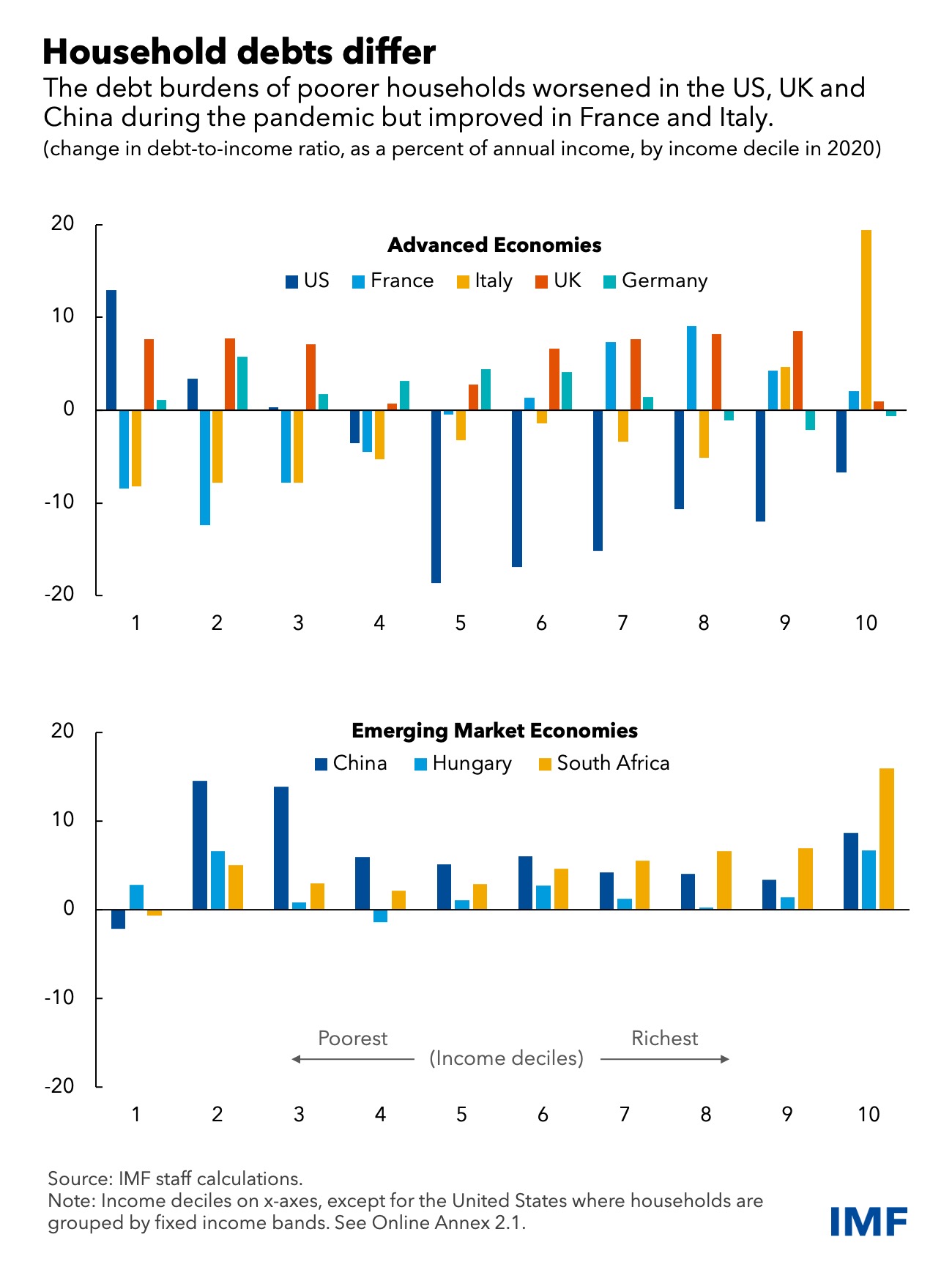
- The impact of the pandemic on household and firm finances varied across countries and within them, reflecting differences in policy responses and sectoral composition.
- Consumers in China and South Africa saw the largest increases in household debt ratios among the countries for which detailed data are available.
- In China leverage increased the most among lower-income households.
- In South Africa households with higher incomes accounted for most of the increase.
- Among advanced economies, low-income households in the United States, Germany, and the United Kingdom saw comparatively larger increases in debt than those in France and Italy, where leverage actually declined for poorer households.
- Vulnerable firms—highly concentrated in contact-intensive services—often borrowed to survive revenue drops; countries with a higher share of contact-intensive sectors are likely to see larger future investment declines.
Quantified effects of tighter financial conditions
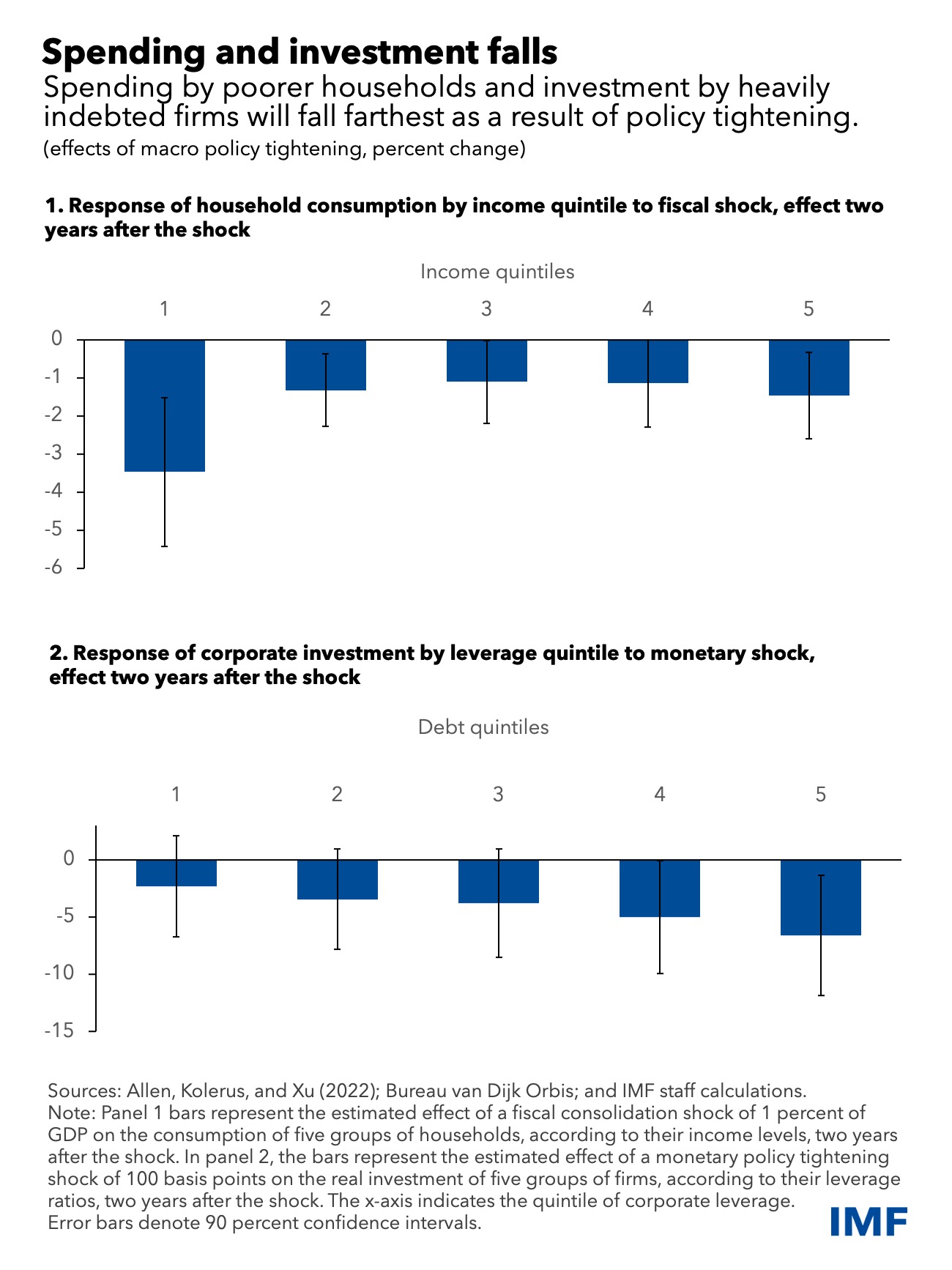
- A surprise tightening of 100 basis points would slow investment by the most leveraged firms by a cumulative 6.5 percentage points over two years—four percentage points more than for the least leveraged.
- Low-income households and vulnerable firms (highly indebted and unprofitable businesses that are struggling to make interest payments) are likely to make sharper cuts to consumption and investment spending, amplifying the drag on future growth where indebtedness is concentrated among these groups.
Policy recommendations
- Fiscal policy:
- Where the recovery is well underway and balance sheets are in good shape, fiscal support could be reduced faster to facilitate central bank action.
- Elsewhere, governments should target fiscal support to the most vulnerable in the transition to recovery while keeping within credible medium-term fiscal frameworks.
- Consider cost-effective debt restructuring programs aimed at transferring resources to relatively vulnerable individuals who are more likely to spend their income; program design should seek to minimize moral hazard.
- Monetary policy:
- When pacing the exit from extraordinary support policies, take account of the impact of fiscal and monetary tightening on the most financially stretched consumers and businesses.
- To prevent rapid tightening from causing large disruptions, policymakers should pay close attention to adverse developments in the financial sector.
- Insolvency and restructuring:
- Authorities should enhance restructuring and insolvency mechanisms (through dedicated out-of-court restructuring, for instance) to promote rapid reallocation of capital and labor toward the most productive firms.
- Governments in countries facing potential waves of bankruptcies in pandemic-hit sectors could incentivize restructuring over liquidation and, where necessary, extend solvency support.
Monitoring and implementation priorities
- The post-pandemic drag on growth could be much larger in countries where:
1. indebtedness is more concentrated among financially stretched households and vulnerable firms, 2. fiscal space is limited, 3. the insolvency regime is inefficient, and 4. monetary policy needs to be tightened rapidly.
- Careful, real-time monitoring of the balance sheets of low-income households and vulnerable firms is key to calibrating the unwinding of support measures and preventing sudden distress when financial conditions tighten.
This blog, based on Analytical Chapter 2 of the April 2022 World Economic Outlook, “Private Sector Debt and the Global Recovery,” also reflects support from Evgenia Pugacheva and Yarou Xu.