Financial Stability Risks Grow as War Complicates Push to Contain Inflation
IMF Blog, April 19, 2022
Source details
- Canonical URL
- Financial Stability Risks Grow as War Complicates Push to Contain Inflation
Other formats
Bibliographic details
- Authors: Tobias Adrian
- Published: April 19, 2022
Overview and main findings
- Author and date: Tobias Adrian, April 19, 2022.
- Russia's invasion of Ukraine raises financial stability risks globally and tests the resilience of financial markets amid an already slowing recovery from the pandemic.
- Severity of disruptions in commodity markets and to supply chains are creating downside risks by weighing adversely on macrofinancial stability, inflation, and the global economy.
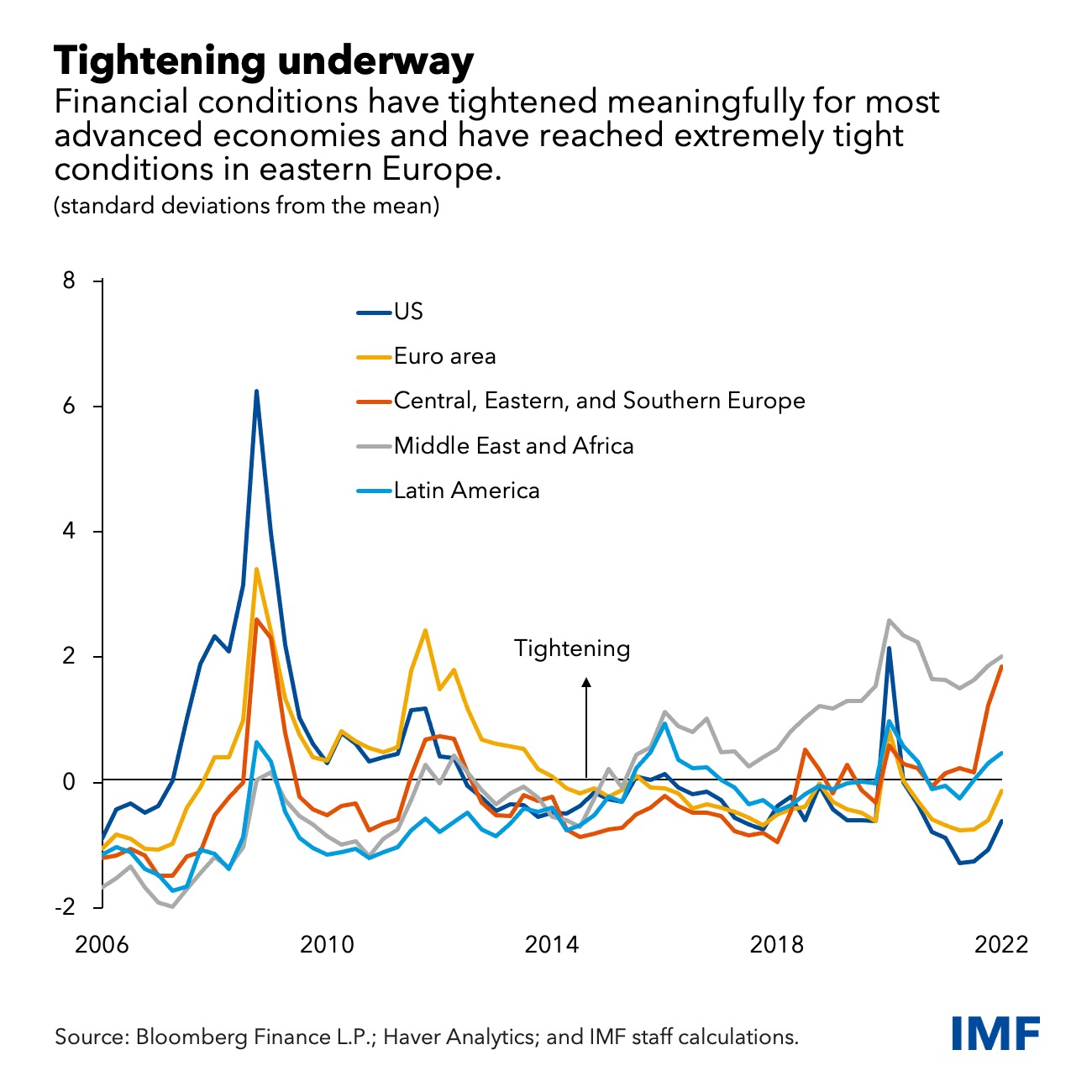
- Since the beginning of the year, financial conditions have tightened significantly across most of the world, particularly in Eastern Europe.
- Even with that tightening, financial conditions are close to historical averages, and real rates remain accommodative in most countries.
- Many central banks may have to move further and faster than what is currently priced in markets to contain inflation; this could bring policy rates above neutral levels (a “neutral” level is one at which monetary policy is neither accommodative nor restrictive and is consistent with the economy maintaining full employment and stable inflation).
Shock transmission and amplification channels
- Repercussions of the war and ensuing sanctions reverberate through multiple amplification channels:
- exposures of financial institutions to Russian and Ukrainian assets;
- market liquidity and funding strains;
- acceleration of cryptoization—residents opting to use crypto assets instead of the local currency—in emerging markets.
- Ongoing volatility in commodity prices may severely pressure commodity financing and derivatives markets and could cause disruptions like the wild swings that halted some nickel trading.
- Any sudden reassessment and repricing of risk from an intensification of the war in Ukraine, or from an escalation of sanctions on Russia, may expose vulnerabilities built up during the pandemic (surge in house prices and stretched valuations), leading to a sharp decline in asset prices.
Regional and market-specific risks
- Europe:
- Bears higher risk due to geographic proximity to the war, reliance on Russian energy, and non-negligible exposure of some banks and other financial institutions to Russian financial assets and markets.
- Emerging and frontier markets:
- Face higher risks of capital outflows, with differentiation between commodities importers and exporters.
- Interplay of tighter external financial conditions and the US Federal Reserve normalization (first rate increase delivered in March and unwinding of the balance sheet expected to be faster) is likely to increase the risk of capital flight.
- Following the Russian invasion of Ukraine, the number of emerging and frontier market sovereign issuers trading at distressed levels (that is, spreads above 1,000 basis points) has surged higher to more than 20 percent of issuers, surpassing pandemic-peak levels.
- While worrisome, this has a limited impact on systemic concerns given these issuers account for a relatively lower proportion of total outstanding debt, to date.
- China:
- Recent equity sell-off, particularly in the technology segment, ongoing stress in the real estate sector, and renewed lockdowns raise concerns about a growth slowdown with possible spillovers to emerging markets.
- Financial stability risks have risen amid ongoing stress in the battered real estate sector; extraordinary financial support measures may be needed to ease balance sheet pressures, but these would add to debt vulnerabilities down the road.
Policy recommendations and near-term actions
- Central banks (near term):
- Take decisive action to prevent inflation from becoming entrenched and keep expectations of future price increases in check.
- Interest rates might have to rise beyond what is currently priced in markets to get inflation back to target in a timely manner; this may entail pushing interest rates well above their neutral level.
- For advanced-economy central banks, clear communication is crucial to avoid unnecessary volatility in financial markets, by providing clear guidance about the tightening process while remaining data dependent.
- Emerging-market central banks:
- Many have already significantly tightened policy and should continue to do so—depending on individual circumstances—to preserve their inflation-fighting credibility and anchor inflation expectations.
- Macroprudential and regulatory policy:
- Tighten selected macroprudential tools to tackle pockets of elevated vulnerabilities (for example, to lean against the surge in house prices), while avoiding a broad tightening of financial conditions.
- Narrow regulatory gaps to ensure integrity and protect consumers in the fast-evolving world of crypto assets.
- Address fragmentation in capital markets and implications for the role of the US dollar; monitor payment systems and central bank digital currency developments.
Energy, climate, and structural tradeoffs
- Tradeoffs between energy security (adequate, affordable supplies) and climate (regulatory mechanisms intended to increase oil and gas prices) are being laid bare as sanctions on Russia ripple across Europe and beyond.
- There may be some setbacks in the climate transition in the immediate future, but reduced energy dependency on Russia could catalyze change.
- Policymakers should strive to honor commitments on climate and intensify efforts to achieve net-zero targets, while taking additional appropriate steps to address energy security concerns.
IMF blog post: Financial Stability Risks Grow as War Complicates Push to Contain Inflation (Tobias Adrian, April 19, 2022).
Content in this bundle
- Chapter 1