War Dims Global Economic Outlook as Inflation Accelerates
IMF Blog, April 19, 2022
Source details
- Canonical URL
- War Dims Global Economic Outlook as Inflation Accelerates
Other formats
Bibliographic details
- Authors: Pierre-Olivier Gourinchas
- Published: April 19, 2022
Overview and growth revisions
- Global economic prospects have been severely set back largely because of Russia’s invasion of Ukraine.
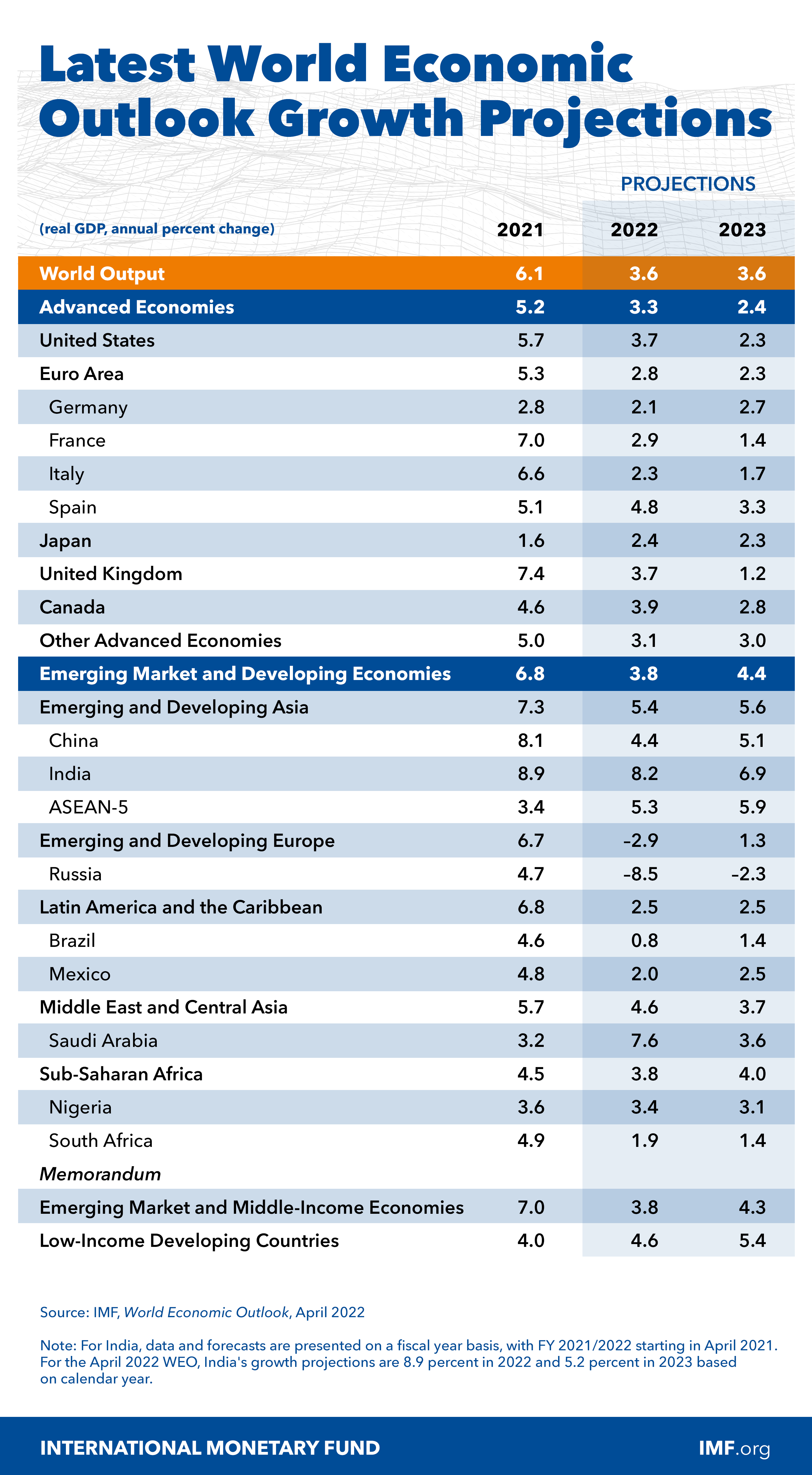
- Compared to our January forecast, we have revised our projection for global growth downwards to 3.6 percent in both 2022 and 2023.
- This revision reflects the direct impact of the war on Ukraine and sanctions on Russia, with both countries projected to experience steep contractions.
- This year’s growth outlook for the European Union has been revised downward by 1.1 percentage points due to the indirect effects of the war, making it the second largest contributor to the overall downward revision.
- The medium-term outlook is revised downwards for all groups, except commodity exporters who benefit from the surge in energy and food prices.
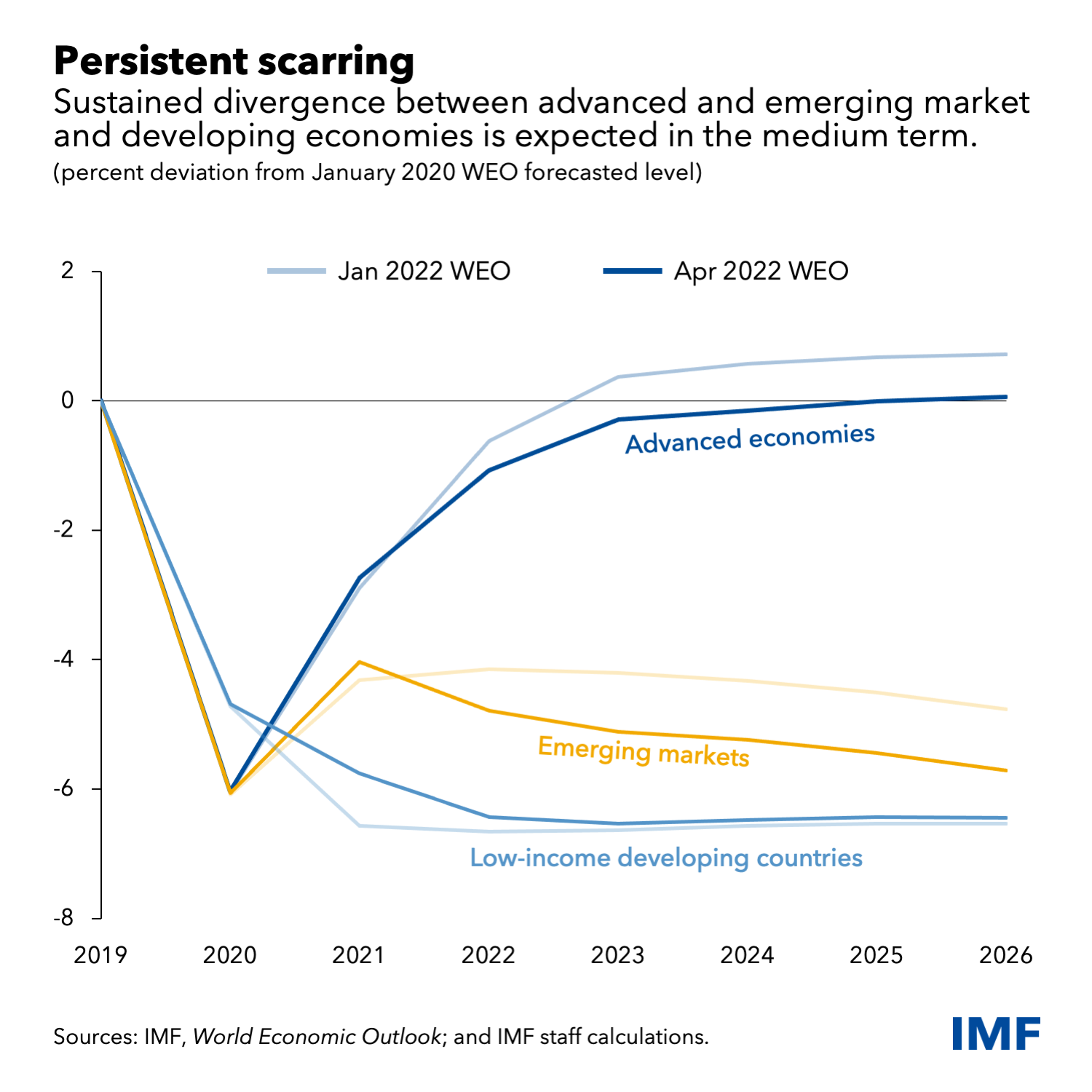
- Aggregate output for advanced economies will take longer to recover to its pre-pandemic trend.
- The divergence that opened up in 2021 between advanced and emerging market and developing economies is expected to persist, suggesting some permanent scarring from the pandemic.
Inflation, supply shocks, and monetary policy
- The war adds to the series of supply shocks that have struck the global economy in recent years, propagating through commodity markets, trade, and financial linkages.
- Reduced supplies of oil, gas, metals, wheat, and corn have driven prices up sharply.
- Inflation has become a clear and present danger for many countries; even prior to the war it surged due to soaring commodity prices and supply-demand imbalances.
- Many central banks, such as the Federal Reserve, had already moved toward tightening monetary policy.
- We now project inflation will remain elevated for much longer.
- In the United States and some European countries, inflation has reached its highest level in more than 40 years, in the context of tight labor markets.
- The risk is rising that inflation expectations drift away from central bank inflation targets, prompting a more aggressive tightening response from policymakers.
- Clear communication and forward guidance on the outlook for monetary policy will be essential to minimize the risk of disruptive adjustments.
Regional impacts, refugees, and vulnerable populations
- Commodity importers in Europe, the Caucasus and Central Asia, the Middle East and North Africa, and sub-Saharan Africa are most affected by surging food and fuel prices.
- The surge in food and fuel prices will hurt lower-income households globally, including in the Americas and the rest of Asia.
- Eastern Europe and Central Asia have large direct trade and remittance links with Russia and are expected to suffer.
- The displacement of about 5 million Ukrainian people to neighboring countries, especially Poland, Romania, Moldova and Hungary, adds to economic pressures in the region.
- Increases in food and fuel prices may significantly increase the prospect of social unrest in poorer countries.
Financial conditions, fiscal space, and debt
- Immediately after the invasion, financial conditions tightened for emerging markets and developing countries; so far, this repricing has been mostly orderly.
- Several financial fragility risks remain, raising the prospect of a sharp tightening of global financial conditions as well as capital outflows.
- On the fiscal side, policy space was already eroded in many countries by the pandemic.
- The surge in commodity prices and the increase in global interest rates will further reduce fiscal space, especially for oil- and food-importing emerging markets and developing economies.
- Policymakers should ensure that the global financial safety net operates effectively; for some countries this means securing adequate liquidity support, for others comprehensive sovereign debt restructuring will be required.
- The Group of Twenty’s Common Framework for Debt Treatments offers guidance for such restructuring but has yet to deliver; the absence of an effective and expeditious framework is a fault line in the global financial system.
Longer-term structural risks
- The war increases the risk of a more permanent fragmentation of the world economy into geopolitical blocks with distinct technology standards, cross-border payment systems, and reserve currencies.
- Such a tectonic shift would cause long-run efficiency losses, increase volatility and represent a major challenge to the rules-based framework that has governed international and economic relations for the last 75 years.
- Rising interest rates and the need to protect vulnerable populations against high food and energy prices make it more difficult to maintain fiscal sustainability.
- The erosion of fiscal space makes it harder to invest in the climate transition, while delays in dealing with the climate crisis make economies more vulnerable to commodity price shocks, feeding into inflation and economic instability.
- Geopolitical fragmentation worsens these trade-offs, increasing the risk of conflict and economic volatility and decreasing overall efficiency.
Policy priorities and recommendations
- The most immediate priority is to end the war.
- Central banks will need to adjust their policies decisively to ensure that medium- and long-term inflation expectations remain anchored.
- Several economies will need to consolidate their fiscal balances while providing well-targeted support for vulnerable populations, especially in light of high energy and food prices.
- Embed targeted support in a medium-term framework with a clear, credible path for stabilizing public debt to create room to deliver needed support.
- Close the gap between stated climate ambitions and policy actions; an international carbon price floor differentiated by country income levels would provide a way to coordinate national efforts aimed at reducing the risks of catastrophic climate events.
- Secure equitable worldwide access to the full complement of COVID-19 tools to contain the virus, and address other global health priorities.
- Strengthen multilateral cooperation to advance these goals and to maintain the overall stability of the global economic order.
Uncertainties and scenarios
- Uncertainty around these projections is considerable, well-beyond the usual range.
- Growth could slow down further while inflation could exceed our projections if, for instance, sanctions extend to Russian energy exports.
- Continued spread of the virus could give rise to more lethal variants that escape vaccines, prompting new lockdowns and production disruptions.
- The many challenges call for commensurate and concerted policy actions at the national and multilateral levels to prevent worse outcomes and improve economic prospects for all.
Pierre-Olivier Gourinchas, April 19, 2022
References
- we have revised our projection for global growth
- https://www.imf.org/wp-content/uploads/2022/04/WEO-Chapter-1-Blog-Chart-1.png
- https://www.imf.org/wp-content/uploads/2022/04/WEO-Chapter-1-Blog-Chart-2-1.png
- https://www.imf.org/wp-content/uploads/2022/04/WEO-Chapter-1-Blog-Chart-3.png
- Common Framework for Debt Treatments
- https://www.imf.org/wp-content/uploads/2022/04/Projections-Table-WEO-Chart-Apr-2022.png