Governments Need Agile Fiscal Policies as Food and Fuel Prices Spike
IMF Blog, April 20, 2022
Source details
- Canonical URL
- Governments Need Agile Fiscal Policies as Food and Fuel Prices Spike
Other formats
Bibliographic details
- Authors: Jean-Marc Fournier, Vitor Gaspar, Paulo Medas, Roberto Accioly Perrelli
- Published: April 20, 2022
Context and immediate impact
- Title and authors: "Governments Need Agile Fiscal Policies as Food and Fuel Prices Spike" — Jean-Marc Fournier, Vitor Gaspar, Paulo Medas, Roberto Accioly Perrelli; April 20, 2022.
- World food prices surged by 33.6 percent in March from a year earlier, according to the Food and Agriculture Organization of the United Nations.
- Russia’s invasion of Ukraine disrupted the global recovery, accelerating energy and food price increases and raising risks of food shortages, malnutrition, and social unrest.
Highly uncertain fiscal outlook and macro fiscal context
- Global public debt is expected to fall in 2022 and then stabilize at about 95 percent of gross domestic product over the medium term, 11 percentage points higher than before the pandemic.
- Large inflation surprises in 2020-21 helped reduce debt ratios, but as monetary policy tightens, sovereign borrowing costs will rise, narrowing the scope for government spending and increasing debt vulnerabilities.
- Global deficits and debt are falling from record levels, but risks around the outlook are exceptionally high and vulnerabilities are rising.
- Regional and country variations:
- Advanced economies: deficits projected to decline; policies shifting from pandemic support to structural transformation; Europe faces exceptional uncertainty given the war in Ukraine and spillovers.
- Emerging markets: deficits will narrow in most, but with large variations across countries.
- Low-income countries: very limited fiscal space and hard hit by spillovers from the war; persistent scarring from the pandemic.
Social and distributional consequences
- Relative to pre-pandemic trends, the COVID-19 crisis pushed 70 million more people worldwide into extreme poverty in 2021.
- In many advanced economies, households accumulated excess savings due to social distancing, mobility restrictions, and uncertainty; these savings are an important buffer but, if spent quickly, could add to inflation momentum.
- Low-income countries are particularly vulnerable to rising food prices given the large share of food spending in household budgets.
Risks from policy responses to commodity-price shocks
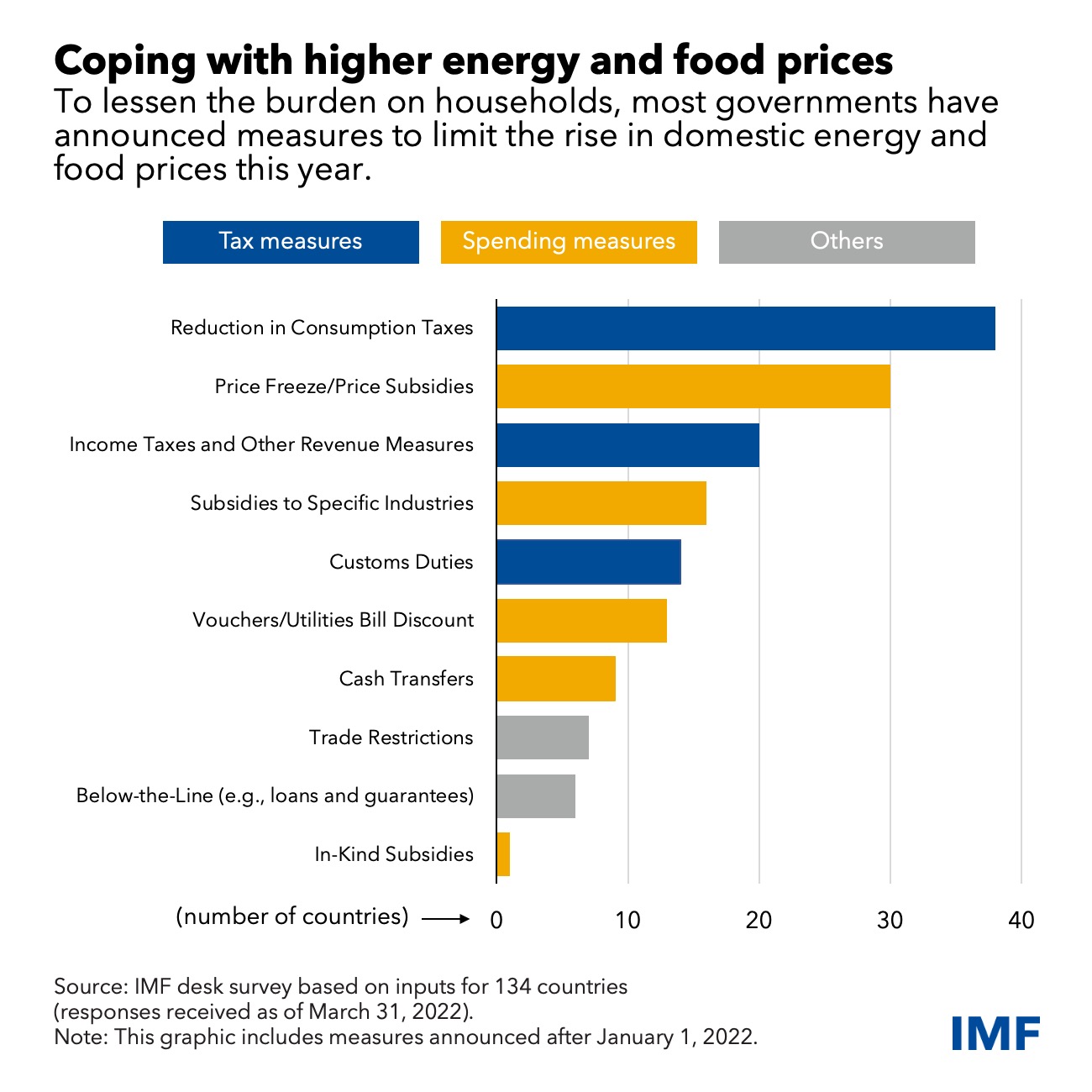
- Government measures to limit rises in domestic energy and food prices can have large fiscal costs and may exacerbate global demand and supply mismatches, putting further pressure on international prices and possibly leading to energy or food shortages.
- Such shortages would disproportionally hurt low-income, import-dependent countries.
Recommended fiscal strategy: agility and tailoring
- Core recommendation: focus on the most urgent spending needs and raise revenue to pay for them; adopt agile fiscal strategies tailored to individual country circumstances.
- Country-specific guidance:
- Economies hardest hit by the war in Ukraine and sanctions on Russia: respond to the humanitarian crisis and economic disruptions; given rising inflation and interest rates, fiscal support should be targeted to those most affected and priority areas.
- Nations with stronger growth and elevated inflation pressures: continue shift from support to normalization.
- Emerging markets and low-income economies with tight financing or risk of debt distress: prioritize spending and raise revenues to reduce vulnerabilities.
- Commodity exporters benefiting from higher prices: seize opportunity to rebuild buffers.
- Priority for responses to international commodity-price surge: protect the most vulnerable to avoid a food crisis and preserve social cohesion.
- Countries with well-developed social safety nets: deploy targeted and temporary cash transfers to vulnerable groups while allowing domestic prices to adjust; this limits budgetary pressures and preserves incentives to increase supply (such as investing in renewable energy).
- Other countries: allow a more gradual adjustment of domestic prices and use existing tools to help the most vulnerable during this crisis, while strengthening safety nets.
Energy transition and climate implications
- Fossil-fuel price hikes underscore urgency of accelerating transition to clean and renewable energy to increase energy security and meet the climate agenda.
- Current trajectory: "we are dramatically off-track to limit global warming to 2 degrees Celsius."
Support for low-income countries and need for collective action
- About 60 percent of low-income countries are either at high risk of debt distress or already experiencing it.
- These countries need support from the international community due to persistent pandemic scarring and vulnerability to food-price rises.
- Broader collective needs: global cooperation is necessary to tackle energy and food crises, current and future pandemics, debt, development, and climate change.
IMF Blog — April 20, 2022. Jean-Marc Fournier; Vitor Gaspar; Paulo Medas; Roberto Accioly Perrelli